EDF-DEU_en 2025
-
This Universal Registration Document (URD) was filed on 31 March 2026 with the French Financial Markets Authority (AMF), as the competent authority under Regulation (EU) 2017/1129, without prior approval pursuant to Article 9 of said Regulation.
This Universal Registration Document may be used for the purposes of an offer of securities to the public or the admission of securities to trading on a regulated market if it is supplemented by a securities note and, if applicable, a summary and any amendments made to the Universal Registration Document. The set of documents formed thereof is approved by the AMF in accordance with EU Regulation 2017/1129.
This document is a translation in English of the official version of the Universal Registration Document issued in French and is available on the Company's website (https://www.edf.fr/investors) as well as on the AMF's website (https://www.amf-france.org) All possible care has been taken to ensure that the translation is an accurate presentation of the original. However, in all matters of interpretation of information, views or opinions expressed therein, the original French language version of the document takes precedence over this translation.
-
1. The Group, its strategies and its activities
1.1 Key figures and business model
Customer proximity
- 34.5 million electricity customers
- 6.6 million gas customers(1)
- Leading brands: EDF, Edison, Luminus, Dalkia
- 215 million visits to digital consumption monitoring platforms(2)
A human ambition
- 197,363 employees(3)
- Nearly 8 million hours of training provided, an average of 41 hours per employee(3)
An ambitious innovation ecosystem
- 2,168 R&D employees at EDF SA
- R&D budget of €806m(3) in 2025
- 811 innovations patented in the EDF SA and Enedis portfolio in 2025
Major industrial assets
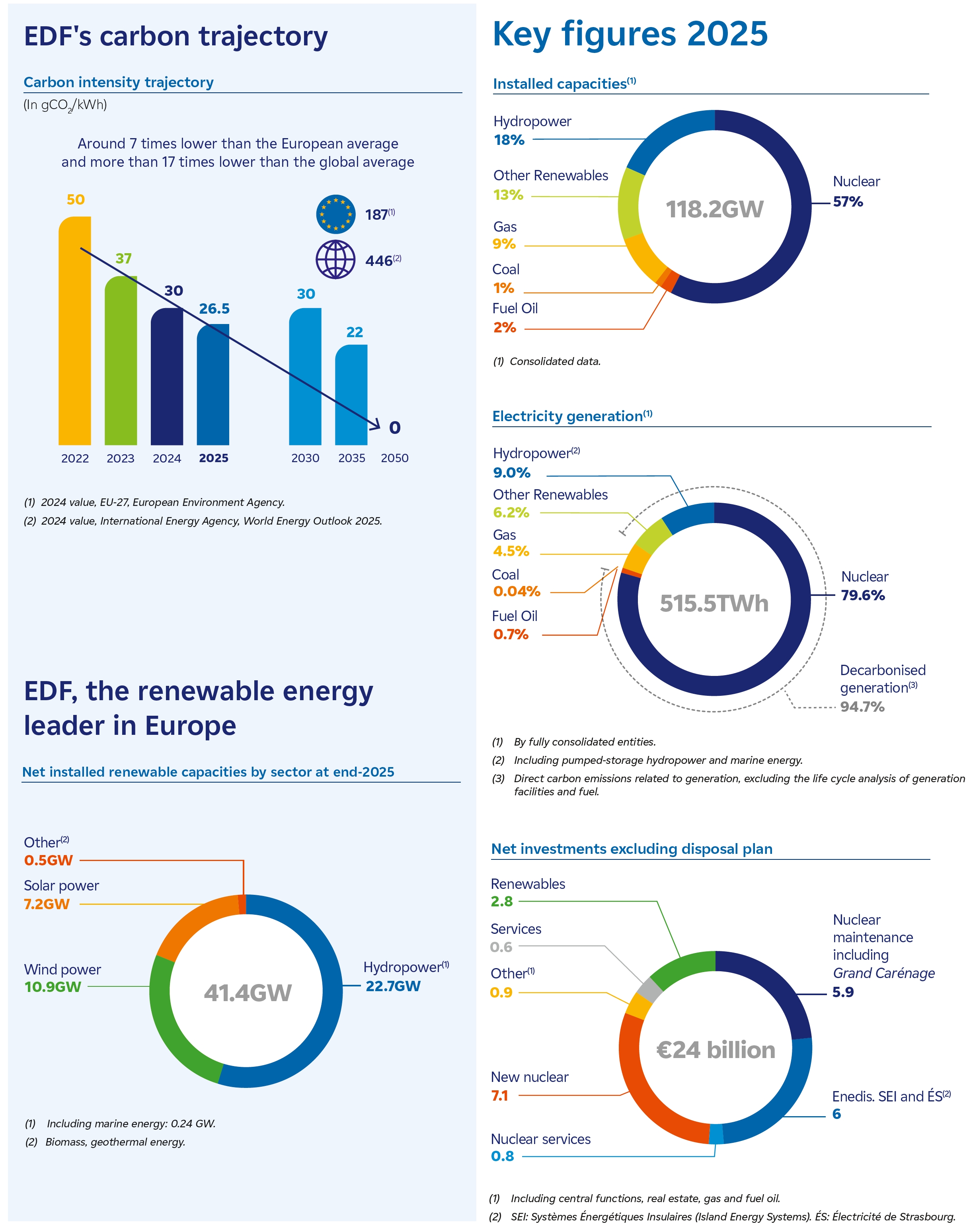
- 118.2GW of electricity generation capacity(4)
- An integrated nuclear industry
- EPR technology
- A wind and solar project portfolio of c. 95.5GW gross(5)
- 1.4 million km of distribution networks(6)
- 45.5 million smart meters installed(3)
- 340 heating and cooling networks operated by Dalkia
A strong CSR commitment
- Leadership
 Climate Change: score A
 - Impact score: 83/100
 : AA
: AA- €30.7 billion in Green & sustainable funding
- (1) Consolidated scope. Counted per site.
- (2) EDF SA scope excluding French overseas and Corsica.
- (3) Group scope.
- (4) Consolidated data for the Group scope.
- (5) Group scope. Pipeline excluding capacity under construction. All projects in the prospection phase from 2020 onwards are included in the pipeline.
- (6) Operated under concession by Enedis.
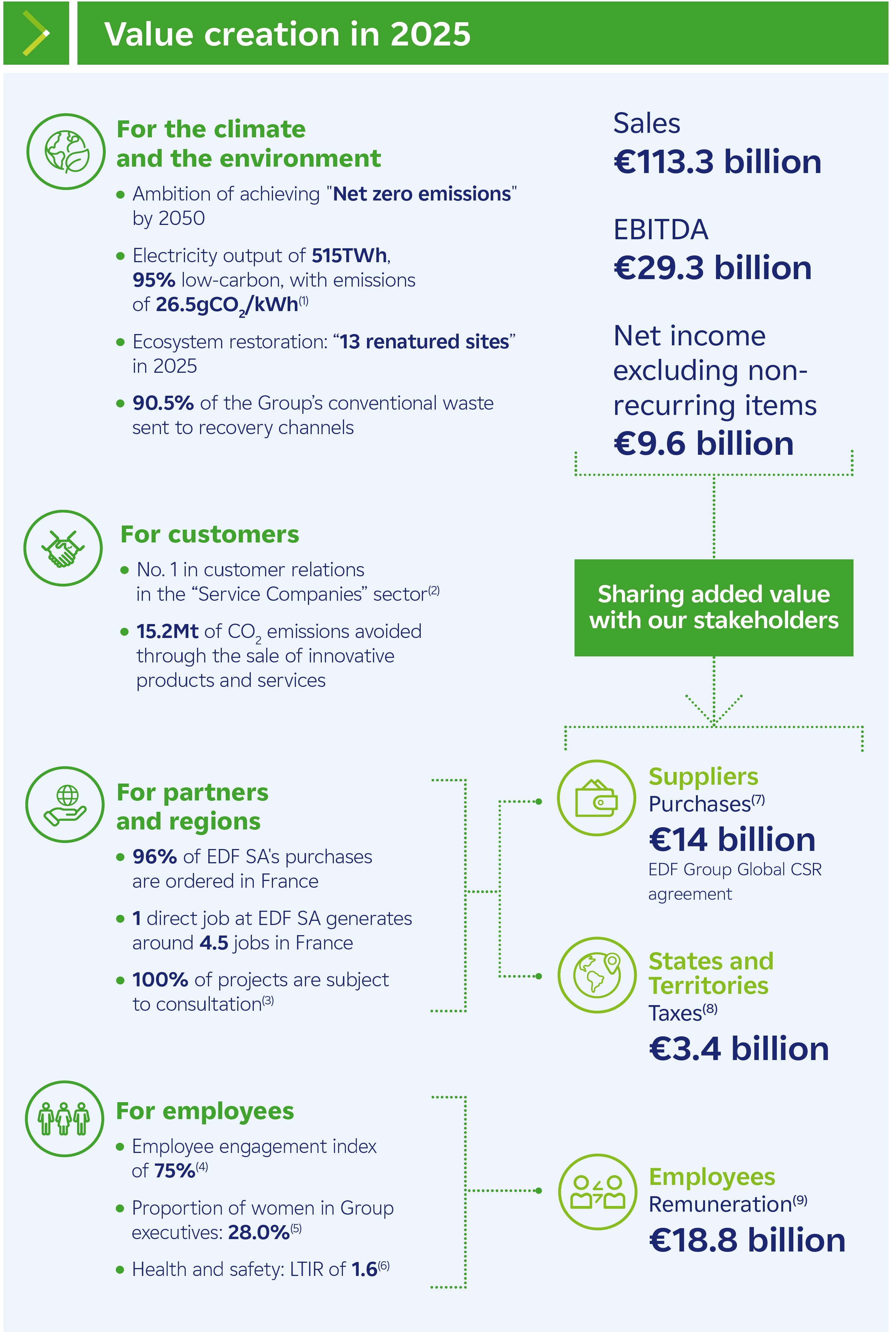
- (1) Specific CO2 emissions due to heat and electricity generation. Group scope.
- (2) BearingPoint Customer Relation Podium Award – 2025.
- (3) Projects over €60 million in accordance with the Equator Principles – Group scope.
- (4) MyEDF Group internal survey.
- (5) Group scope.
- (6) Lost Time Incident Rate for Group employees and contractors.
- (7) Consolidated other external expenses.
- (8) Consolidated taxes other than income taxes.
- (9) Consolidated personnel expenses (excluding capitalised production held in inventory).
-
1.2 Presentation of the Group
1.2.1 Structure of the Group
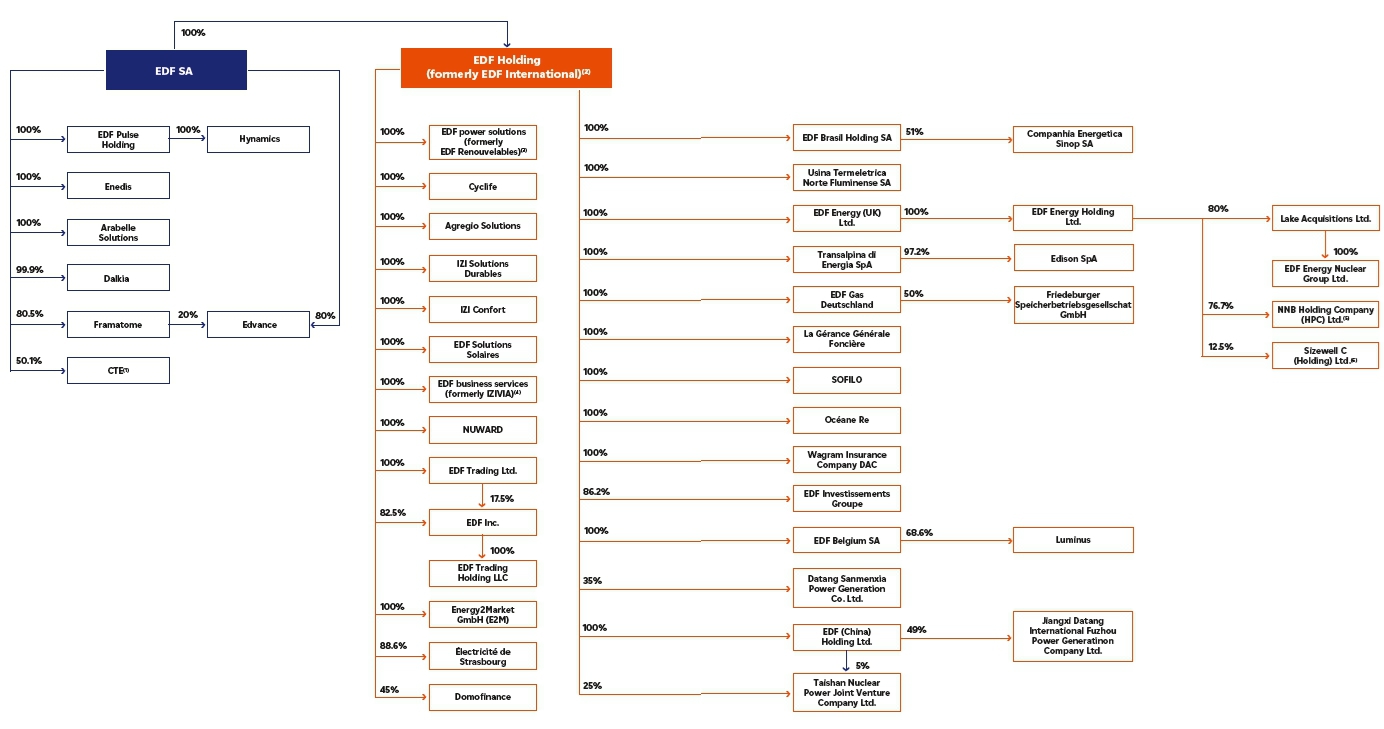
A simplified organisation chart of the Group at 31 December 2025 is presented below. The percentage given for each entity (subsidiary or sub-group of subsidiaries) corresponds to the ownership interest held directly or indirectly in the capital. The values given are rounded. The companies or groups of companies included in the Group’s scope of consolidation are indicated in section 6.1 “Consolidated financial statements at 31 December 2025”, note 24 “Main entities in the scope of consolidation”. Changes in the scope of consolidation in 2025 are discussed in section 6.1 “Consolidated financial statements at 31 December 2025”, note 3.1 “Changes in the scope of consolidation”.
- (1) Coentreprise de Transport d’Électricité (CTE), the company that holds 100% of RTE.
- (2) On 31 December 2025, EDF Holding SAS, EDF Immo, Société C3 and EDEV were merged into EDF International (renamed EDF Holding on 1 January 2026).
- (3) In September 2025, EDF Renewables changed its name to EDF power solutions.
- (4) On 28 January 2026, IZIVIA changed its name to EDF business services.
- (5) See section 6.1 “Consolidated financial statements at 31 December 2025”, note 13.4 “Non-controlling interests (minority interests)”.
- (6) See section 6.1 “Consolidated financial statements at 31 December 2025”, note 11 “Investments in associates and joint ventures”.
-
1.3 Group strategy and objectives
1.3.1 Environment and strategic challenges
The fight against climate change is the defining challenge of our generation. Current policy projections predict +2.5°C to 2.9°C global warming by 2100(1), but it is generally recognised that global carbon neutrality must be achieved by 2050 to limit warming to 1.5°C and respect the Paris Agreements.
In Europe, the “Green Deal” developed in 2020 and the European Commission’s “Fit for 55” climate package provide the framework for measures enabling the European Union to achieve carbon neutrality by 2050. The recovery programmes that followed the Covid pandemic further reinforced the priority given to the climate. Also, in the context of global energy market disruptions caused by the war in Ukraine, the “REPowerEU” programme announced by the European Commission in 2022 seeks to address the additional challenges of resilience, competitiveness and sovereignty in this energy transition.
Among the priority focuses of the new European Commission appointed in 2024, decarbonisation and competitiveness of the European Union have been strongly reaffirmed. The electrification of energy uses in all countries is one of the main levers for achieving European decarbonisation commitments, complementing the priority development areas of renewables and energy efficiency. In addition to the target of a -55% reduction in CO2 emissions by 2030, the Commission proposed a European target of a -90% reduction in carbon emissions by 2040; the European legislative process to validate this target is currently underway.
In France, electricity accounts for just over 10% of CO2 emissions (as opposed to 40%(2) worldwide). France’s Climate and Energy Law of 8 November 2019 places the reduction of greenhouse gas emissions at the heart of French energy policy. The goal is “to become carbon-neutral by 2050, by cutting greenhouse gas emissions more than sixfold”.
The EDF group is acting to accelerate the electrification of uses, by replacing fossil fuels in major energy-consuming sectors (transport, construction, industry), and by providing support for new electrical uses (data centres).
The availability and competitiveness of low-carbon electricity generation by EDF make France attractive for electricity-consuming sectors and will continue to do so in the future. This electricity is an asset for industrial players in all regions and therefore for the country’s sovereignty.
EDF’s goal is to make a success of the energy transition by providing its customers with an abundant supply of reliable, competitive, sovereign and decarbonised electricity.
On Friday 13 February 2026, the French government published a decree setting out the new Multi-Year Energy Plan (PPE) covering the next ten years.
This PPE comes against a backdrop of overcapacity in the French electricity system: demand remains 6 to 7% below its pre-Covid level, due notably to the still insufficient electrification of fossil fuel-based uses. At the same time, generation capacity increased in 2025 with the connection of nearly 7GW of renewable energy, including 5.7GW of solar power, further widening the gap between supply and demand. In this context, the PPE aims to balance long-term needs — including a structural increase in electricity demand estimated at around +150TWh by 2035, mainly as a replacement for fossil fuels — with the short-term situation, which is characterised by sluggish consumption.
The PPE3 makes electrification the central lever for competitiveness, sovereignty and decarbonisation (by accelerating the shift from fossil fuels to electricity). It includes adjustments to the development of renewables (solar, offshore and onshore wind power) given the delay in the electrification of uses.
- for the electrification of end-use sectors with all downstream industries already on board, with the objective of contributing to the creation of 150TWh of additional electricity demand by 2035 compared with 2023, primarily by replacing carbon-intensive energies; and
- for low-carbon generation through the EPR2 construction programme, extended reactor lifespans, and the revival of investment in hydropower, whilst ensuring that expertise in renewable energy is maintained. This comprehensive trajectory should make it possible to secure a competitive, reliable, sovereign and low-carbon electricity mix.
-
1.4 Description of the Group’s activities
1.4.1 Electricity generation
Against a backdrop of increasing electricity uses, the EDF group has one of the largest power generation fleets in the world with some of the lowest CO2 emissions, thanks to the share of nuclear and renewable energy in its energy mix. The Group aims to maintain the generation activity of its nuclear fleet, to green its thermal power generation, and to continue the expansion of renewable energies in France and around the world. It is also preparing for the nuclear power of the future with the EPR2 and the development of SMRs (Small Modular Reactors).
- * Direct carbon emissions related to generation, excluding the life cycle analysis of generation plants and fuel.
- a diversity of generation facilities, providing adequate coverage of EDF’s downstream portfolio needs (end users, sales to alternative suppliers, sales on the wholesale markets, etc.). The guiding principle for managing use of the various plants in the fleet is prioritising the facilities with the lowest variable costs;
- a nuclear fleet of 57 reactors in France(2) and 9 reactors in operation in the United Kingdom;
- construction of EPR-type reactors worldwide;
- control of the entire life cycle of nuclear generation facilities: design, operation, and decommissioning;
- implementation of actions aimed at improving the power plants’ technical performance and extending their operating lifespan;
- 95% of the fleet’s generation produces no CO2 emissions(3) thanks to the predominance of nuclear power and hydropower;
- a geographical position at the intersection of electricity exchanges between the European continental plate and the “electricity peninsulas” (Italy, Spain and the United Kingdom).
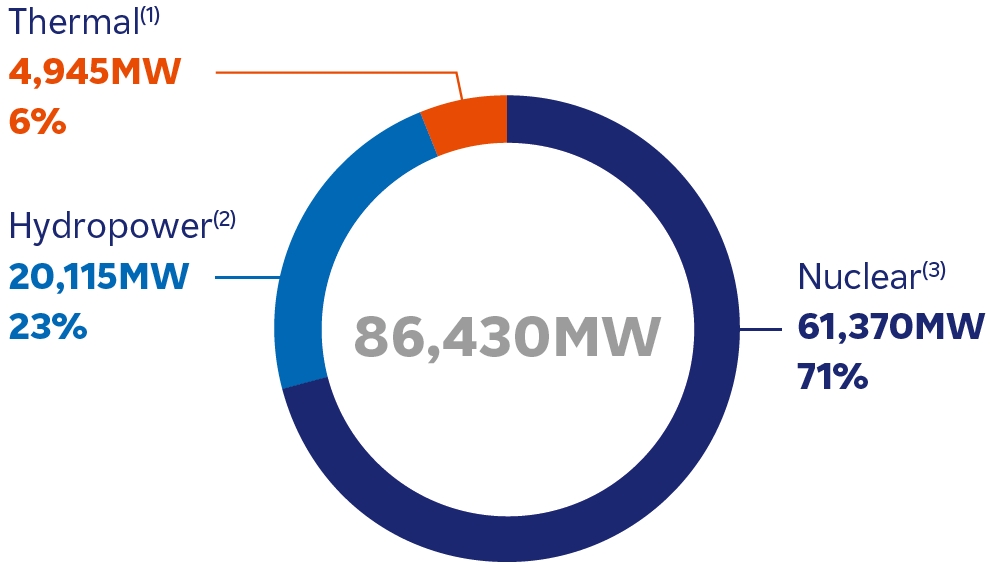
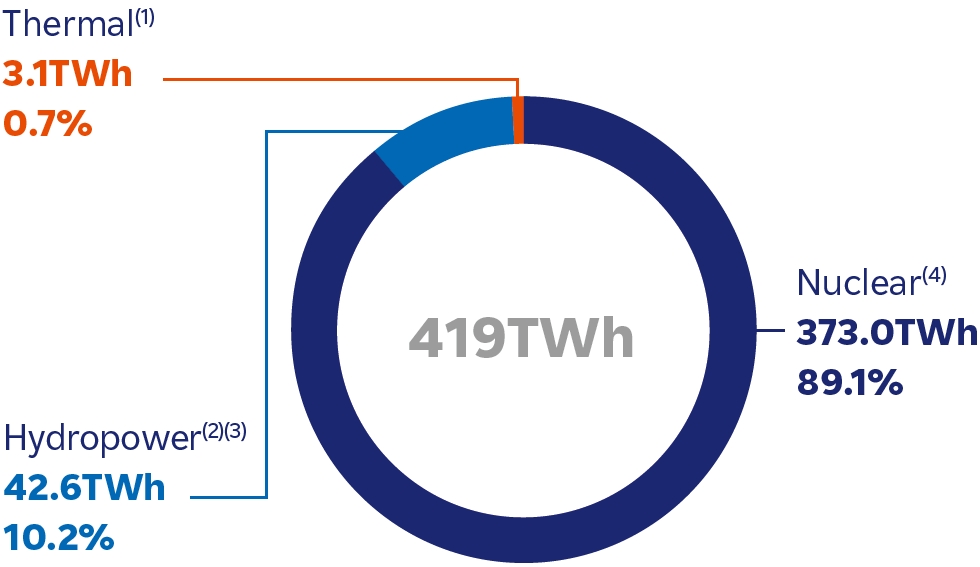
With total installed capacity of 86.4GW in mainland France(4) at 31 December 2025, EDF’s power plants produced 419TWh(5) in mainland France in 2025. The principal components of this generation fleet at 31 December 2025 were as follows:
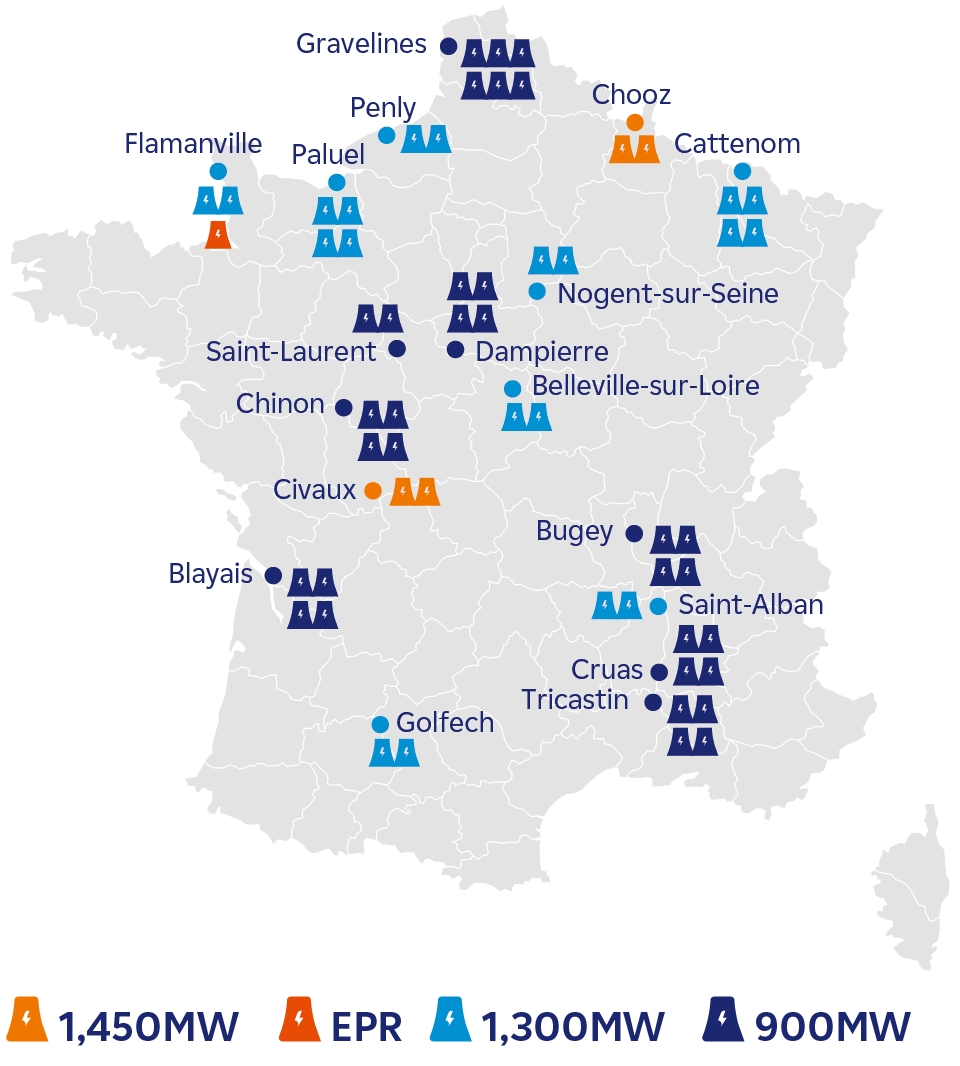
- 57 pressurised water reactors (PWRs). Their power generation capacity ranges from 900MW to 1,620MW, and their average age (excluding Flamanville 3) is 40 years. See also section 1.4.1.1.2 “Nuclear power generation in France”;
- 19 thermal units in operation. See section 1.4.1.2 “Thermal generation in mainland France”;
- 424 hydropower plants, with an average age of 80 years(6). See section 1.4.1.3.1 “Hydropower generation in France”;
- other hydropower plants owned by the Group’s subsidiaries: ÉS, SHEMA Group, CERGA and RKI (on the Rhine, owned 50-50 with German energy company EnBW) and the Franco-Swiss entities of Chatelôt and Émosson.
- (1) See section 3.2.2.1.2.4 “Invested resources and current and future expenditures related to the climate change objective” and section 6.1 “Consolidated financial statements at 31 December 2025”, note 19.4 “Low-carbon investments”.
- (2) After the permanent shutdown of the two reactors at Fessenheim and connection of the Flamanville 3 reactor to the electricity grid.
- (3) Direct CO2 emissions related to generation, excluding the life cycle analysis of generation plants and fuel.
- (4) Excluding Corsica and French overseas départements and regions.
- (5) Including pumped-storage hydropower.
- (6) Sliding 1-year arithmetic mean for a constant fleet, recalculated in 2021; no new facilities commissioned or declassified in 2025.
- (1) Excluding Corsica and overseas départements and regions, i.e. 778.2MW in 2025.
- (2) Excluding Corsica and overseas départements and regions, i.e. 439MW in 2025, including marine energy: 240MW.
- (3) Excluding Flamanville 3 (1,620MW).
- (1) Excluding Corsica and overseas départements and regions, i.e. 1.3TWh in 2025.
- (2) Excluding Corsica and overseas départements and regions, i.e. 1.1TWh in 2025.
- (3) Including pumped-storage hydropower.
- (4) Including Flamanville 3 (2.2TWh).
The EDF group will have a major role to play in relaunching the nuclear programme, and a new organisation for nuclear operations was put in place with effect on 1 January 2026. This change aims to group know-how and skills by major discipline, industrialise methods to improve performance, and strengthen cross-functionality in the Company. Nuclear operations are now structured around five Divisions and one unit:
- the Project Ownership for New Nuclear Division, which is responsible for the strategic management of new nuclear programmes;
- the Industrial Projects and Partnerships Division, which is the prime contractor for new nuclear projects;
- the Nuclear Engineering Division, which carries out cross-functional engineering assignments to service the existing fleet and New nuclear projects;
- international nuclear development, authority on technical matters and products, and responsibility for planning remain with the Strategy, Technologies, Innovation and Development Department;
- the Nuclear and Thermal Generation Division, which is responsible for the operation, maintenance and dismantling of existing nuclear and thermal fleets and newly-commissioned projects in France. It continues to roll out the Grand Carénage industrial refurbishment programme and the START programme(1);
- the “Industry and Services” unit, which manages operational activities involving design and studies, manufacturing and industrial services for nuclear steam supply systems, fuel, instrumentation and control (Framatome) and turbines (Arabelle Solutions).
The electricity generated by EDF in France from its fleet of nuclear power plants represented 89.1% of its total electricity output in 2025(2).
EDF’s PWR fleet in operation is divided into four series of available power generation capacity. The French nuclear fleet consists of 57 reactors in operation(3), located on 19 sites owned by EDF. Its total authorised capacity was 62,990MW at 31 December 2025. With an average age (excluding Flamanville 3) of around 40 years, it is within the average range of nuclear fleets installed worldwide.
- (1) A transformation programme launched in 2021, focused on regaining industrial control of unit outages, which began its second phase (“START Season 2”) in 2026.
- (2) EDF SA in mainland France, including pumped-storage hydropower.
- (3) Including the Flamanville 3 EPR.
The commissioning dates of EDF’s reactors and the dates of their last 10-year inspection (VD - visite décennale), based on the post-inspection coupling date, were as follows as at 31 December 2025:
Reactors Year of
industrial
commissioningMost recent
10-year
inspectionNext 10-year
inspectionBugey 2 1979 2021 VD5 Bugey 3 1979 2023 VD5 Bugey 4 1979 2021 VD5 Bugey 5 1980 2022 VD5 Dampierre 1 1980 2022 VD5 Gravelines 1 1980 2022 VD5 Gravelines 2 1980 2024 VD5 Tricastin 1 1980 2019 VD5 Tricastin 2 1980 2021 VD5 Dampierre 2 1981 2022 VD5 Dampierre 3 1981 2024 VD5 Dampierre 4 1981 2024 VD5 Tricastin 3 1981 2022 VD5 Tricastin 4 1981 2024 VD5 Gravelines 3 1981 2022 VD5 Gravelines 4 1981 2024 VD5 Blayais 1 1981 2021 VD5 Blayais 2 1983 2024 VD5 Blayais 3 1983 2024 VD5 Blayais 4 1983 2025 VD5 Saint-Laurent 1 1983 2025 VD5 Saint-Laurent 2 1983 2023 VD5 Chinon B1 1984 2024 VD5 Cruas 1 1984 2025 VD5 Chinon B2 1984 2016 VD4 Cruas 2 1984 2018 VD4 Cruas 3 1984 2025 VD5 Gravelines 5 1985 2017 VD4 Gravelines 6 1985 2018 VD4 Cruas 4 1985 2016 VD4 Paluel 1 1985 2016 VD4 Paluel 2 1985 2018 VD4 Paluel 3 1986 2017 VD4 Paluel 4 1986 2019 VD4 Saint-Alban 1 1986 2017 VD4 Flamanville 1 1986 2019 VD4 Saint-Alban 2 1987 2018 VD4 Flamanville 2 1987 2020 VD4 Cattenom 1 1987 2016 VD4 Chinon B3 1987 2020 VD4 Chinon B4 1988 2021 VD4 Cattenom 2 1988 2018 VD4 Nogent 1 1988 2019 VD4 Belleville 1 1988 2021 VD4 Belleville 2 1989 2019 VD4 Nogent 2 1989 2020 VD4 Penly 1 1990 2023 VD4 Cattenom 3 1991 2021 VD4 Golfech 1 1991 2024 VD4 Cattenom 4 1992 2024 VD4 Penly 2 1992 2025 VD4 Golfech 2 1994 2014 VD3 in progress Chooz B1 2000 2020 VD3 Chooz B2 2000 2019 VD3 Civaux 1 2002 2021 VD3 Civaux 2 2002 2022 VD3 Flamanville 3 During 2026 - VD1 - in the 900MW series, 25 of the 32 reactors had completed their fourth 10-year inspection. The fourth 10-year inspections of Cruas 3, Saint-Laurent 1, Blayais 4 and Cruas 1 were completed in 2025;
- in the 1,300MW series, 19 of the 20 reactors had completed their third 10-year inspection (including Penly 2 in 2025). The third 10-year inspection of Golfech 2 is currently being conducted;
- in the N4 series, all 4 reactors had completed their second 10-year inspection;
- for Flamanville 3, the reactor was connected to the national electricity grid on 21 December 2024. After this initial coupling, in accordance with the start-up procedure, the testing and grid connection and disconnection phases continued throughout 2025, and the reactor reached full power on 14 December after obtaining authorisation from the ASNR to exceed the 80% threshold on 12 December 2025. The Group has set the start date for Flamanville’s initial full inspection at 26 September 2026, for a provisional duration of 350 days.
Regulatory framework
Regulations applicable to Basic nuclear installations (INBs)
Following a procedure set out in the French Environment Code, the construction of a basic nuclear installation or INB is authorised by a decree of the French Prime Minister, issued after consulting the French Nuclear Safety and Radiation Protection Authority (ASNR) and on the basis of a report produced by the French Minister in charge of nuclear safety. The authorisation to commission an INB is issued by the ASNR, also on completion of a procedure set out in the French Environment Code. The general regulations applicable to basic nuclear facilities give priority to the protection of public safety, health and sanitation, and the protection of nature and the environment (“protected interests”). Law 2023-491 of 22 June 2023 amended certain provisions of the French Environment Code in order to accelerate procedures related to the construction of new basic nuclear installations near existing nuclear sites, and the operation of existing facilities.
In the 1970s and 1980s, EDF developed industrial cooperation with European nuclear operators, in the form of nuclear power allocation contracts linked to reactors in EDF’s French nuclear fleet.
Under these contracts, a share of the capacity of the reactors concerned is reserved for the co-contracting parties, in exchange for payment of a corresponding share of the reactors’ overheads (construction costs, annual operating costs, decommissioning costs, local taxes and specific nuclear taxes, etc.); these parties are sold the same share of the power generated by these reactors at the variable cost of the fuel (including front-end and back-end costs) throughout their operating lifespan.
As of 31 December 2025, 10 of EDF’s nuclear reactors were concerned by contracts of this kind (up to 1GW) with the following European energy companies:
- Cattenom 1-2: EnBW (5%);
- Bugey 2-3: Électricité de Laufenbourg(1) (17.5%);
- Tricastin 1 to 4: Electrabel(2) (12.5%);
- Chooz B1-B2: Luminus, an EDF subsidiary in Belgium (3.3%).
EDF has also entered into a second type of nuclear power allocation contract concerning a fleet of power plants (totalling some 2GW). In these contracts, the term and the contribution to overheads remain linked to clearly identified reactors, but the total volume of power sold at variable fuel cost is determined by the availability of a broader baseline fleet of power plants, applied to the share of capacity reserved for the co-contracting parties for the reactors in question. These contracts mainly concern the following reactors:
- Chooz B1-B2 (the first N4 reactors): Electrabel (21.7%);
- Cattenom 3-4: Électricité de Laufenbourg (7.8%) and the Swiss electricity group CNP (21.8%).
The contracting parties in both types of contract shared the industrial risks with EDF during the development of the fleet. They now bear risks associated with the power plants’ current operation, but have no operational role.
Nuclear power is a means of generation with a low (mainly fuel-related) variable cost, that represents less than 30% of operating costs(3). The main competitive levers of the nuclear fleet during its operating phase are thus the energy output and the optimisation of fixed operating and maintenance costs. The levers relating to the fuel cycle are described in section 1.4.1.1.2.3 “The challenges of nuclear operations”.
EDF must address the challenges of strong seasonal variations in consumption in France due to high sensitivity to temperatures, while managing availability of maintenance resources and efficient use of reactor fuel.
EDF has therefore adopted 12-month and 18-month generation cycles for its fleet, distributed as follows at end-2025:
Each generation cycle consists of a period when the reactor is in operation, and then an outage period during which a portion of the fuel is replaced. Two types of scheduled outages take place in alternation at the end of each operating cycle:
- simple refuelling outages, with a standard duration of approximately 40 days. The principal operation is unloading the spent fuel and reloading the new fuel. Certain tests and maintenance operations are also carried out;
- partial inspections, with a standard duration(4) of around 85 days, dedicated to refuelling and maintenance.
Every ten years, each reactor is shut down in order to carry out a 10-year inspection(5), and a safety review to assess the facility’s compliance with the rules applicable to it and update the assessment of the risks or issues associated with facility for the protected interests listed in Article L. 593-1. This review notably considers the condition of the facility, the experience gained during its operation, new developments in know-how, including knowledge on climate change and its effects, and the rules applicable to similar facilities. The risk assessment takes into account the consequences of climate change for the external attacks included in the assessment. The 10-year inspection lasts around 180 days(6) on average. The duration varies according to the works and maintenance programme, and the series concerned.
- unloading of spent fuel and reloading of fresh fuel, as at every outage;
- hydropower testing of the primary circuit, containment leakage testing, and inspection of the reactor vessel;
- modification work recommended by periodic reviews;
- other specific maintenance operations, particularly renovation or replacement of major components.
After each 10-year inspection, the ASNR must give its approval to restart the reactor for the next cycle and state its position on continuing operation for another 10 years, issuing technical recommendations if necessary.
Flamanville 3 is expected to generate around 14TWh during the cycle starting after the first nuclear reaction. After this first generation cycle, the reactor will undergo its first full inspection.
- (1) Axpo Group.
- (2) Engie Group.
- (3) Operating costs are defined as follows: fuel costs (including back-end fuel cycle expenses), operating expenses (purchases and external services, personnel expenses) and maintenance costs (expenses and investments). They do not include investments related to construction or decommissioning expenses.
- (4) The standard durations are realistic optimised benchmark durations defined by outage type, taking account of past experience. The planned duration of shutdowns varies around the benchmark depending on the programme of work to be carried out.
- (5) Pursuant to Article L. 593-18 of the French Environment Code.
- (6) The “normal” duration excluding special and/or extreme cases.
Regulatory framework
The French Nuclear Safety Authority, now the French Nuclear Safety and Radiation Protection Authority (ASNR)
When Law 2024-450 of 21 May 2024 took effect on 1 January 2025,(1) the activities of the ASN and the IRSN were combined to form a new authority, the French Nuclear Safety and Radiation Protection Authority (ASNR). The ASNR is an independent administrative authority which contributes to the control of nuclear safety and radiation protection in France, and to informing the public about these matters.
Its activity relates principally to the following missions:
- contributing to regulatory development by giving the French government its opinion on proposed decrees and ministerial orders, and making regulatory decisions of a technical nature;
- examining all individual applications for authorisations concerning Basic nuclear installations (INBs). The ASNR is the body that grants authorisations except in the case of major INB operations such as construction or decommissioning;
- inspecting installations, through scheduled and unannounced regulatory on-site inspections, particularly during the regular inspections that are mandatory for a power plant to continue operating;
- informing the public about the status of nuclear safety and radiation protection in France;
- in the event of an emergency, the ASNR verifies the action taken by the operator to make the installation secure. It informs the public of the situation and assists the Government. In particular, it provides the competent authorities with recommendations on measures to be taken for civil security.
Owing to their low variable cost, nuclear generation facilities are primarily used for baseload generation. They are used just after run-of-river hydropower and other unavoidable renewable energy generation, as well as energy purchased under purchase obligations from distributed electricity producers. In 2025, the low level of domestic consumption and the increase in renewable generation, partially offset by an increase in exports, once again led to use of the reactors’ flexibility capacities. High seasonal variations in consumption in France and the substantial demand during the winter months mean that scheduled nuclear fleet outages must be concentrated mainly between April and October.
On 20 February 2025, EDF’s Board of Directors authorised the signature of contractual documentation to start the experimental phase of the irradiation service agreed between the French State, the CEA and EDF(2). This phase will last as long as necessary for EDF to study the feasibility of the service, which will have no impact on the operation or electricity generation purpose of the power plant concerned; it will remain governed by the regime for civil nuclear facilities. This irradiation service could potentially also be used in medicine or the aerospace industry.
Nuclear generation output stood at 373TWh for 2025, up by 11.3TWh compared with 2024 (361.7TWh). This increase was achieved by an improved performance on unit outages and good industrial management of inspections and the remaining stress control repair work.
The impact of the stress corrosion issue on nuclear generation was minimal in 2025 compared to previous years, as the action plan was completed thanks to industrialisation of the related technical and organisational work.
The START transformation programme, launched in 2021 with a focus on regaining industrial control of unit outages, continues to bear fruit: the average length of unit outage extensions is following a trajectory comparable to 2024. In the 2025 campaign, for 23 out of 42 completed outages recoupling took place before the target date, compared to 17 out of 41 for a comparable period in 2024. In view of its results, the START programme will enter a second phase in 2026.
The best 10-year inspection performance of the year was at Cruas 3, completed 16 days ahead of schedule. The best performances on partial inspections were at Paluel 4 in the 1,300MW series, completed 17 days ahead of schedule, and at Tricastin 1 in the 900MW series, completed 20 days ahead of the provisional schedule. Dampierre 2 and Saint Laurent B2 achieved the best refuelling outages, completed 11 days faster than initially planned.
However, during the 2025 campaign two reactor outages significantly overran their provisional duration (> 28 days). The reactors at Gravelines 2, Nogent 1, Belleville 2, Gravelines 1 and Chooz B1 were affected by design-critical technical hazards, while Golfech 2 was affected by industrial action. The recoupling of Belleville 2, Gravelines 1, Chooz B1 and Golfech 2 was postponed to 2026.
Nuclear generation output expressed in annual energy volume provides the basis for calculating a generation rate for the whole French nuclear fleet. This rate is defined as the ratio of energy generated to the theoretical maximum energy (the volume that would be generated by year-round operation at the installed capacity). It is also known as the load factor (“Kp”). It is calculated by multiplying two other factors (Kp = Kd × Ku):
- the availability factor (“Kd”) (ratio of available energy(3) to theoretical maximum energy, i.e. the volume that would be generated by year-round operation at the installed capacity). The Kd depends on outage durations, and is therefore impacted by the standard durations and the work programmed for outages;
- the utilisation factor (Ku) (ratio of energy generated to available energy). The Ku reflects environmental, regulatory and labour constraints, system services supply, and optimisation carried out by EDF (via fuel and modulation).
The reactor was coupled to the national electricity grid on 21 December 2024. After this first coupling, in accordance with the start-up procedures, several test phases were undertaken:
- the 25% power test phase and the ASNR authorisation obtained on 31 January 2025 to exceed that threshold;
- the BAS 108 test, which consists of voluntarily cutting off external sources, carried out on 23 May 2025;
- the start of tests at 60% power from 29 May 2025 and the remainder of this test phase on 12 November, with an anti-islanding test carried out on 7 November 2025;
- the start of tests at 80% power from 12 November 2025, which led to the ASNR issuing authorisation on 12 December 2025 to bring the reactor to 100% power. This milestone was reached on 14 December 2025;
- the start-up programme is continuing with equipment testing at full power, taking readings and verifying that everything is working properly. The power is varied to continue the tests at different power levels.
- (1) The French Nuclear Safety and Radiation Protection Authority (ASNR) was officially created on 1 January 2025, the effective date of Law 2024-450 of 21 May 2024 on the organisation of governance of nuclear safety and radiation protection to meet the challenge of revitalising the nuclear industry.
- (2) See EDF’s press release of 18 March 2024 “EDF responds to the request of the French government to study the creation of an irradiation department to support the CEA”.
- (3) Available energy is equal to the theoretical maximum energy less generation losses due to technical reasons inherent to power plants, such as planned outages, unplanned outages due to damage or for safety reasons, and regulatory testing.
The start-up of a reactor is a long and complex process that brings equipment into operation for the first time. This explains the unplanned outages experienced by the new reactor, including:
- an outage from 15 February 2025 to 19 April 2025 to carry out work on several pieces of equipment, particularly the turbine;
- an outage from 19 June to 15 October 2025 in order to carry out work on the three protection valves in the primary circuit.
In the first half of 2017 the ASNR examined higher-than-expected carbon content levels in the bottom of the reactor vessel and the vessel head, following documentation submitted by Framatome under EDF’s supervision. Based on the opinion of a group of ASNR-appointed experts, the ASNR concluded that the mechanical properties of the vessel head and vessel bottom were adequate for their uses, including in the event of an accident(1). On 9 October 2018, the ASNR authorised commissioning of the bottom of the vessel subject to functional checks, and commissioning of the vessel head for a limited lifespan until the end of 2024.
In December 2022, Framatome submitted a request to postpone the date for replacement of the vessel head until the end of the first operating cycle.
In response to this request, and following the public consultation held from 11 to 31 March 2023, the ASNR published a resolution on 16 May 2023 authorising use of the current reactor vessel head until “the reactor shutdown during which the first complete requalification test of the primary circuit takes place”.
The new vessel head has now been manufactured in Framatome’s factories. The existing one will be replaced during the first full inspection.
EDF has taken into account the lessons learned from the start-up and operation of EPRs currently in service internationally.
Before the first nuclear reaction at the Flamanville 3 EPR in September 2024, measures were taken to replace 64 heat-treated peripheral fuel assemblies at the Taishan 1 EPR in order to guard against the risk of fuel rod leaks observed during its second operating cycle. These fuel leaks were caused by:
- the failure of devices (springs) in certain fuel assembly retention grids located on the periphery of the reactor core, as these springs did not undergo rapid, sufficient irradiation due to the extended power ramp-up time;
- wear and tear on the fuel cladding (the metal casing containing the uranium pellets) due to friction with the broken springs.
Following the longer than expected ramp-up period for the Flamanville 3 EPR, adopting a prudent, conservative approach, an additional measure was implemented during the first full inspection, involving the introduction of non-irradiated fuel assemblies into the Flamanville 3 reactor core before the start of its second operating cycle.
For details on the investments made for the Flamanville 3 EPR, see section 6.1 “Consolidated financial statements at 31 December 2025”, note 9.3 “Property, plant and equipment used in generation and other tangible assets by the Group”.
During scheduled controls included in the 10-year inspection of the Civaux 1 reactor in late 2021, stress corrosion was identified on parts of the auxiliary circuit piping in the reactor’s main primary circuit. EDF immediately carried out inspections and expert appraisals of the four series of reactors making up the French nuclear fleet (900MW, 1,300MW-P4, 1,300MW-P’4 and N4).
The examinations performed in 2022 led to an initial characterisation of the stress corrosion sensitivity of the fleet’s 56 reactors: 40 reactors were identified as having little or no sensitivity to stress corrosion (the 32 reactors in the 900MW series and the 8 reactors in the 1,300MW-P4 series), and 16 reactors were identified as sensitive or highly sensitive to stress corrosion (the 12 reactors in the 1,300MW-P’4 series and the 4 reactors in the N4 series). The industrial programme for the preventive replacement of sections of piping in stress corrosion-sensitive reactors ended in the first quarter of 2024.
The reactor inspection programme continued in 2025 with a volume of checks similar to 2024. The inspections were carried out during scheduled maintenance outages and no additional or dedicated outages were conducted. As a result the auxiliary lines inspection programme was completed by the end of 2025 as initially scheduled, supplemented by controls on other lines (pressuriser expansion lines, main primary circuit, small-diameter lines).
EDF has finalised its monitoring and maintenance strategy and submitted it to the ASNR, which is expected to state its position in 2026.
Two processes for desensitising lines to stress corrosion (remote levelling of internal wall welds and compression of welds) were qualified and implemented at several reactors in 2025.
The stress corrosion management project was closed at the end of 2025 and stress corrosion monitoring will transition to permanent mode in routine equipment maintenance programmes from 2026, through implementation of the monitoring and maintenance strategy.
The risk associated with the stress corrosion issue is described in section 2.2.1 “Operational performance risks” risk 1B “Risk of non-achievement of objectives for operation and/or lifespan extensions of nuclear power plants (France and United Kingdom)”.
EDF continues to pay particular attention to quality control in the manufacturing and assembly of parts for nuclear plants in operation or under construction. The detection of any signs of fraud or suspicious practices systematically leads to investigations and the implementation of actions to protect EDF’s interests.
Given the current increase in practices that could relate to CFSI, EDF has launched an action plan primarily designed to strengthen its prevention and detection capabilities and engage the entire nuclear sector in the fight against CFSI. Details of this plan, which defines targeted and graduated actions, were presented in a letter from EDF to the ASN dated 19 March 2024, and it has been considered appropriate by the ASNR.
In 2025, implementation of these reinforcement actions continued at both the fleet in operation and the power plants under construction.
At the fleet in operation, documentation checks and inspections of components potentially suspected of being CFSI did not reveal any particular anomalies in the equipment concerned.
The risks related to nuclear safety, the environment and radiation protection are described in section 2.2.2 “Specific nuclear operation risks”, risk 2C “Nuclear safety risks at plants in operation resulting in nuclear civil liability”.
As a nuclear operator, EDF takes responsibility for nuclear safety. In a rapidly changing context (competitive market, environmental challenges, European interconnection, etc.), EDF reaffirms the absolute priority of protecting human health and the environment, notably by preventing accidents and limiting their nuclear safety consequences. Implementation of the French nuclear power programme has led EDF to put in place a safety policy that:
- takes into account, right from the design stage, the risks and issues that might arise during power plant operation (risks relating to the operation itself, and to internal or external attacks);
- is founded on application of strict rules of operation, and a cautious and inquiring attitude in its technical teams, developed through establishment of a true safety culture;
- draws on the experience accumulated from operating a standardised fleet;
- integrates and promotes a continuous improvement approach, notably embodied in a constant concern to reduce the number of automatic reactor shutdowns;
- benefits from nuclear engineering and R&D internal to the Group, in order to anticipate any failings, maintain facilities in good working order, upgrade equipment continuously, reassess safety margins, monitor technological advances, and implement new, more efficient techniques and project management for facilities undergoing decommissioning;
- invests significantly in skill development: every nuclear generation site is equipped with a simulator used for training and practice for all types of situation.
Regulatory framework
Nuclear transparency
The French Environment Code contains specific provisions (Articles L. 125-10 and following) on the right to information regarding the nuclear industry, aimed at guaranteeing the public’s right to reliable, accessible information. In particular, the operator of an INB is required to declare to the ASNR and the competent administrative authority, as soon as possible, any accidents or incidents occurring as a result of operation of the facility that could potentially be detrimental to the protected interests listed in Article L. 593-1 of the Environment Code, namely public safety, health and sanitation, and the protection of nature and the environment.
Other authorities also contribute to nuclear transparency. They include the High Committee for Transparency and Information on Nuclear Safety (HCTISN) and Local Information Committees (CLIs), which are formed for any site with one or more INBs.
Nuclear safety is subject to numerous controls, both internal and external. For each nuclear power plant(1), EDF carries out Overall Excellence Assessments jointly with WANO(2) peer reviews every four years. These take place over a three-week period and involve some 40 inspectors.
The General Inspector for Nuclear Safety and Radiation Protection is appointed and reports directly to the Chairman and CEO of EDF. He or she holds discussions with employees in the nuclear sector. Every year, an opinion on the overall safety of France’s nuclear fleet is issued based on the inspections carried out, and initiatives for improvement are proposed to the Company’s management. The Inspector’s annual report is made public.
The steps taken by EDF have reduced the average annual number of automatic reactor shutdowns, which has been divided by four in some twenty years. In 2025, there were 23 across the entire fleet, including one at the Flamanville 3 reactor.
- > scheduled or unannounced inspections carried out by the ASNR: around 450 per year across all EDF’s nuclear facilities,
- > regular 10-year inspections to verify the facility’s compliance with the rules applicable to it. These inspections are also conducted to update assessments of risks or issues associated with the facility for protected interests (public safety, health and sanitation, and the protection of nature and the environment). They consider the condition of the facilities, the experience gained during their operation, new developments in know-how, including knowledge on climate change and its effects, and the rules applicable to similar facilities.
At the end of the 10-year inspection, the operator sends the ASN a report on the conclusions, stating its position regarding the compliance of its facility, and the changes made to correct any points of non-compliance identified or improve the safety of the facility. The ASNR shares its analysis of this report with the minister responsible for nuclear safety, and states its position as regards continued operation of the reactor for another 10 years following the inspection. It may also set additional requirements for the operator(3). The 10-year inspection is an essential step for continuing power plant operation.
- (1) They involve the Nuclear Electricity Generation Centres (CNPEs).
- (2) World Association of Nuclear operators.
- (3) See the Regulatory framework panel, “The Nuclear Safety Authority, now the Nuclear Safety and Radiation Protection Authority (ASNR)”, in section 1.4.1.1.2.1 “EDF’s nuclear fleet in France and its operation”.
- At international level, inspections take place regularly. They are a channel for sharing experience accumulated worldwide:
- > inspections by the IAEA’s(1) Operational Safety Analysis Review Team (OSART) are carried out at the request of the French State (once per year). Their purpose is to make recommendations and spread good practices. In 2025, an OSART inspection was carried out at Chinon,
- > international peer reviews conducted by the WANO(2) are organised at the request of EDF. They involve a safety performance assessment with regard to international best practices. In 2025, four peer reviews were carried out.
In the event of an accident, a crisis response procedure is in place to limit the environmental and human impacts and make sure the facility is safe. This procedure is founded on two closely coordinated plans, designed to cover the local and national level respectively:
- the internal emergency plan for each nuclear site, developed by EDF;
- the special intervention plan, prepared by French prefectures in collaboration with the French government and EDF.
For greater effectiveness, these plans take account of risks both external (flooding, etc.) and internal (fire, etc.). The adequacy of the system for warning, informing and protecting people is regularly assessed through accident simulation exercises. Each year, approximately 100 exercises are organised for the entire French nuclear fleet, i.e. around one every three days. Around ten of these are nationwide exercises overseen by the ASNR, which involve EDF and the public authorities, including the prefectures.
EDF has been enriching its crisis management procedure since the earliest analyses following the Fukushima accident of March 2011. It has set up a national unit capable of providing rapid material and human assistance to any site experiencing a serious issue. Simulation exercises for this nuclear rapid response unit, called the FARN, have been conducted from the regional bases at Civaux, Paluel, Dampierre and Bugey. The unit can be deployed to a reactor at any site in difficulty.
The operational safety of nuclear facilities is taken into consideration right from their design phase. It is regularly monitored, with a staff mobilisation policy and major investment plans.
Any shortcoming classified as particularly important according to the detailed criteria defined by the ASNR is referred to as a “significant event”. The detection of significant events by nuclear operators plays a key role in the prevention of incidents and accidents. The regulations require all nuclear operators to declare significant events to the ASNR, to protect the interests listed in Article L. 593-1 of the French Environment Code.
The significance of the event is determined by the power plant’s management based on an analysis carried out by the plant’s teams and the site’s independent safety department.
The declaration process for significant safety events (SSE) is part of the ongoing drive to improve nuclear safety and transparency. One of its main aims is to enable analysis of these events, so as to facilitate the subsequent assessment of an incident or the risk of an incident, and improve prevention practices in an establishment and/or a sector of activity.
All significant events must be declared to the ASNR by the nuclear operators or transporters within a maximum period of 48 working hours. Declarations include a proposed classification on the INES(3) scale (which comprises seven levels from 1 to 7, depending on the events’ significance; events with no nuclear safety significance are classified INES level 0). The ASNR retains final authority for the classification of events. The ASNR refers to the INES scale to select events that are sufficiently serious to warrant a public statement.
Since the introduction of a scale of this kind in France in 1987, no event at INES level 3 (serious incident – very low external radioactive emission and exposure of the public, representing a fraction of regulatory limits) or above has occurred in the French nuclear fleet. In 2025, EDF declared 742 significant safety events (SSEs) in France, excluding Flamanville 3, compared to 755 SSEs in 2024. No SSE of INES level 2 or above was declared (as in 2024).
The Group’s nuclear safety policy is an integral part of the training given to employees of EDF and its service providers. After initial training lasting several months – up to 24 months for key positions (safety engineer, operator, etc.) – each employee must undergo mandatory retraining every year, two years or three years, depending on the functions and fields of activity.
Detailed nuclear safety results for 2025 are published in the annual report drawn up by the General Inspector for Nuclear Safety and Radiation Protection and are available online(4).
EDF’s environmental approach was initiated in 2002 at a number of sites. It was then extended to all nuclear generation units. It is based on an ISO 14001-certified environmental management system (EMS). See section 3.2.1 “Environmental management system”. For a description of the processing of radioactive waste from the back-end of the fuel cycle and decommissioning, see section 1.4.1.1.2.3 “The challenges of nuclear operations”.
Thanks to mobilisation of the various stakeholders, EDF is continuing the drive for improvement of radiation protection and dosimetry (through training and exercises for employees and management, stricter monitoring of plant cleanliness, upgrading the equipment available to operators, optimised installation of lead screens, standardisation of working methods and equipment on the nuclear sites, reinforced supervision, etc.).
As a result, for the past decade the average annual collective dose is 0.69 man-Sieverts (manSv)(5) per reactor, down by 1% from the previous decade, whereas the average volume of hours worked has increased by 23%. In 2025, the average collective dose was 0.68 manSv per reactor. The average annual individual dose (EDF employees and industrial partners) remained below 1 millisievert (mSv) in 2025 (0.81mSv), well below the regulatory limit of 20mSv for the whole body over a rolling 12-month period.
EDF is proactively pursuing its ALARA (As Low as Reasonably Achievable) policy to manage collective dose levels. It continues to reduce exposure to radiation through multi-year plant clean-up programmes, and by testing new technologies aimed at reducing the radioactive source term.
- (1) International Atomic Energy Agency.
- (2) World Association of Nuclear operators.
- (3) International Nuclear Event Scale.
- (4) 2025 report: igsnr.com/wp-content/uploads/2026/02/Rapport-IGSNR-2025.pdf
- (5) Sum of the doses absorbed by the whole body due to exposure to radiation from radioactivity for all activities and all persons involved.
Regulatory framework
Regulations on radiation protection
In France, nuclear activities that present a risk of human exposure to ionising radiation are regulated by two separate sets of rules for two categories of people to be protected.
French regulations on the radiation protection of the general population, which are governed by the French Public Health Code, principally require declaration, registration or authorisation for all nuclear activities. Authorisations granted to establish a Basic Nuclear Installation (INB) fulfil the authorisation requirements of the French Public Health Code. Article R. 1333-11 of the French Public Health Code allows a maximum exposure of 1mSv per year for the general public.
French regulations on the radiation protection of workers, which are governed by the French Labour Code, lay down various obligations for employers of workers who are likely to be exposed.
The risks associated with the nuclear fuel cycle are described in chapter 2, risk 2B “Risks related to control of the fuel cycle”.
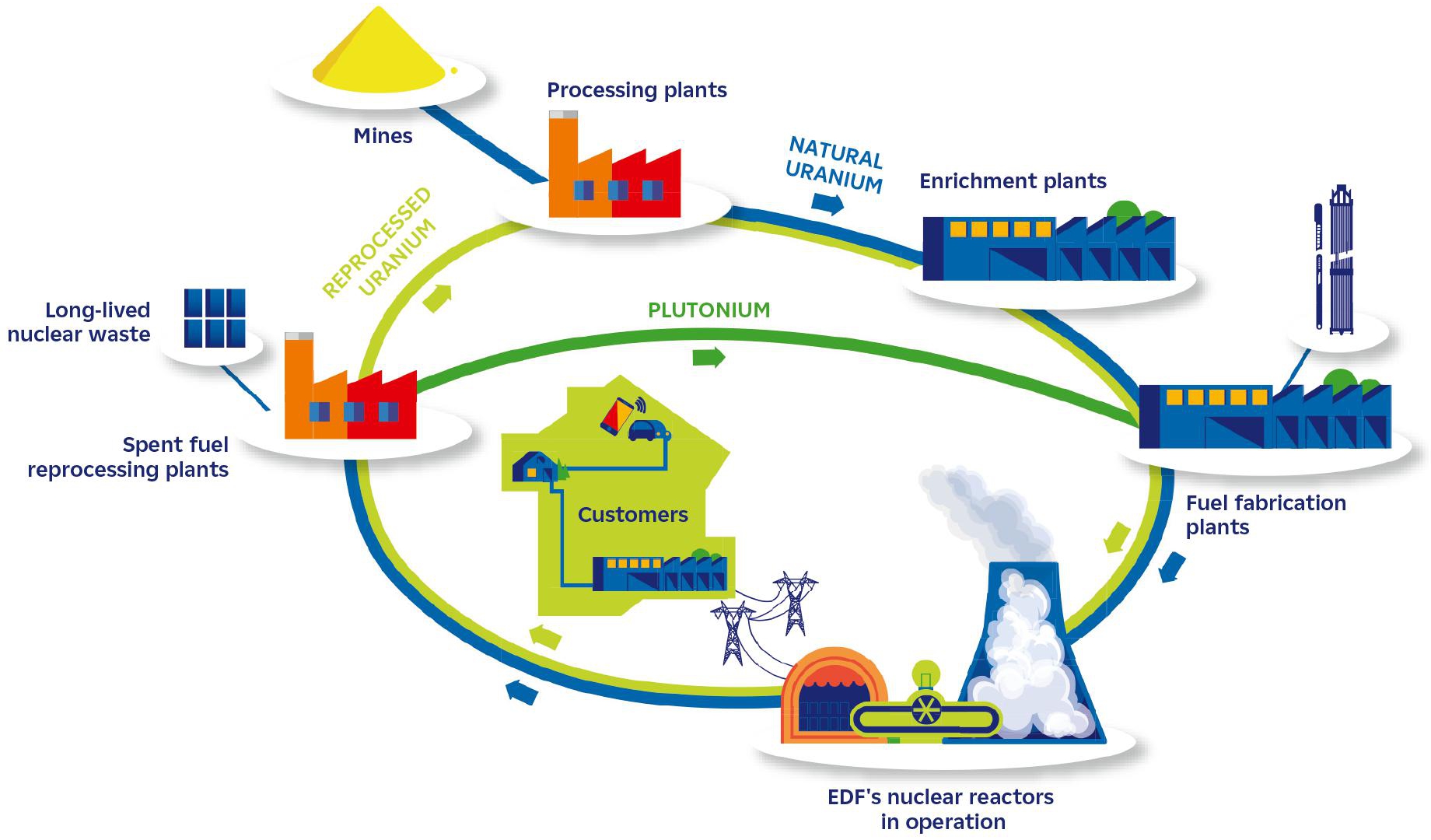
The nuclear fuel cycle encompasses all industrial operations in and outside France which contribute to supplying fuel to generate energy in a reactor, then to unloading and processing the fuel.
- the front end of the cycle, comprising the purchase by EDF of concentrates derived from uranium ore, which are then made into more sophisticated products through fluorination (or conversion), enrichment, and fuel assembly fabrication by industrial fuel cycle operators with which EDF has multi-year service contracts;
- the core of the cycle, when the fuel is used in the reactor: reception, loading, operation, and unloading. The fuel stays four to five years in the reactor. These operations are carried out by EDF;
- the back end of the cycle, for the reactor fleet in France, comprising interim pool storage, reprocessing of spent fuel, conditioning of radioactive waste and recycling of reusable materials, and interim storage of conditioned waste prior to long-term storage.
In most cases EDF is the owner of, and responsible for, the fuel and materials it uses in the various stages of the cycle.
To ensure continuity and security of supply for its reactors in France and the United Kingdom, EDF retains overall control of all operations at every stage of the cycle, through a portfolio of contracts and by building up stocks at the various stages of the front end of the cycle (natural uranium, fluorinated enriched or unenriched uranium, and warehousing of new fuel assemblies). Orano is an important supplier in this stage of the cycle.
EDF’s uranium supplies are guaranteed by long-term contracts for periods of up to 20 years, following a policy of diversification in terms of sources and suppliers. The indexation formulas in these supply contracts are partly fixed (baseline prices that may be inflation-adjusted) and partly variable (based on market price indexes). They generally stipulate floor and ceiling prices that moderate the effects of market price fluctuations on supply costs. Where necessary, the Group implements a strategy to hedge its foreign exchange risk and the US inflation risk.
EDF takes care to implement best practices in mineral extraction. Since 2011, EDF has carried out regular mine audits based on a method developed with the WNA(1). See section 3.3.3.4.3 “Responsibility in the fuel supply chain”.
EDF’s needs are covered by Orano in France, and other producers internationally such as Cameco in Canada and Converdyn in the United States.
EDF covers its enrichment service requirements through contracts with major global enrichment companies: Orano (France), Urenco (United Kingdom, Germany, Netherlands, United States), based on contracts with mostly fixed prices.
Since the 1990s, reprocessing has made it possible to recycle uranium from spent fuel processing (95% of the spent fuel mass) for reuse in the reactors. This reprocessing resumed in 2018 and currently concerns four 900MW reactors. Subject to the completion of technical modifications and obtaining the necessary authorisations, some 1,300MW reactors will receive reprocessed uranium-based fuel assemblies by 2027.
EDF sources its fuel assemblies either internally, through its subsidiary Framatome, or externally from Westinghouse.
In September 2016, EDF, Orano and Framatome signed agreements for the supply of uranium, conversion and enrichment services, and fuel assembly fabrication, for the Hinkley Point C reactors’ fuel supply.
The risks associated with the back end of the cycle are described in section 2.2.2 “Specific nuclear operation risks”, risk 2A “Risks related to control of radioactive waste processing, decommissioning of nuclear facilities, and secure coverage of the related obligations” and risk 2B “Risks related to control of the fuel cycle”.
Regulatory framework
As producer of the waste, EDF is responsible for treatment and processing of its spent fuel and for the related waste. This responsibility cannot be transferred or limited in time.
Orano performs the spent fuel processing.
France’s National Agency for Radioactive Waste Management, ANDRA, is in charge of long-term management operations for final radioactive waste storage, in accordance with Article L. 542-12 of the French Environment Code.
Management of radioactive and non-radioactive waste is governed by Articles L. 541.1 and following of the French Environment Code.
In accordance with its powers under Article L. 594-4 of the French Environment Code, in early 2024 the Directorate General for Energy and Climate (DGEC) and the French Treasury commissioned an external audit of the valuation of EDF’s spent fuel management costs at 31 December 2023. The audit began in the second quarter of 2024 and was completed on 28 May 2025 with no significant impact on EDF’s approach to calculating its obligation as reflected in the amount of the provision for spent fuel management at 31 December 2023. To date, the DGEC, which commissioned this audit, has not yet issued a follow-up letter.
EDF’s current strategy, in agreement with the French State, is to process spent fuel and wherever possible recycle substances: plutonium in the form of MOX fuel, and reprocessed uranium (see “Front end of the cycle” above).
Some 1,100 tonnes of spent fuel are processed every year. The volume is determined by the amount of recyclable plutonium in the reactors that are authorised to load MOX fuel.
Relations between EDF and Orano concern the shipment, processing, and recycling of spent fuel. The two companies have entered into a series of agreements:
- in December 2008: a framework agreement covering the period 2008-2040;
- in October 2024: an implementation contract covering the period 2024-2026, and the related supply contracts for MOX assemblies.
On 26 February 2024 the Nuclear Policy Council (CPN), chaired by the French President, confirmed France’s policy for the back end of the nuclear fuel cycle, involving continuation of the processing and recycling of spent fuel with a view to closing the cycle. These policy orientations are in line with the French President’s speech given in Belfort on 10 February 2022 concerning the continued operation of the current fleet and the construction of new reactors.
EDF and Orano have proposed an industrial plan for the future nuclear fuel cycle facilities at the Orano site in La Hague, notably including a new spent fuel processing plant and a new MOX fuel fabrication plant. Orano will be the project manager of the plan, which also comprises a project for new storage capacities that will later be connected to the future processing facilities. This plan was presented to the ASNR on 24 September 2024 and the DGEC, in its letter of 10 March 2025, did not issue any objections. In addition, the CPN specified on 17 March 2025 that the plan “will principally be financed by EDF”. The industrial plan, developed under the leadership of Orano, is the “Aval du Futur” programme. At its meeting of 12 March 2026, the Nuclear Policy Council took note of the progress made on this programme, which aims to upgrade the back-end fuel cycle facilities at La Hague in order to meet the needs of the existing nuclear fleet, and subsequently the EPR2 reactors. It also highlighted the preliminary agreement reached between Orano and EDF, which will secure the programme’s development until the final investment decisions are taken.
Moreover, the prospect of keeping the current nuclear fleet in operation beyond 50 years if the safety conditions are fulfilled, as stated in the President’s speech given in Belfort, has deferred the horizon of the saturation risk for the spent fuel storage facilities operated by Orano in La Hague to 2040, or possibly later.
The projected commissioning date of these new storage capacities is compatible with the needs identified for the purpose of continuing the operation of the nuclear fleet.
Finally, implementation of the plan to densify the storage pools at Orano’s current facilities in La Hague is continuing, marked by immersion of the first densified baskets in mid-2025. This plan is an effective countermeasure to the risk of saturation in the event of a malfunction in the fuel cycle facilities.
As another supplementary solution, Orano is also studying the possibility of dry temporary storage for spent fuel. Specific financial provisions have been set aside for the dry storage and densification scenarios.
Radioactive waste is classified into different categories depending on its nature, its level of radioactivity and the lifespan of its radionuclide components: high-level waste (HLW), intermediate-level waste (ILW), low-level waste (LLW) and very low-level waste (VLLW). It is called long-lived (LL) when it remains active for more than 31 years.
After spent fuel processing, vitrification of high-level waste (HLW) is possible; this is a very high-quality conditioning process resulting in a small volume. The volume of waste is calculated on the basis of a reference inventory corresponding to the former plants’ operation and 50 years of operation for the current PWR fleet (including Flamanville 3). The total volume of all the HLW conditioned in this way is around 9,300m3 (electricity consumption by one million people over one year generates around 3m3 of HLW).
- structures from assemblies (radioactive waste flasks and end-pieces, pieces of fuel cladding, etc.) separated during spent fuel processing. They are currently compacted and conditioned in stainless steel containers;
- waste resulting from certain operating, maintenance and dismantling activities.
The total volume of ILW-LL is about 37,000m3. This includes waste generated during the operation and decommissioning of permanently shut-down installations, including UNGG (natural uranium graphite gas) reactors, and waste from the PWR fleet currently in operation (including Flamanville 3). The calculation is based on a 50-year operating lifespan for PWR plants.
The Cigéo project is France’s deep geological storage facility project for ILW-LL and HLW generated by all French nuclear facilities until they are decommissioned, including waste from spent fuel processing. This project is led by ANDRA. The centre is to be located in the east of France at the border between the Meuse and Haute-Marne départements.
After 15 years of research, evaluation and a public debate, the principle of deep geological storage was adopted by Law 2006-739 of 28 June 2006 (amended) on the sustainable management of radioactive materials and waste, as a safe long-term solution to manage this type of waste without shifting the burden onto future generations. Cigéo will consist of surface facilities to receive and prepare waste packages, and to excavate and build the necessary underground structures. The waste will be stored in installations some 500 metres underground, in an impermeable layer of argillaceous rock able to contain radioactivity over very long periods (several hundred thousand years). Cigéo is designed to operate for at least 100 years while having the flexibility to be adaptable for future generations.
Pending its storage in deep-level geological layers, HLW and ILW-LL from the reprocessing of spent fuel at the Orano plant in La Hague is stored on site in dedicated specific facilities.
On 11 January 2018, the ASN considered that the Cigéo project had reached satisfactory overall technological maturity at the safety options file stage. A detailed design review was organised by a group of independent experts at the request of the Directorate General for Energy and Climate (DGEC). In late 2020, this group issued a generally favourable opinion on the file presented by ANDRA.
The public inquiry regarding the Cigéo project’s public utility was held between 15 September and 23 October 2021. It resulted in a favourable opinion from the inquiry commissioners (along with five recommendations to the project manager), made public on 20 December 2021. The findings of the commission noted that the public enquiry had “attracted a large number of contributions from the public, most of them with extensive supportive arguments” and that Cigéo was “opportune, relevant, and robust”.
Prior to the enquiry, a second appraisal of Cigéo’s Socioeconomic assessment by France’s General Secretariat for Investment (SGPI) had resulted in a favourable opinion “both for the overall project and its transport component”. It stressed that “the Cigéo project has strong prudential and insurance value to cope with environmental and health risks”.
In an opinion issued on 13 January 2021, the French Environmental Authority emphasised the educational nature of the environmental assessment. It made a series of recommendations, which ANDRA took into account in the public inquiry.
Decree 2022-993 of 7 July 2022 declared Cigéo to be in the public interest and adjusted the Pays barrois (Meuse) area land use master plan, the Haute-Saulx (Meuse) local inter-municipality urban planning document, and the Gondrecourt-le-Château (Meuse) local urban planning document for compatibility. Decree 2022-992 of 7 July 2022 also included the Cigéo project among the operations of national interest specified in Article R. 102-3 of the French Urban Planning Code.
On 22 June 2023 the ASN declared the application admissible, and on 27 June 2024 France’s Environmental Authority also issued an opinion on the application to create the centre. This meant that technical examination of the application could begin. This involved three meetings of the ASN’s Advisory Committee of Experts: the first took place in April 2024, the second in December 2024, and the third in June 2025. In an opinion issued on 25 November 2025, the ASNR considered that ANDRA had acquired sufficient knowledge regarding the basic data used for the safety assessment and that the safety demonstration for the operational and post-closure phases, based on that knowledge, was satisfactory at the stage of application for an authorisation to create a new facility. This demonstration will have to be expanded in preparation for commissioning, which will be limited to the pilot industrial phase. The ASNR considers that the file, supplemented by ANDRA in accordance with the commitments it made during the investigation, could give rise to a public inquiry.
ANDRA’s schedule underlying the costing defined in 2016 includes an initial industrial pilot phase and anticipated delivery of the first waste between 2035 and 2040. This date will be updated in the reference schedule supporting the new cost order.
As part of its review of Cigéo’s safety options file, the ASNR requested that alternative options to storing bituminous waste in its current state at Cigéo be investigated. In September 2018, a group of experts was appointed by the DGEC to draw up a report on current bituminous waste management practices. In September 2019, this group concluded that the various management options (storage or neutralisation) were feasible in principle. However, it stressed the importance of continuing the studies already under way to identify the most appropriate option. A four-party research programme involving producers and ANDRA is still exploring this question.
Regarding the tax status of Cigéo, Article 127 of France’s Finance Law for 2021 modified the tax regime for basic nuclear facilities (INB) set out in Article 43 of France’s Finance Law for 2000. It introduced a change in the calculation method for the tax on storage of high-level waste and long-lived intermediate-level waste. Subsequently, Article 18 of the Finance Law for 2025 codified the provisions relating to the INB tax that will be payable by Cigéo. However, the application measures for these principles and their potential impact on the level of taxation on the installation have yet to be clarified.
In May 2025, ANDRA submitted a report on the Cigéo cost update to the Directorate-General for Energy and Climate (DGEC), the ASNR and the relevant parliamentary committees. Stakeholders, including waste producers, issued an opinion on this report which will lead the State to set the new “target cost” for Cigéo in the first half of 2026. EDF has nonetheless updated the Cigéo provision in the 2024 financial statements to take account of information that is sufficiently certain and was not included in the 2016 cost calculation.
ICEDA, located at the Bugey site, is the facility dedicated to the conditioning and interim storage of long-lived intermediate-level waste (ILW-LL) from operations (excluding ILW-LL from spent fuel processing) and reactor dismantling. The facility was commissioned in 2020 and conditioned its first waste in 2021.
Since 2021, all the radioactive waste from decommissioning operations at Chooz A and operating activities at Fessenheim and Cruas has been conditioned at the ICEDA facility.
In 2024, the ASN approved a modification to the radiological characteristics of waste that could be received for conditioning at the ICEDA facility. On 24 February 2025, the ASNR granted conditioning authorisation incorporating the new scope, allowing ICEDA to condition 100% of the waste for which the facility was designed.
After the two reactors at the Fessenheim plant were shut down permanently, EDF filed an application to modify the ICEDA’s authorisation decree in order to allow the facility to condition waste resulting from the decommissioning of Fessenheim. The amended decree was published on 28 February 2025.
Long-lived low-level waste (LLW-LL) comes from the dismantling of UNGG reactors (graphite bricks that made up the core of these reactors and their fuel assemblies). In July 2015, ANDRA submitted a report on the feasibility of a storage facility located in the Soulaines region (Aube) in France to the ASN for review. Work on this proposal is ongoing as part of the National Plan for Managing Radioactive Matter and Waste (PNGMDR), to identify the waste that could be stored in the facility.
In accordance with ASN opinion 2020-AV-0357 of 6 August 2020 and the fifth PNGMDR(1), in March 2024 ANDRA submitted a file presenting the technical and safety options selected for LLW-LL storage at the Vendeuvre-Soulaines site. This file is currently being examined by the ASNR.
In addition, the studies conducted by EDF to characterise the radiological inventory of this waste in more detail have demonstrated significant gains, suggesting that it should be possible to store the graphite from the first decommissioned reactor (Chinon A2) in the existing Aube surface level storage centre, with no need to wait until a specific storage centre is commissioned.
The scenario currently modelled in the financial provisions for Chinon A2 graphite extracted from the reactor up to 2045 is therefore storage at the Aube centre, assuming construction of a temporary storage facility at Chinon and final storage in a specific LLW-LL centre.
For other reactors, the financial provisions cover direct storage of graphite waste in an LLW-LL repository.
Short-lived low-level and intermediate-level waste (LILW-SL) and very low-level waste (VLLW) comes from:
- the operation of nuclear facilities: gloves, filters, resins, etc.;
- the decommissioning of these facilities: concrete, scrap metal, insulation, pipes, etc.
This type of waste is stored near surface at the Soulaines and Morvilliers facilities run by ANDRA in the Aube département. To reduce volumes, some waste undergoes preliminary melting or incineration at the Centraco plant owned by Cyclife France.
Following the public debate on the PNGMDR carried out in 2019, in line with the joint decision by the Ministry for the Ecological Transition and the ASN (the authorities in charge of the PNGMDR), legislation allowing the reuse of very low-level metallic waste in France was published on 14 February 2022. This regulatory change made it possible to implement an industrial recycling and sale solution for this waste metal. This is the purpose of the EDF-developed Technocentre project, concerning a dedicated facility for recycling and sale of very low-radioactivity metals, to be located on the Fessenheim site.
EDF referred the Technocentre project to the National Public Debate Commission (CNDP) in early 2024. The public debate, organised by the CNDP and led by EDF, took place from 10 October 2024 to 7 February 2025 and after it ended EDF decided to go ahead with the project.
Creation and development of the Cyclife group: a subsidiary dedicated to decommissioning and radioactive waste management
EDF created the holding company Cyclife in 2016 following the acquisition of the English and Swedish assets of the waste processing company Studsvik. The objective of the Cyclife group, formed by merging Cyclife UK, Cyclife Sweden and Cyclife France (formerly a SOCODEI subsidiary), is to consolidate development of the Group’s internal and external waste processing and decommissioning activities, with two aims:
- to take advantage of opportunities on the decommissioning market in Europe and Japan, capitalising on the know-how and assets developed for decommissioning work in France;
- to control critical operations and key technologies and optimise them over the long run, to provide a secure foundation for the EDF group’s future decommissioning operations.
- (1) Decree 2022-1547 and the implementation order published in France’s Journal officiel of 10 December 2022.
In 2018, Cyclife SAS acquired an 84.6% stake in Cyclife Digital Solutions, which specialises in systems and digital simulation for decommissioning and waste management. This subsidiary is now wholly-owned.
In 2019, the subsidiaries Cyclife Engineering and Graphitech(1) were formed to develop solutions for dismantling light-water reactors and designing waste processing facilities (Cyclife Engineering), and for dismantling graphite reactors (Graphitech).
Cyclife Germany was set up in December 2021 to provide a direct presence in one of the largest markets in Europe, in order to strengthen Cyclife’s positioning in waste processing and facilitate its development in decommissioning activities.
On 22 December 2021, Cyclife SAS signed a contract to acquire the engineering company Aquila Nuclear Ltd. in the United Kingdom.
This new acquisition strengthened Cyclife’s position in the United Kingdom’s nuclear engineering sector and complemented the introduction of a decommissioning business unit at the subsidiary Cyclife UK, which was already active in this market.
In February 2022, EDF set up a new nuclear waste management subsidiary owned in equal shares by Cyclife SAS and Veolia Nuclear Solutions, named Waste2Glass. Its purpose is to develop new nuclear waste processing channels using vitrification based on the Veolia group’s Geomelt and MVS processes, and conduct technical and economic feasibility studies for identified nuclear waste streams.
On 31 March 2022, the Cyclife group pursued its expansion by acquiring the French company Quadrica, a specialist in the development of digital tools. In January 2024, Cyclife Digital Solutions and Quadrica merged, to gain in visibility and continue development of digital solutions.
On 1 January 2024, Cyclife Japan was created to strengthen the Group’s Japanese footprint. Initial partnerships have already underpinned work on the relevance of the solutions offered by Cyclife to the needs of Japanese nuclear operators.
In June 2024, Cyclife GmbH acquired 100% of the shares in BalckeDürr Nuklear Service, which has since been renamed Cyclife GmbH. This company specialises in decommissioning and clean-up operations and waste sorting/conditioning/release services, with projects notably in Germany and Sweden.
On 1 July 2025, the acquisition of 51% of DNUC and Effectiv Consulting (EC) was completed via the subsidiary Cyclife Engineering. DNUC and EC specialise in on-site work and dismantling operations.
The Cyclife Technocentre subsidiary was created in November 2025 to build and operate the new VLL metal recycling facility in Fessenheim.
On 1 January 2026, the subsidiaries Cyclife UK and Cyclife Aquila Nuclear merged into Cyclife UK to improve their visibility, strengthen their market presence and optimise cross-functional activities.
The Cyclife Group is therefore continuing its growth (over 1,400 employees at the end of 2025). With operations in five countries (France, Germany, the United Kingdom, Sweden and Japan), Cyclife is able to provide a fully integrated decommissioning/waste management offering.
EDF conducts both its own R&D activities and R&D with a network of partners (nuclear operators, industrial operators, very small, small and medium-sized businesses, institutional and academic players). This work focuses on radioactive waste management and decommissioning. As a recognised major player in these areas, EDF is actively participating in four different European projects, aiming to:
- improve the performance of waste management and decommissioning projects;
- develop its expertise;
- contribute to the development and implementation of international best practices.
Every year, EDF sets aside financial provisions for the back end of the nuclear fuel cycle in France and for radioactive waste management(2).
The French Environment Code does not specify any maximum operating lifespan for nuclear installations, but it requires an inspection every 10 years to assess their compliance with applicable regulations, and an updated assessment of their risks and issues for protected interests. These assessments consider the condition of the installations, the experience gained during their operation, new developments in know-how, including knowledge on climate change and its effects, and the rules applicable to similar facilities.
EDF’s industrial strategy is to continue operation of the fleet significantly beyond 40 years, in optimum conditions as regards safety and efficiency, given the significant investment made during the fourth 10-year inspections, the post-Fukushima improvements, and French energy needs. The French President announced during a speech on 10 February 2022 in Belfort that he wanted “to extend the lifespan of all reactors that can be extended” and that “no nuclear reactor in operation will be closed in the future (…), except for safety reasons”. He also stated that he had asked EDF to “study the conditions necessary for extending the lifespan beyond 50 years”, paving the way for continuing operation of France’s nuclear reactors beyond a 50-year lifespan.
EDF’s industrial ambition as it prepares for the future of the nuclear fleet refers to three time horizons: up to 50 years, 50 to 60 years and beyond 60 years
EDF is carrying out the fourth 10-year inspections of its 900MW and 1,300MW series, with large-scale modifications to the installations and major safety improvements, in order to demonstrate that these reactors are fit to operate for a further 10 years. For the 1,450MW series, procedures for the 30-year milestone have the same improvement objectives as the 40-year milestone for the other two series.
During the first half of 2016, all the technical, economic and governance conditions were fulfilled for extending the operating lifespan of the 900MWe series power plants in the French nuclear fleet in line with the Group’s industrial strategy. On 28 July 2016, EDF’s Board of Directors therefore approved the extension of the operating lifespan of 900MWe series power plants in France (excluding Fessenheim) from 40 to 50 years from 1 January 2016 onwards, without prejudice to the ASNR’s position on the measures suggested by EDF for each of the nuclear units in question.
On 23 February 2021, the ASNR issued a resolution on the conditions for continued operation of EDF’s 900MW reactors beyond their fourth 10-year inspection in view of the conclusions of the generic phase, and set out related requirements. The ASNR “considered that the measures planned by EDF, combined with the ASN’s requirements, open up the prospect of continued operation of the 900MW reactors for a further ten years following their fourth 10-year inspection”. These generic measures will be supplemented by measures specific to each reactor, once the report of the conclusions of each reactor’s inspection has been submitted to the Ministry in charge of nuclear safety and the ASNR.
On 10 August 2023, the ASNR stated its position on the continued operation of Tricastin 1 beyond 40 years (until its fifth 10-year inspection, scheduled for 2029), in view of the conclusions of its fourth 10-year inspection.
- (1) Jointly owned by EDF and Veolia.
- (2) See section 6.1 “Consolidated financial statements at 31 December 2025”, note 14 “Provisions related to nuclear generation and dedicated assets”.
In addition, following a request from EDF to extend the deadlines for some of the requirements defined in the resolution of 23 February 2021 mentioned earlier, the ASNR issued a new resolution on 19 December 2023 amending certain requirements.
The modifications being rolled out in the first phase of works during the fourth 10-year inspections are continuing, thanks to the lessons learned from the first such inspections (by the end of 2025, the fourth 10-year inspections had been completed for 25 reactors). The modifications in the second phase of work were successfully completed on the Tricastin 1 first-of-a-kind reactor during its partial inspection in 2023, rolled out in 2025 to four additional reactors (Bugey 2, Tricastin 2, Dampierre 1, Bugey 4) and completed in early 2026 at another reactor (Gravelines 1). The results of these fourth 10-year inspections are satisfactory. They demonstrate that there is a strong capability for industrialising operations, and that the involvement of industrial partners has contributed to the success of this project.
Examination with the ASNR of the generic phase of the fourth 10-year inspections of the 1,300MWe series began in 2021 and is continuing.
On 1 July 2025, the ASNR stated its position on the conditions for continued operation of EDF’s 1,300MW reactors beyond their fourth 10-year inspection in view of the conclusions of the generic phase, and set out related requirements. These generic measures will be supplemented by measures specific to each reactor, once the report of the conclusions of each reactor’s inspection has been submitted to the Ministry in charge of nuclear safety and the ASNR.
In January 2026, EDF began the first fourth 10-year inspection of the 1,300MWe series, on the first of its kind, Paluel’s reactor 1.
On 28 July 2021, the Board of Directors approved extension of the depreciation period of the 1,300MWe power plants from 40 to 50 years in the consolidated financial statements. This accounting estimate is not an indication of the ASNR’s future position concerning continuing plant operation, which will be stated for each reactor after their 10-year inspections, as specified by law.
Examination with the ASN of procedures for the third 10-year inspections of the 1,450MW series has begun, and the first of these inspections is planned for 2029. The accounting depreciation period for the 1,450MW series currently remains at 40 years, but its future extension remains an industrial objective for the Group.
On 13 June 2023, the ASN issued an opinion on the prospects for continuing operation of EDF’s nuclear reactors until they reach 60 years.
Studies for the fifth 10-year inspections of the 900MWe series were launched at the end of 2022, with the first of these inspections planned for 2029. These studies include the major issue of adaptation to climate change and an in-depth compliance review of plants and the potential impacts of ageing.
Following the public consultation launched at the end of October 2024, the ASNR stated a position on 10 December 2024 on the general guidelines adopted by EDF for these fifth 10-year inspections, which it considers relevant and consistent with the current state of knowledge. The fifth 10-year inspections should make it possible to consolidate the significant safety improvements made to the reactors during their fourth 10-year inspections, and increase the consideration given to the effects of climate change.
At the end of its ongoing examination, the ASNR will issue a position in 2028 on the continued operation of the 900MWe reactors for a further 10 years, based on the conclusions of the generic phase of the fifth 10-year inspections.
A “long-term” review of the fleet’s continued operation beyond 60 years was initiated in 2023. It is included in the timetable set by the ASNR, which will state its position in late 2026 after expert assessment and examination phases in 2025 and 2026 respectively.
The work focuses on the issues of ageing, as well as covering the identification of scientific and methodological R&D and development needs. It is also informed by intensive international discussions with other nuclear operators, and with leading centres of expertise.
Investment in the existing nuclear fleet in France: the Grand Carénage industrial refurbishment programme
On 22 January 2015, EDF’s Board of Directors approved the principle of the Grand Carénage programme to renovate major equipment, enhance reactor safety and, conditions permitting, continue their operation beyond 40 years. It incorporates the additional safety improvements identified after the Fukushima accident.
- the objectives of the Law on the Energy Transition for Green Growth;
- France’s multi-year energy programmes (PPEs);
- the ASNR’s opinions and recommendations;
- specific procedures needed for reactors to remain in operation for more than 40 years.
On 31 March 2022, EDF’s Board of Directors formally recorded the completion of the Grand Carénage programme’s first phase on 31 December 2021, and approved the principle of its continuation, with a new roadmap for 2022-2028 incorporating information gained from current ASNR examinations, notably concerning the fourth 10-year inspections of 900MW and 1,300MW plants, and the start of the Studies phase for the fifth 10-year inspections of 900MW plants.
Investments for the period 2022 to 2028, phase 2 of the Grand Carénage programme, were re-estimated at the end of 2025 at €36.3 billion, in current euros, or €32.6 billion in 2021 euros. In 2025, total investments amounted to €5.0 billion. These amounts include the cost of stress corrosion-related work, estimated at €1.3 billion in current euros (€1.2 billion in 2021 euros) over the period 2022-2025.
Industrial work will continue beyond 2028, and investment expenditure will remain high beyond that date.
In its capacity as an operator, EDF takes full regulatory, financial, and technical responsibility for the decommissioning of its power plants and the other nuclear installations it operates(1). EDF therefore manages the entire life cycle of its nuclear generation facilities.
Regulatory framework
Regulations applicable to the decommissioning of nuclear installations
The decommissioning of a basic nuclear installation (INB) is ordered by a decree, issued after an opinion from the ASNR and completion of a public inquiry. This decree determines the characteristics of the decommissioning, the timeframe for its completion, and where applicable, the operations incumbent upon the operator after decommissioning.
The reference scenario adopted by EDF since 2001 is for decommissioning without waiting for radioactive decay. This is consistent with French regulations, which require decommissioning to take place “in as short a time as possible” after final shutdown, on acceptable economic terms and in line with the principles set out in the existing laws and regulations.
- (1) The Tricastin Operational Hot Unit (BCOT), the Saint-Laurent silos, the ICEDA waste storage facility, etc.
The regulatory process for decommissioning involves the following:
- a final shutdown declaration at least two years before the planned shutdown date, describing the preparatory decommissioning operations planned;
- application for a decommissioning permit, filed within two years of the final shutdown declaration, which after examination by the authorities and a public inquiry, leads to a decree ordering decommissioning of the facility;
- key stage progress reviews if necessary, subject to approval from the ASNR, based on a file including revision of the safety standards specific to the planned decommissioning operations;
- finally, once the decommissioning and clean-up operations are complete and the facility has reached its target final state, “declassification” to remove it from the legal regime governing basic nuclear installations.
- three pressurised water reactors (PWRs): one at the Chooz site (Chooz A) and two at Fessenheim;
- the heavy water reactor (HWR) at Brennilis;
- the Superphenix fast neutron reactor (FNR) at the Creys-Malville site;
- the six Natural Uranium Graphite Gas (UNGG) reactors at Bugey, Saint-Laurent and Chinon.
These sites remain the property of EDF, and they will remain under its responsibility and monitoring. Given its role as responsible operator, EDF will act as the project owner for the decommissioning.
EDF estimates that it will take approximately fifteen years to dismantle a PWR reactor, with no schedule margin.
The decommissioning of EDF’s legacy nine first-generation reactors in final shutdown will produce approximately 1.5 million tonnes of primary waste. 80% of this waste is non-radioactive, and the remaining 20% is intermediate-level waste (ILW) or very low-level waste (VLLW). None of it is high-level waste.
The decommissioning of the two reactors at Fessenheim will produce 380,000 tonnes of waste, 95% of it non-radioactive.
The existing reprocessing facilities for short-lived VLLW and LLW have been supplemented by the ICEDA facility for the conditioning and storage of long-lived intermediate-level waste (ILW-LL) from operation and decommissioning(1).
The system for handling decommissioning waste has yet to be completed with the new LLW-LL storage facility (see the paragraph on “Long-lived low-level waste (LLW-LL)” in section 1.4.1.1.2.3 “The challenges of nuclear operations”, paragaph “A - Stages and challenges of the nuclear fuel cycle”). For the dismantling of UNGG reactors, there are plans to build an interim storage facility for the LLW-LL graphite sleeves(2) from the Saint-Laurent silos until a permanent disposal site becomes available (the first removal of graphite from the Chinon A2 reactor is scheduled for 2045).
Chooz A is a pressurised water reactor that used a technology similar to the 57 reactors currently in operation. It was commissioned in 1967 and operated until 1991. The reactor location, in a rocky cavern in a hillside, means that access conditions, entry and exit of materials, and effluent management are more difficult than for the rest of the existing PWR fleet.
The work begun in 2017 to complete the underwater dismantling of the Chooz A reactor vessel and its internal components experienced difficulties until 2022. The Covid pandemic had a serious impact on the work: in particular, filtration was suspended during the 2020 lockdown, resulting in the formation of organic matter and thus high turbidity in the water. In addition, given the frequent unavailability of the crane needed to lift the reactor vessel and remove it from its concrete shaft, it was decided to completely renovate this crane to address obsolescence issues and qualify it to handle the mass of the reactor vessel.
- emptying the pool after segmentation of vessel internals;
- segmentation of the primary system pipework prior to lifting out the vessel;
- renovation of the reactor cavern crane.
In 2025, the work reached a new major milestone when the reactor vessel was lifted out (extraction from the concrete shaft in which it was installed) and transferred to the transit stand. Pre-segmentation operations are currently under way, notably leak–proofing the bottom of the pool using a polymer seal and the start of cutting of the insulation.
To ensure that the decommissioning scenario respects the provisions of the Chooz A decommissioning decree, particularly the timetable for the intermediate stage (“stage 1”: electromechanical dismantling and clean-up of structures), an application to amend the decree under Article R. 593-48 of the French Environment Code was officially submitted in December 2025. Completion of reactor vessel dismantling is currently expected in 2027.
A partnership agreement between EDF and the French national research agency CNRS was signed on 7 September 2022 for a project to reuse the caverns for research on neutrinos once the installations have been decommissioned. This will put the facility’s unusual configuration to good use.
Reactors 1 and 2 at the Fessenheim power plant were permanently shut down on 22 February 2020 and 30 June 2020 respectively. These shutdowns were followed by the start of decommissioning operations (draining of circuits, removal of boron, removal of fuel) and preparations for dismantling (sealing off and removal of certain equipment and support functions, decontamination of primary circuits, etc.).
On 1 September 2023, responsibility for the Fessenheim site was transferred from EDF’s Nuclear Generation Division (DPN) to the Decommissioning Projects and Waste Department (DP2D).
All the spent fuel was removed from the site and sent to La Hague in the space of just over two years, a very good performance. As a result, 99.9% of the site’s radioactivity has been removed and the first industrial transfer of radioactive operating waste to the ICEDA facility has taken place. A large-scale primary circuit decontamination operation (Full System Decontamination: FSD) was carried out on both reactors. It was completed in June 2023.
The treatment of the upper parts of the used steam generators (resulting from replacement during the operation of reactors 1 & 2) was carried out in Sweden. The first three lower parts were transported to Sweden in October 2025, after obtaining multilateral agreement from the safety authorities of the countries crossed in transit. Transport of the last three lower parts is scheduled for mid-2026.
The electromechanical dismantling of part of the turbine hall, with a view to converting it into a radioactive waste decoupling and transit facility, has been completed and the conversion work is under way.
- (1) See section 1.4.1.1.2.3 “The challenges of nuclear operations”, paragraph on “The ICEDA radioactive waste conditioning and interim storage facility”.
- (2) These graphite sleeves come from the operation of France’s legacy UNGG (natural uranium graphite gas) reactors. They are hollow cylindrical graphite structures that surrounded the fuel rods.
Major steps were taken towards obtaining the decree ordering decommissioning operations, which will mark the start of the decommissioning phase: the decommissioning application for Fessenheim was filed with the Minister for the Ecological Transition and the ASN in December 2020, the ASN Advisory Committee held a meeting on 22 June 2023, a public inquiry took place (from 25 March to 30 April 2024) and subsequently the Inquiry Committee and the Prefecture issued favourable opinions.
Under the current schedule, the decommissioning decree for the Fessenheim installations is expected to be published in the first quarter of 2026 and to take effect in the second quarter of 2026, following approval by the ASNR of the general operating rules applicable to decommissioning.
The trajectory of the preparatory work for decommissioning is in line with the provisional schedule. It was 96% complete by the end of 2025, making it possible to reach the initial state of decommissioning required by the decree in the first half of 2026: adaptation or renovation of dismantling support functions (electricity, ventilation-heating, handling), new facilities and tools in preparation for dismantling, updating of operating documentation in accordance with the new framework resulting from the decree.
The decommissioning work included in the scope of the decree authorising partial dismantling has been completed and the site is now preparing for the next stage, which will concern the reactor vessel. The work involved in this new stage is being carried out under the terms of the “full dismantling” decree, published on 26 September 2023, which came into effect in June 2024 following the ASN’s approval of the new general operating rules.
In 2025, asbestos removal work was completed on one of the two loading faces of the reactor block, from which the extraction operations for the vessel’s fuel channels will be carried out, due to begin in 2027. In addition, assembly of the site buildings (metal structures, workshops and waste conditioning areas) for the dismantling of the vessel’s peripheral circuits has been completed. The first cuts in the concrete wall to create the openings in the reactor block for access to the peripheral circuits were made in December 2025. Segmentation of these circuits is scheduled to begin in 2026.
After removal of the reactor vessel containment plugs, installation of the “SCOT” rotating confinement structure and commissioning of the automated workshop, segmentation of the reactor vessel internals began in 2024.
By the end of 2025, the neutron shield support (the first part of the vessel internals) had been completely segmented and conditioned in waste packages, and the second part, the diagrid, had been extracted and was in the process of segmentation. The diagrid, a metal component that supported the fuel elements, was the last large-scale component that could be removed from inside the vessel for dismantling in an adjacent workshop. The segmentation operation has been slowed down by a delay in restoration of the evacuation line for the R73 waste containers suitable for transporting this type of waste. Meanwhile, work inside the reactor building is continuing: the internals segmentation machine has been inserted into the vessel, the testing phase prior to segmentation of the vessel’s fixed internal structures has begun, dismantling of the small rotating plug has been completed and dismantling work has started on the reactor pit and the safety containment vessel.
In the peripheral buildings, dismantling work in the steam generator buildings began in 2025 and will continue until 2030.
The industrial dismantling strategy for the UNGG reactors was reviewed in depth in late 2015, notably leading to a switch from underwater to in-air dismantling, which involves:
- an essentially remote-controlled dismantling process;
- qualification of tools and the remote operation platform on the Industrial Demonstrator located near Chinon;
- dismantling of the initial “first-of-a-kind” reactor (Chinon A2), and putting the five other reactors into a safe storage configuration in order to benefit from experience on the first reactor decommissioning before the wider roll-out.
Under this strategy, dismantling operations for the reactor caissons should be completed between 2063 and 2093, depending on the reactors.
Updating the industrial decommissioning scenario for first-generation power plants, particularly UNGG plants, led to a €590 million increase in the related financial provision at 31 December 2015.
In a cover letter accompanying the resolutions of 17 March 2020 supporting the technical options chosen, the ASN took the view that EDF should aim to shorten the schedule for completing this work “in view of the legal obligation for the dismantling of each reactor to take place in as short a time as possible”. EDF confirmed that it was conducting regular schedule reviews based on the results from the industrial demonstrator and the first reactor. So far, no new information has arisen to enable optimisation of the schedule.
Construction work on the Industrial Demonstrator was completed in late 2021. The first tests, carried out in September 2022, concerned the development of tools for recovery of graphite bricks from reactors, and the progressive design of the robotic arms required to dismantle UNGG reactors is moving forward. The manufacture of the mechanical part of the first remote operation arm was completed in 2025, on schedule. All that remains is to mount the hydraulic part on the arm and carry out the overall tests.
Following the inspection on “the management of complex projects” which ended in November 2020, EDF’s responses and commitments were sent to the ASN in May 2022.
Regarding the regulatory aspect of these procedures, the application for a dismantling authorisation for the silos at the Saint-Laurent site was submitted to the ASN in electronic format on 30 September 2022. The dismantling applications for Chinon A2 and A1 and the applications for substantial changes to the decommissioning decrees for Chinon A3, Saint-Laurent A, and Bugey 1 were filed on 15 December 2022, in line with the ASN resolutions of March 2020. EDF submitted updated versions of all these applications in February 2024 in response to the requests made by the Nuclear Safety and Radiation Protection Mission (MSNR) as part of the admissibility analysis. The ASN and the IRSN began their examination of the applications on 25 November 2024 in preparation for a meeting of an Advisory Committee of Experts that was held in March 2026. In 2025, three decommissioning matters were examined in parallel:
- a technical assessment by the ASNR/DES branch;
- a review of the dismantling schedule by the ASNR/DRC, mainly through a three-day inspection in Lyon and on site, resulting in a follow-up letter and a positive assessment from the ASNR. “Thus, at the end of this inspection, the inspectors have a high level of confidence in EDF’s ability to develop “derisking” tests in the Industrial demonstrator, to dismantle the first UNGG reactor and the reactors planned in the future”;
- an assessment of the environmental (chemical and radiological) condition of soil and groundwater by an ad hoc Working Group led by the decommissioning advisory committee.
These assessments and reviews are general and cross-functional, although specific requests can be made, notably for the Chinon A2 “first-of-a-kind” reactor.
Meanwhile, decommissioning operations around the reactor caissons are continuing at all three sites.
At the Bugey 1 site, the electrical buildings have been demolished, bringing the total decommissioned surface to 27% of the target for the safe storage configuration (which requires decommissioning of all surfaces other than the reactor building and premises needed for dismantling the reactor building). Asbestos was removed from the turbine hall in 2023 by extracting several hundred asbestos-containing tubes integrated into the engineering equipment. On 29 September 2025, the effluent storage station was commissioned for industrial operation.
At Chinon A2, the ferrules (sections of the primary circuit) of all four heat exchanger buildings were evacuated to Cyclife-France for melting. An inspection programme to establish a detailed characterisation of the installation is under way, with a particular focus in 2025 on scanning the reactor ceiling to enable accurate modelling.
Decommissioning of the Chinon A3 heat exchangers has been completed: 5,200 tonnes of metal circuits have been dismantled after 12 years of work.
At the Saint-Laurent A2 reactor, decommissioning of non-caisson components resumed in the second quarter of 2024 after reinforcing control of lead risks. Thanks to fast-paced industrial operations, the milestone of completing dismantling of the circuits located under the reactor vessel was achieved in early December 2024. Electro-mechanical dismantling work is continuing, notably in the pool buildings that used to house the fuel storage pools.
Since the beginning of operations at its power plants, EDF has established financial provisions to cover dismantling, engineering, monitoring and maintenance of its facilities, and site security(1). The aim of decommissioning operations is to restore the sites to their original condition and makes the land reusable for industrial purposes.
Article L. 594-2 of the French Environment Code and its implementing regulations define the provisions that are unrelated to the operating cycle and must therefore be covered by dedicated assets(2). Accordingly, dedicated assets have been gradually built up since 1999(3).
An external audit commissioned by the Directorate General of the Treasury and the Directorate General for Energy and Climate (DGEC) concerning “dismantling expenses for existing permanently shut-down facilities and the management of radioactive waste from these facilities” took place from December 2020 to May 2021, pursuant to the letter of instruction received on 5 June 2020 from the DGEC. This audit covered non-PWR legacy installations that have been shut down permanently, i.e. Superphénix, Brennilis, and the six UNGG reactors. The final audit report was remitted to the audited party on 9 July 2021. The DGEC’s follow-up letter was issued on 22 November 2021 and the audit report was posted on the Ministry for the Ecological Transition website.
This report highlighted “an organisation with a structural focus on execution of dismantling projects”, an “annual costing and review process [that] is robust, and provides good traceability for the assumptions used and the original data”, and “a long-term industrial approach to overcome the few remaining technological challenges”. Finally, the report confirmed that “the provisions are consistent with the basic scenarios of the projects and cover the full range of expenses of the audited scope” and concluded they “are adequately sized” due to testing of the size of EDF’s expenses and provisions.
Beyond the well-controlled processes and organisations, two minor points with low materiality were reported (and corrected when the estimates were revised at the 2021 year-end). Areas for improvement were identified relating to project planning, project maturity assessment and the risks and uncertainties quantification process. They did not call into question the conservative estimates of the associated decommissioning and waste management costs. The audit report also noted EDF’s use of a set of best practices that are rarely implemented in decommissioning projects.
The written response to this follow-up letter was sent on 21 February 2022, resulting in introduction of an action plan to address the areas for improvement mentioned above. All of the actions were completed by the end of 2024.
For the risks associated with these projects, see section 2.2.1 “Operational performance risks”, risk 1A “Risks related to management of large, complex industrial projects, including EPRs”.
Thanks to the work done by EDF and Framatome on the New Model EPR project, the technical configuration was developed in late 2017 for an “EPR2” model which could ultimately expand the offering of the French nuclear industry both in France and for the export market. The EPR2 is an optimised version of the EPR, an industrial successor to the EPR that integrates experience gained from EPR projects and power plants currently in operation.
In May 2021 EDF submitted a comprehensive dossier on a renewal programme for nuclear installations in France to the French State (“Proposal by EDF and the nuclear industry for a new reactor programme in France”). The basic principles of this dossier are the implementation of a programme to build three pairs of EPR2 reactors successively at Penly, Gravelines and near Bugey, and the continuation of feasibility studies for the construction and operation by EDF of eight additional EPR2 reactors at other nuclear sites.
On 17 March 2025, the Nuclear Policy Council examined the main principles of the proposed financing and regulatory framework and announced plans for a subsidised State loan covering at least half of the construction costs, a contract for difference cover nuclear power output, and risk sharing between EDF and the State. These measures were the subject of a preliminary agreement between the State and EDF on the above basis; they await approval by the European Commission as compatible with the State aid rules defined in the Treaty on the Functioning of the European Union (TFEU), with a view to EDF making a final investment decision (FID) in late 2026. The French government filed the official notification in November 2025, and on 31 March 2026 the European Commission adopted the decision to begin the formal review procedure(4).
On 18 December 2025(5), EDF presented to its Board of Directors the forecast estimate for the programme to build six EPR2 reactors at the Penly, Gravelines and Bugey sites. This estimate amounts to €72.8 billion2020 and was audited in the first quarter of 2026 by the Interministerial Nuclear New Build Delegation (DINN). At its meeting of 12 March 2026, the Nuclear Policy Council took note of the findings of this audit and asked EDF to implement the recommendations made by the end of 2026, and to report on them as part of the follow-up process overseen by the DINN. It also confirmed the key principles and parameters of the financing and regulatory framework for the EPR2 programme.
Pending the FID in 2026, the Board of Directors authorised EDF to continue development of the programme, with a budget of €2.7 billion for 2026. The target date for commissioning of the first EPR2 at Penly is 2038, to be followed by the other reactors at intervals of 12 to 18 months.
- (1) See section 6.1 “Consolidated financial statements at 31 December 2025”, note 14 “Provisions related to nuclear generation and dedicated assets”.
- (2) See section 6.1 “Consolidated financial statements at 31 December 2025”, note 14.1.3 “Coverage of EDF’s long-term nuclear obligations”.
- (3) See section 6.1 “Consolidated financial statements at 31 December 2025”, note 14.1.2.2 “Strategic allocation and composition of dedicated assets”.
- (4) See the European Commission’s press release of 31 March 2026.
- (5) See EDF’s press release of 18 December 2025 “EDF shares its forecasted cost estimate of the EPR2 programme for €72.8bn”.
Pursuant to the recommendations made by Jean-Martin Folz in 2019(1) and the French Court of Auditors in its summer 2020 report on EPRs, EDF has decided to strengthen the design & build governance for EPR2 reactors. EDF has therefore set up a new organisation that separates the Project Owner function from the Project Manager function. This organisation was strengthened in 2024 as part of the reorganisation of EDF’s nuclear activities described in section 1.4.1.1.1 “Nuclear organisation and governance”. This work is continuing, with reinforced positioning for the project owner and inclusion of Edvance and the Supply Chain team in project management.
- controlling the safety, quality, time and cost dimensions of the new nuclear projects (the EPR2 and SMR programmes);
- ensuring that the programmes’ long-term profitability is secure;
- overseeing programmes during both the development and execution phases;
- ensuring that the programmes achieve a good operational performance over the long term;
- ensuring that administrative authorisations are obtained, managing land use, integrating the project into the local area, and overseeing major construction projects.
The project manager is responsible for designing the EPR2 reactors and if the FID is made, will ensure that they are built in compliance with the safety, quality, cost, schedule and security objectives set by the project owner.
The general conceptual design studies begun in 2018 were finalised by the end of 2021. This stage was preceded by the submission of the preliminary safety report to the ASN in February 2021, and completion of the ASN’s examination of the safety options file (as stated in letters of April and September 2021).
- continuation of engineering studies; a technical maturity review was organised in 2023 covering the main buildings of the nuclear island. This review gave EDF feedback on the project from a committee of independent experts, in order to secure the next steps in EPR2 development and construction. A second review held in mid-2024 validated completion of the “detailed design” milestone for the nuclear buildings. In 2025, studies continued, including a decision to increase the size of one of the buildings to facilitate fuel handling and the installation of equipment. Design maturity reviews will continue in the first half of 2026, to prepare for the FID;
- close relations with key partners, to learn from studies by suppliers and give them the necessary visibility to invest in skills and industrial facilities; the main civil engineering contract for Penly was signed in October 2023;
- worksite preparation, particularly procedures for administrative and regulatory authorisations:
-
>Penly: on 11 February 2022 EDF referred the proposal to build two EPR2 reactors at Penly to the National Public Debate Commission (CNDP). The public debate was held between late October 2022 and late February 2023, in parallel with a public consultation on energy organised by the State. On 28 June 2023, EDF’s Board of Directors decided to continue preparations for the EPR2 programme and the Penly project, following which applications were submitted for an authorisation to create a facility and an environmental authorisation. In June 2024, an environmental authorisation decree was issued authorising EDF to carry out preparatory work. This authorisation was the subject of a non-suspensive appeal before the Council of State, which was rejected on 22 December 2025. The Penly project was officially recognised as a project of common interest by a Council of State decree of 25 January 2025,
-
>the preparatory work that began in 2024 intensified in 2025, with a particular focus on reinforcing the existing sea wall, cliff reprofiling, setting up temporary accommodation and car parks, extending the offshore platform, evacuating past archaeological excavations, and constructing the site access station and car park at the site entrance,
-
>Gravelines: on 22 November 2023 EDF referred the proposal to build two EPR2 reactors at Gravelines to the CNDP. At its plenary session on 10 January 2024, the CNDP decided to organise the Gravelines public debate, which began on 17 September 2024 and ended on 17 January 2025. On 20 May 2025, EDF’s Board of Directors decided to continue developing the project to build two EPR2 units at Gravelines. This project entered a key phase when its Grand Chantier (major project) status was officialised on 18 June 2025, and it was recognised as a project of common interest by a Council of State decree of 17 July 2025. An application was made to have the planning documents adjusted for compatibility, giving rise to a preliminary consultation in the summer of 2025. In September 2025 EDF began ongoing consultation with the aim of continuing information sharing and dialogue about the project with the public in the long term. In late October, EDF filed an application for environmental authorisation for site preparation work,
-
>Bugey: the public debate for the Bugey site began on 28 January and ended on 15 May 2025. On 30 September 2025, EDF announced that it had decided to continue the project (while making certain changes based on the information collected), and to file the applications for the necessary administrative authorisations for construction. Application for recognition as a project of common interest was made in late November 2025.
The EDF group is continuing its strategy of developing a Generation III Small Modular Reactor (SMR) jointly with its subsidiary NUWARD, to support the energy transition and meet industrial operators’ needs in Europe and internationally in the 2030s. The basic design phase of NUWARD continued in the first half of 2024, with deeper consideration of the project’s design and market positioning. The lessons learned led to a change in strategy, and development is continuing with a new approach based exclusively on proven technological building blocks.
This approach will build on the technical, industrial and commercial knowledge accumulated by NUWARD, and the Group’s own experience in nuclear power and PWR technology. NUWARD is aiming for a simple, highly modular design that can be delivered in 5 years.
In 2025, the project continued with the conceptual design phase focusing on a 1,150MWth multi-energy platform, capable of delivering up to 400MWe or up to 320MWe and 290MWth in co-generation mode, achieving an overall efficiency of 53%. The conceptual design phase is scheduled to end in mid-2026. Meanwhile, NUWARD has pursued a co-development strategy aimed at attracting equity from industrial players, customers and financial investors and continuing to benefit from State support.
NUWARD aims to develop its first series of power plants through its customers, as a Nuclear IPCEI(2) under a cross-border partnership with France, Italy and Poland.
- (1) In a report submitted to the French Minister for the Economy and Finance and the Chairman & Chief Executive Officer of EDF in October 2019.
- (2) Important Project of Common European Interest.
In the United Kingdom, EDF Energy is a participant in the project to build two nuclear reactors at Hinkley Point, together with China General Nuclear Power Corporation (CGN). The project company Nuclear New Build (NNB) is the project owner.
- overall management of the project, and ensures that lessons learnt are shared across projects (to benefit HPC and future projects);
- monitoring of manufacturing (via the Supply Chain Division);
- construction, and preparation for the commissioning phase (via the Construction & Testing Division).
The subsidiaries EDVANCE and EPR-Engineering, with the support of the Engineering Division, carry out design studies and contract monitoring.
Framatome supplies the components and the instrumentation and control system, and the turbine is supplied by Arabelle Solutions.
EDF is a participant in the Sizewell C project to build two EPR reactors, owing a 12.5% stake alongside the UK government (44.9%), La Caisse (20%), Centrica (15%) and Amber Infrastructure (7.6%) (see section 1.4.5.1.2.5 “The New Nuclear Industry”).
EDF also owns a 33.5% stake in Bradwell B, in partnership with CGN (see section 1.4.5.1.2.5 “The New Nuclear Industry”).
In March 2018, EDF and the Indian national electricity company Nuclear Power Corp of India Ltd. (NPCIL) signed the “Industrial Way Forward Agreement” (IWFA), a non-binding industrial cooperation agreement for the construction of six EPR reactors in India at the Jaitapur site. This agreement sets out the industrial plan, the partners’ roles and responsibilities, and the next steps in the project. It states that the EDF group and its partners will supply all the studies and equipment for the nuclear island, the conventional island, the auxiliary systems, and the heat sinks and galleries. EDF does not plan to invest in this project. The client, NPCIL, will be the general project manager, constructor and integrator in the execution phase.
In accordance with the schedule laid down in the IWFA, EDF and its partners submitted a comprehensive conditional non-binding proposal to NPCIL in late 2018, followed by a binding technical and commercial proposal in April 2021. Since then, EDF, with the support of the French government, has continued its discussions with Indian stakeholders within the framework of a Special Task Force led by the two countries’ governments. In the long term, the goal is to be able to converge with NPCIL on technical and commercial matters, with a view to signing a binding Pre-Engineering Contract.
The Netherlands made a major shift in its energy policy in 2021. Having initially planned to close the country’s only nuclear power plant in Borssele in 2033, the government decided to revive nuclear power to meet two imperatives: reducing CO2 emissions by phasing out fossil fuels, and ensuring a secure electricity supply, in line with European and national climate targets.
The process of selecting a partner to build a plant with two high-power units was also initiated. In response, EDF carried out a paid Technical Feasibility Study for the construction of two EPR reactors at the Borssele site, and is currently participating in the competitive dialogue led by the Dutch government and NEO NL, the entity it has created to take charge of the project’s development. The next step in this process will lead EDF and its competitors to define the outline of a fair and robust call for tenders together with NEO NL. Announcement of the selected partner is currently scheduled for late 2027/early 2028.
Poland’s energy transition plans are the most ambitious in Europe, as coal still accounted for 54% of its electricity mix and 65% of its heat mix in 2024. This transition is mainly based on the development of offshore wind farms and a nuclear programme that is the largest in Europe after the French programme, with a target of 6 to 9GW of nuclear capacity in service by 2045. In July 2025, the Polish government invited four countries (Canada - Atkins Realis, South Korea - KHNP, France - EDF, and the United States - Westinghouse) to participate in competitive dialogue for the contract to build the country’s second nuclear power plant, in central Poland.
EDF is aiming to develop a fleet of high-power reactors in Europe, as several countries have decided to launch or relaunch new nuclear programmes on the continent. EDF is in discussions with Finland, Sweden, Slovenia and other countries to carry out preliminary studies to derisk projects prior to the submission of formal offers.
In Canada, EDF provides support for local operators (Ontario Power Generation and Bruce Power) in their respective development processes for large-scale projects in Ontario.
The Nuclear Engineering and Project Transformation Programme aims to deeply and sustainably transform nuclear engineering in order to improve its industrial control and competitiveness.
- standardise and simplify engineering processes and methods by integrating system engineering principles, and digitise them for the move towards digital engineering and efficient data-centric practices;
- standardise products based on proven solutions, base international offerings on the standard products and replicate them across projects;
- reconfigure relations with the supply chain by streamlining the supplier panel, making suppliers accountable, and developing the extended enterprise model of operation;
- integrate the information system around PLM (Product Lifecycle Management) solutions, and ensure its interoperability with the information systems of external stakeholders (customers, suppliers, authorities, etc.) to establish a truly digital ecosystem;
- capitalise more effectively on knowledge and know-how and develop internal skills, while optimising the use of outsourcing.
Framatome(1) is a leading international player in nuclear energy, owned by EDF (80.5%) and Mitsubishi Heavy Industries (19.5%).
The company is highly-reputed for its innovative solutions and high added-value technologies for the worldwide nuclear fleet. With its recognised expertise, sound references and more than 24,000 employees, Framatome designs, manufactures, installs and maintains components and fuels, as well as instrumentation and control systems for nuclear power plants. In 2025, Framatome hired over 2,600 employees to maintain and increase its skills and ensure its growth.
- (1) Framatome, Framatome Healthcare, Framatome Defense, and Framatome Space are registered brands and trademarks of Framatome and its subsidiaries in the USA and other countries.
Framatome’s German subsidiary is headquartered in Erlangen (Bavaria). With over 2,500 employees, it is the company’s second-largest engineering site. Its main business is maintaining, prolonging and upgrading nuclear plants (especially Instrumentation & Control systems) all over the world. This site also contributes to EPR reactor construction projects in France and the United Kingdom, having already participated in the construction of EPR reactors in Finland and China. Framatome’s subsidiary Advanced Nuclear Fuels GmbH (ANF) produces fuel assemblies for PWRs (pressurised water reactors) and BWRs (boiling water reactors).
Framatome’s U.S. subsidiary is headquartered in Lynchburg (Virginia). With over 2,300 employees, its main business is maintaining and modernising North American nuclear power plants (United States and Canada) currently in operation, to supply them with the necessary fuel, provide support for the potential construction of new plants, and restart nuclear power plants that had been permanently shut down. Framatome also owns 50% of IsoGen Corp., a joint venture with Kinectrics Inc., which produces medical isotopes at nuclear reactors operated by Bruce Power in Canada.
Framatome also has industrial or commercial operations in more than 20 countries, including South Africa, Argentina, Belgium, Brazil, Bulgaria, Canada, China, South Korea, Spain, Finland, Hungary, Japan, Kazakhstan, the Czech Republic, Romania, the United Kingdom, Slovakia, Switzerland and Sweden.
Framatome’s strategy focuses on its core business of manufacturing, supplying and commissioning nuclear steam supply systems, providing maintenance services, and supplying reactor fuel. It aims to offer safe, competitive solutions, industrialise them and execute projects in accordance with the quality/cost/deadline criteria set with customers.
The company has a customer base that includes some of the world’s leading energy companies, and it works on more than 380 nuclear reactors worldwide. Framatome’s experience with reactors of all types of technology means it can meet specific customer requirements all over the world.
With over 65 years of experience in the design and construction of nuclear power plants, Framatome can draw on recognised expertise, provided by highly-qualified engineers and operators.
Framatome’s experts are specialists in the design of the principal components of nuclear steam supply systems, metallurgy, mechanics, neutronics, scientific calculation work, fluid mechanics and risk and safety analysis. Framatome’s engineering services include the core of the power plant, known as the nuclear island, and the main components of the primary circuit. These notably include steam generators, pumps, the pressuriser and the nuclear reactor vessel.
Framatome’s specialists and technicians mainly work on major nuclear new build projects such as EPRs, and development of SMRs and Generation IV reactors.
More than 100 power plants in 11 countries are fitted with Framatome components. The Framatome plants in Le Creusot, Saint-Marcel, Jeumont and Montbard in France produce key nuclear steam supply system equipment for electricity companies all over the world, to equip new-build power plants or to replace items at power plants in operation. The company manufactures advanced-technology heavy equipment (reactor vessels, steam generators, etc.) and mobile components (reactor coolant pump units and control rod drive mechanisms).
In 2025, Framatome continued to ramp up production at its Saint-Marcel plant which specialises in heavy components. The plant supplies key forged components for new build projects, notably the EPR reactors at Hinkley Point C in the United Kingdom, and has started production of components for the EPR2 programme in France and the Sizewell C EPR in the United Kingdom. It also supplies parts for replacement components in reactors currently in operation.
The acquisitions of Jeumont Electric and Vanatome in 2024, then Velan France (now Valserve) and Segault in 2025, together with the acquisition of a stake in Selectarc, ensure stability in Framatome’s supply chain and have strengthened its industrial capacity and performance in the nuclear and defence sectors.
Framatome designs, manufactures and installs reliable nuclear instrumentation and control systems for plants in operation and new builds. Its analogue and digital solutions include safety I&C systems, operational I&C systems, nuclear instrumentation, lifecycle solutions, global I&C engineering expertise simulators, human-machine interface design and human factors engineering. Framatome has installed over 300 complete I&C systems on reactors of all types worldwide.
Framatome designs, develops and manufactures fuel assemblies for pressurised water reactors, boiling water reactors and research reactors. The company’s know-how spans the entire process: from design of the fuel assembly, to production of zirconium and its alloys – zirconium being vitally important for fuel production – on to fuel fabrication and related services, right through to operations on nuclear power plants.
The company performs all relevant calculations for improving fuel management and performance, in compliance with the highest safety standards. Nearly 260,000 Framatome fuel assemblies have been loaded into more than 200 reactors in operation around the world.
Framatome has gained substantial international experience from working with nuclear safety authorities on all types of reactors that exist around the world. The company can thus support operators in dealings with their respective safety authority, and in the application of existing regulations in the relevant country.
In France, Framatome has developed expertise in application of the ministerial order concerning nuclear pressure equipment.
The company also provides its international customers with technical centres where numerous tests are carried out each year to qualify their equipment. It assists customers preparing qualification studies and the related documentation.
Framatome offers innovative solutions and services to maintain and modernise existing nuclear power plants and extend their lifespan while preserving their safety, performance and availability. Framatome has over 65 years’ international experience and puts it to use for all types of technologies and the maintenance of more than 300 reactors worldwide. Its teams have expertise and knowledge of the requirements concerning maintenance, component replacement, inspections and checks, refuelling operations, and optimised management of reactor outages for maintenance. The company’s activities principally cover the management of equipment and spare parts, I&C modernisation, and chemistry and radiochemistry services.
Framatome’s involvement in new-build nuclear reactor projects spans design, procurement and supply, and commissioning. The company’s teams draw on its expertise in the management of complex projects to meet customer requirements in compliance with the most stringent international safety standards. In the case of new-build projects, the company proposes solutions for nuclear islands.
As the equipment designer, Framatome participates in the maintenance of the four EPR reactors in service around the world: China (Taishan 1 & 2), Finland (Olkiluoto 3) and France (Flamanville 3).
Framatome is participating alongside EDF in the construction of EPR projects in France (the EPR2 programme) and the United Kingdom (Hinkley Point C 1 & 2 and Sizewell C 1 & 2).
In 2017, EDF and Framatome created Edvance, a joint engineering subsidiary for new nuclear build projects in France and worldwide.
Project execution was well controlled, in accordance with the company’s contractual commitments, and the actions to optimise structural costs continued. Production output by the plants was in line with the commitments made to customers, despite pressures on the supply chain.
Several primary component replacement operations were carried out: in France for EDF (replacement of steam generators in Unit 2 of the Flamanville nuclear power plant, which will continue until the second quarter of 2026), and in Canada for Bruce Power (Bruce Power Unit 3).
Framatome continued to grow its installed base in the North American market in an environment that remained active and highly competitive. Deliveries of equipment for the Angra 3 project in Brazil were suspended, given the payment difficulties of the customer Electrobras.
The instrumentation and control business continued to grow, driven in France, the UK, Europe and the United States by new build projects, renovation projects, and dynamic service activities.
In 2025, Framatome decided to group all of its commercial cybersecurity activities within its I&C business in order to pool its expertise and establish a unified cybersecurity strategy, against a backdrop of growing cybersecurity needs among players in the nuclear and critical industries.
The subsidiaries Allentis (network monitoring and detection), Cyberwatch (vulnerability management) and Foxguard (industrial cybersecurity integrator and supplier of customised IT systems) now belong to the Framatome Cybersecurity Business Line, which is part of the I&C Business Unit.
- For the Flamanville 3 EPR, after connection to the grid on 21 December 2024, the project reached several major milestones in 2025: the end of the DEM33 testing phase (zero power testing and gradual ramp-up to 60% power) in November 2025, and the final DEM34 testing phase (ramp-up to 100% power and verification of the behaviour of the core and primary systems), which has been under way since December, with 100% power reached on 14 December 2025.
- For the EPR2 programme, Framatome started manufacturing the U1 EPR2 Primary Motor Pump Unit (GMPP) in September 2025. Production of large components also continued at the Le Creusot, Saint Marcel and Jeumont plants.
- For the HPC EPR, after production of the reactor vessel was completed in July 2025, the hydraulic tests of the steam generators of the second reactor at Hinkley Point C were finalised in September 2025. The reactor vessel and two steam generators for the second reactor were delivered to the HPC project, and the remaining two steam generators were also completed.
- For the Sizewell C EPR, after the Financial Investment Decision (FID) in July 2025, officially launching construction, the Financial Close (signature of operational and financial agreements) was reached in November 2025. Production of large components began at the Le Creusot, Saint Marcel and Jeumont plants.
In 2025, Framatome’s fuel business concluded contracts in Hungary and the Czech Republic to supply fuel to VVER-type power plants and renewed agreements for the supply of MOX fuel to EDF’s power plants. It is also benefiting from the dynamism of the American market.
Investments were launched as part of an industrial programme to ramp up production, in conjunction with the EPR2 programme in France and with the intent of strengthening sovereignty. These investments concern the manufacturing and assembly of primary and auxiliary equipment components. They also concern the fuel supply chain, which is modernising and consolidating its growth and production capability for new operations.
Several external growth transactions were completed in 2025. Framatome acquired Velan SAS and Segault, two companies specialising in high-performance valves for the nuclear, defence and energy sectors. Velan SAS changed its name to Valserve. These acquisitions are part of the strategy to grow and strengthen the supply chain, and follow the acquisition of Vanatome in 2024, thus enabling the creation of Framatome’s Valves Business Line. Framatome also completed the acquisition of the remaining stake in Reaktortest, a Slovakia-based non-destructive testing (NDT) company, and acquired a 40% stake in Selectarc. The partnership with Selectarc aims to ensure a long-term supply of strategic filler metals, which are essential to the manufacturing process for components of the primary circuit of French nuclear reactors.
More generally, Framatome is part of the EDF group’s operational excellence initiative aiming to enhance operational performance and optimise lead times. The objective of this initiative is to ensure stability in the supply chain, control and optimise the manufacturing lead times of Framatome and its key suppliers, and maintain skills. Framatome’s plants are thus rolling out plans to ensure that manufacturing and construction are compliant from the outset. All stakeholders are engaged, with the aim of standardising activities.
Framatome also continued to develop its brands (Framatome Healthcare, Framatome Defense and Framatome Space).
As part of the development of activities related to its Framatome Healthcare brand, Framatome’s proprietary isotope production technology is used for the commercial production of lutetium-177 in a CANDU reactor operated by Bruce Power in Canada. In 2025, Framatome and SN Nuclearelectrica SA signed an agreement confirming a similar medical isotope production project at the Cernavoda power plant in Romania. Furthermore, Framatome and the Belgian company Ion Beam Applications announced in early 2025 that they intended to set up a network of facilities in Europe and the United States for the production of Astatine-211, a radioisotope used for alpha radionuclide therapy. Finally, an agreement for a prototype irradiation project was signed with EDF in November 2025, for the production of Cobalt-60 in one of the reactors of EDF’s fleet.
Under the Framatome Defense brand, launched in October 2020, Framatome serves the needs of France’s defence programmes and related sovereignty issues through its industrial establishments located throughout the country. Framatome Defense’s main contributions are to future nuclear programmes such as the Barracuda-type nuclear attack submarine programme, third-generation ballistic missile submarines (SNLE 3G), the future new-generation aircraft carrier (PA-NG) and projects for the benefit of the CEA’s Military applications division, particularly concerning nuclear propulsion. All of Framatome’s Business Units are involved, and 2025 saw the implementation of industrial capacity investment plans financed by the French Ministry of Defence, the commissioning of the Defence Business Line at the Jeumont site, and the production and delivery of equipment, components, studies and services from several industrial sites for its defence customers.
Under the Framatome Space brand, launched in October 2023, Framatome provides nuclear skills and tools to the space industry to help it achieve its next exploration objectives. The year 2024 was marked by the first ALUMNI study for the European Space Agency (ESA), conducted in cooperation with Ariane Group and the CEA. This study paves the way for future developments in both radioisotope and fission reactor technologies. In 2025, Framatome established strategic partnerships in Italy with Enea to conduct a feasibility study for the development of TRISO fuel for a surface reactor, and in the United Kingdom with Perpetual Atomics to provide support for the development of radioisotope space systems. This second partnership led to the signature of the first ‘prime contractor’ contract for the ESA in September 2025. Framatome is positioning itself as a specialist for future developments.
At the WNE (World Nuclear Exhibition), the major global event for the civil nuclear industry, the Waste Eraser project – concerning the treatment of ion exchange resins(1) – won an innovation award.
Framatome operates an INB which makes nuclear fuels located at its Romans-sur-Isère site, identified by the French authorities as INB 63-U.
As in 2024, there were no major safety or radiation protection events at the sites for which Framatome is a nuclear operator, i.e. the Romans-sur-Isère, Richland and Lingen fuel production sites. In 2025, Framatome declared 13 significant safety events (SSE) of level 0 on the international INES scale, and 1 SSE of level 1.
Detailed nuclear safety results for 2025 are published in the annual report drawn up by the General Inspector for Nuclear Safety and the report on the Romans-sur-Isère site published in application of the French Law on Transparency and Nuclear Safety(3).
Dedicated assets have been established to cover long-term nuclear commitments. See section 6.1 “Consolidated financial statements at 31 December 2025”, note 16.1 “Other provisions for decommissioning”.
On 31 May 2024, EDF acquired the nuclear activities of GE Vernova relating to the conventional island of nuclear power plants, with the exception of service activities in the Americas. These activities are managed by Arabelle Solutions, a wholly-owned subsidiary of EDF.
- New nuclear activity: design, manufacture and installation of core equipment for the conventional island (including the Arabelle turbine and the Gigatop alternator) for new nuclear power plants, notably suitable for EPR and EPR2 technology reactors, and Small Modular Reactors (SMR);
- Services activity: maintenance and upgrades of this equipment for existing nuclear power plants. Arabelle Solutions also supplies turbines for naval activities, notably for British nuclear submarines.
Arabelle Solutions employs approximately 3,600 people in 16 countries, mainly in France (2,350 employees, or approximately 65% of the workforce), India (approximately 500 employees) and the United Kingdom (approximately 350 employees).
The principal industrial assets operated by Arabelle Solutions are the following, located in those three countries:
- the Belfort site in France, where Arabelle turbines and very high-power alternators (over 1,000MW) are manufactured;
- the Sanand plant in India, specialising in low-power turbines (for SMRs) and medium-power turbines (notably for Indian nuclear facilities);
- two repair workshops: one in La Courneuve in France for turbines and pumps, and the other in Rugb in the United Kingdom, which handles repairs of alternators and medium-power turbines, and also manufactures the turbines currently used in British nuclear submarines;
- an industrial facility located in Ludres in France, specialising in obsolescence management and the production and repair of electronic boards for nuclear power plants.
Arabelle Solutions currently has industrial or commercial operations in some twenty countries around the world.
Arabelle Solutions has a customer base that includes some of the world’s leading energy companies. Its technology is present in one-third of all the nuclear plants installed in the world, and it carries out maintenance operations on more than 100 nuclear units each year.
Arabelle Solutions is involved alongside EDF in the construction, commissioning and maintenance of the conventional islands of Flamanville 3 and Hinkley Point C, as well as in the preparations for EPR new builds in France (the EPR2 programme) and the United Kingdom (Sizewell C).
Arabelle Solutions has done business in China for over 27 years, providing construction services (engineering and equipment) and maintenance services for turbines and/or alternators. These services have been used at more than 30 units in China, with multiple reactor types (M310, CPR1000, EPR, AP1000, etc.). Arabelle Solutions operates in China through a joint venture, named Arabelle (Wuhan) Engineering Technology Co., Ltd., with the Central Southern China Electric Power Design Institute (CSEPDI, 20% minority shareholder).
- (1) Ion exchange resins, used in nuclear power plants to treat waste water, are difficult to solidify for final storage. By liquefying the resins, the Waste Eraser reduces the volume of waste and therefore the costs associated with final storage, while ensuring safe long-term storage.
- (2) Framatome’s objective is to detect, report and address as adequately as possible all points of non-compliance and anomalies arising in the course of its activities. This indicator aims to further strengthen the sharing of experience, and to broaden the analyses of and the importance assigned to weak signals. The INES level 0 events declared are safety deviations, considered as “weak signals” that must be given due consideration in a continuous improvement approach, for better control of risk prevention in the performance of activities. In order to promote reporting of “weak signals” and the sharing of experience, Framatome detects and records every deviation, which is then analysed by the independent safety function to determine the level of declaration to the Safety Authority.
- (3) Available from the website www.framatome.com
Arabelle Solutions has also done business in India for many years. It has supplied the great majority of the turbines for India’s nuclear power plants and is working with its partner BHEL on production of the turbines for the new Gorakhpur and Kaiga nuclear power plants. It also has a factory in Sanand.
Arabelle Solutions is also participating in projects for the construction of the Akkuyu nuclear power plants in Turkey and the El Dabaa plant in Egypt, and the extension of the Paks power plant in Hungary (see section 2.2.1 “Operational performance risks”, risk 1A “Risks related to management of large, complex industrial projects, including EPRs”).
The main projects completed by Arabelle Solutions in 2025 include several critical component repairs on the existing French fleet for EDF, and in South Africa for Eskom (the Steam Generator Retrofit contract concerning unit 1 of the Koeberg power plant). New structural agreements were concluded with EDF, notably for increasing the capacity of CP1-model reactors with EDF (11 low-pressure shaft lines) and the renewal of a long-term Nuclear Controls agreement. Arabelle Solutions is beginning to see growth on the Services market in a global environment that remains highly competitive, and has signed new agreements, notably in Romania (Cernavoda lifespan extension), Sweden (multi-year maintenance contract with Uniper), China (Service Cooperation Agreement with Dongfang) and the United Arab Emirates (Barakah). Nevertheless, equipment deliveries to international customers proceeded without incident.
In new nuclear projects, significant contracts were signed for the supply of equipment (with or without installation), mainly for projects in Poland (AP1000), the United Kingdom (Sizewell C/EPR), the United States (SMR project developed by Terrapower) and France (EPR2 with an extended scope including heat exchangers, pumps, valves, engine room pipes, and the PANG new-generation aircraft carrier project with Naval Group). Significant project milestones were achieved regarding Flamanville 3 in France, Hinkley Point C in the United Kingdom, EPR2, Akkuyu in Turkey, El Dabaa in Egypt, and Darlington in Canada.
Thermal power generation facilities are an important component of the electricity mix to keep a real-time balance between generation and consumption. They respond to fluctuations in electricity consumption and renewable energy generation (solar and wind power in particular). They help to ensure an adequate level of voltage and frequency on the grid. This role is set to increase with the massive influx of intermittent generation facilities into the French and European electricity grids.
At 31 December 2025, the thermal fleet operated by EDF was diversified both in terms of fuel and capacity:
Unit capacity
(in MW)Number of
units in
operation at
31/12/2025Total capacity
(in MW)Year
commissionedGeneration
(net energy output in TWh)Fuel At 31/12/2025 At 31/12/2024 Coal 580 2 1,160 1983 and 1984 0.20 0.20 Combustion turbines using fuel oil, gas and dual-fuel (gas and fuel oil) 85 4 340 1980 and 1981 0.36 0.31 203 1 203 1992 134 1 134 1996 125-129 2 254 1998 and 2007 185 2 370 2010 179-182 3 542 2008 and 2009 Combined Cycle Gas (CCGT) 427 1 427 2011 2.57 2.15 465 2 930 2012 and 2013 585 1 585 2016 Electricity generation by EDF’s thermal power plants in mainland France represented 0.75% of its total electricity output in 2025. At the end of 2025, the thermal generation fleet in operation had a total installed capacity of 4,945MW.
Thermal generation (net energy output) in 2025 totalled 3.14TWh, with a higher level of operation than in 2024 (2.65TWh). In 2025, coal-fired plants supplied 0.2TWh, CCGT plants 2.57TWh, and combustion turbine plants 0.36TWh.
The challenge for these thermal generation facilities, which are used to variable extents throughout the year, is maintaining maximum reliability and availability. The fleet’s adaptability to a sustained level of operation has been demonstrated. Particularly high demands were made of combustion turbine plants, which provided a very good response rate when called into operation.
Between 2013 and 2015, EDF permanently shut down 10 coal-fired generation units, and on 1 April 2021, it permanently shut down the Le Havre power plant. In May 2025, EDF announced that it is going to permanently shut down the last two generation units of the Cordemais thermal power plant on 31 March 2027.
An action plan to limit the environmental footprint of other thermal generation facilities in mainland France
The Group launched a cross-functional strategic project for decarbonised thermal energy in 2021, which identified the various measures and techniques available to decarbonise its current fossil-fired generation plants or construct new low-carbon thermal plants.
Roadmaps were defined and are currently being implemented to examine all the opportunities for decarbonising existing generation plants, and to manage solutions for developing new decarbonised thermal capacity in case the electricity system needs it.
Tests of operation fuelled by bioliquid (Hydrotreated Vegetable Oils, compliant with the RED II directive) were therefore conducted on two combustion turbines in July 2023 (Brennilis) and June 2024 (Vaires-sur-Marne).
The results of these tests were positive in both their technical and environmental aspects, confirming the relevance of this decarbonisation solution. Also, following the RED certification awarded at the end of the feasibility assessment process during the June 2024 test at Vaires, the electricity generated using sustainable fuel is officially recognised as renewable.
In 2025, EDF’s thermal fleet in mainland France emitted 1.5 million tonnes of CO2 (1.3 million tonnes in 2024). The CO2 content per kWh generated in 2025 was 469g/kWh net (compared to 477g/kWh net in 2024). This decrease was mainly due to higher power output by the CCGT fleet, notably reflecting the return to the network and EDF’s thermal generation mix of the Bouchain CCGT plant, which had been offline since April 2024. As a result, the share of the four CCGT plants was greater than in 2024, contributing 65% of the thermal fleet’s CO2 emissions; 20% were contributed by the CETAC operation centre’s combustion turbines (a slight increase compared with 2024, given the heavy use of oil-fired combustion turbines) and 15% by Cordemais. CCGT plants contributed 81% of thermal power generation in 2025 (compared to 79% in 2024), resulting in a lower relative contribution from the coal-fired plants in 2025 at nearly 6% of thermal power generation (compared to nearly 7.5% in 2024). In 2010, the CO2 content per kWh generated was more than 900gCO2/kWh net.
In 2025, EDF’s thermal power plants in mainland France emitted 225 tonnes of SO2 (294 tonnes in 2024), 1,293 tonnes of NOx (974 tonnes in 2024) and 7 tonnes of dust (6 tonnes in 2024). Per kWh generated, compared to 2010, pollutant emissions were reduced by a factor of more than 30 for NOx, more than 165 for SO2, and 500 for dust. These drastic reductions have been made possible by:
- closing down the oldest thermal power plants;
- renovating and installing state-of-the-art flue-gas treatment equipment at the most recent coal-fired plants;
- using low-sulphur fuel;
- commissioning combined-cycle gas turbines;
- the preferential use of gas at the Montereau combustion turbines since 1 January 2025.
Regulatory framework
Emission regulations
Thermal generation activities are subject to specific regulations derived from several European directives: Directive 2012/18 of 4 July 2012 (known as “Seveso 3”), Directive 2016/2284 on the reduction of national emissions of certain atmospheric pollutants, Directive 2010/75/EU of 24 November 2010 on industrial emissions (the IED Directive) amended by Directive 2024/1785 of 24 April 2024.
- France’s first combined cycle gas turbine (CCGT) at Blénod in 2011;
- two CCGTs at Martigues in 2012 and 2013;
- a new-generation CCGT at Bouchain in 2016, in partnership with General Electric.
This modernisation of the thermal generation fleet has reduced atmospheric emissions of CO2, nitrogen oxides and sulphur oxides.
The Martigues CCGT facilities result from repowering of former oil-fired units, reusing some of their equipment such as the steam turbine, the condenser and the water treatment facilities. The installed capacity of the Martigues site is 930MW. Its efficiency is over 50%, significantly higher than the efficiency of coal-fired thermal units.
The Bouchain CCGT plant has innovative features in terms of capacity (it can reach 600MW in under 30 minutes) and efficiency (over 60%). It also demonstrates good environmental performance. Its CO2 emissions are around 360g/kWh, close to just a third of the emissions by the nearby old coal-fired plant shut down in 2015.
Ever on the lookout for flexibility and innovative solutions for electricity grid security, EDF has launched its project to hybridise the Blénod CCGT plant with a BESS (Battery Energy Storage System), a 15MW battery capable of storing and releasing electricity according to network needs, while operating in synergy with the CCGT.
This demonstrator is a first in France and involved more than 70 experts from several Group entities. The innovation is based on the principle of hybridisation: the battery is integrated into the Blénod combined cycle gas turbines, creating a patented technical synergy. The battery can operate on its own or as a complement to the CCGT, providing increased flexibility. It can be activated in a few seconds, without additional CO2 emissions, which makes it possible to take advantage of the full power of the CCGT: the responsiveness of the BESS (Battery Energy Storage System) improves the responsiveness to the CCGT, which then takes over.
EDF has planned all the decommissioning operations for units that have been permanently shut down or are scheduled for permanent shutdown. Financial provisions have been set aside to cover decommissioning costs for all the units currently in operation and the site remediation works(1).
EDF is careful to preserve the potential of its sites, through reasonable allocation of spaces and local monitoring of relevant urban planning regulations to secure its own needs. By applying this differentiated management of spaces and ground, EDF’s land is gradually being released from land use rules (freeing up new land resources, with potential for biodiversity and land de-artificialisation) while taking account of the Group’s needs and assisting local authorities as they develop new types of activity.
- (1) See section 6.1 “Consolidated financial statements at 31 December 2025”, note 16.1 “Other provisions for decommissioning”.
Regulatory framework
Regulations applicable for the end of operation
Fossil-fired thermal power plants are subject to the legislation on installations classified for environmental protection (ICPEs) contained in the French Environment Code. Activities covered by this legislation are identified in a list and subject to declaration, registration, or authorisation requirements depending on the level of risks and issues they may cause. These regulations require sites to be restored when a facility ends operation, depending on the expected future use of the land. For certain facilities, financial guarantees must also be established. Depending on the nature of the hazards and/or drawbacks for each category of installation, these guarantees are intended to ensure surveillance of the site, the ongoing security of the facility, interventions in the event of accidents prior to or subsequent to shutdown, and restoration of the site after shutdown.
The EDF group is a major player in renewable energies in Europe, and the largest supplier of hydropower in the European Union.
Hydropower is the principal renewable energy produced by the Group. The Group is also a leading actor in the development of competitive industrial channels, primarily for wind and solar power.
The EDF group’s commitments for expanding renewable energies are also presented in section 3.2.2.1.2.1.2 “Low-carbon generation” - “Roadmap for increasing the Group’s decarbonised generation”.
(in MW) Hydropower Wind
powerSolar power Biomass Geothermal
energyMarine
energyTotal France 20,502 2,060 1,280 443 1 240 24,525 Europe excl. France 1,192 2,121 688 5 - - 4,007 America 205 5,161 2,759 25 - - 8,150 Asia 432 1,191 893 23 - - 2,539 Africa(2) 168 381 1,590 - - - 2,140 Total net installed capacity 22,499 10,914 7,210 496 1 240 41,360 Hydropower is the largest source of renewable electricity, and the second source of electricity generation in France after nuclear power. It is an important sector for the electricity system due to its flexibility and its contribution in terms of network balance and supply security.
EDF’s hydropower fleet comprised 424 power plants at the end of 2025, with an average age of 80 years(1).
In mainland France, hydropower plants are mainly located in mountainous areas in the Pyrenees, the Alps, the Massif Central and the Jura, and along the Rhine. Their combined installed capacity amounts to around 20.12GW(2) (23.3% of EDF’s total installed capacity) and the observed potential average annual output is nearly forty terawatt hours.
The various hydropower facilities are designed to optimise the use of water resources in the valleys under a multi-use water management approach. Given the size and variety of its facilities, EDF has installations able to respond to all types of desired uses, in base load and peak load. They provide optimisation levers due to their flexibility of use.
- (1) The average generation potential over 60 years is restated based on observed climate change.
- (2) Gravity-based generation potential only, not including pumped-storage energy.
- (1) Sliding 1-year arithmetic mean for a constant fleet, recalculated in 2021; no new facilities commissioned or declassified in 2025.
- (2) Excluding French overseas départements and regions, and Corsica.
In 2025, EDF spent more than €630 million (external purchases and capitalised labour) on hydropower fleet development and maintenance, to ensure optimised, safe operation.
Approximately 77% of the installed hydropower capacity (i.e. over 20,115MW) is remotely controlled from telecontrol centres, under centralised management for each valley. These centres can adjust the operating programme at any time to meet electricity system requirements or respond to economic opportunities on the electricity market.
To improve the reliability of its power plants, EDF monitors physical parameters of the machinery (temperature, vibration, etc.) from its regional operations centres. Any anomaly can thus be speedily detected, and incidents can be avoided through enhanced knowledge of the condition and operating behaviour of equipment.
Two of these regional operations centres now function as 24/7 support and service centres, providing remote support to the operator in order to limit mobilisation of on-call personnel and provide technical support to the employees mobilised when necessary.
Hydropower output can vary significantly from year to year due to weather-related fluctuations in water resources. The year 2025 was characterised by a slight water deficit and good generation performance. EDF’s hydropower fleet delivered 10.23% of EDF’s total power output in France.
Anticipating future needs driven by the rise of intermittent renewable energy (solar and wind power), the emphasis is on increasing hydropower plant flexibility and fine-tuning power plant management.
EDF performs regular monitoring and maintenance of dams, contributing to hydropower safety. Hydropower safety consists of all the measures taken during the design and subsequent operation of hydropower facilities, to protect people and property against water-related hazards arising from the presence or operation of structures.
- control of operational risks, i.e. risks caused by changes in water levels or water flow downstream of the facilities;
- management of the facilities during periods of exceptionally high water levels, to keep the installations and surrounding communities safe;
- measures to prevent the major risk of dam or reservoir failure, through regular monitoring and maintenance of facilities under the supervision of public authorities. In France(1), 259 class A and B hydropower structures undergo hazard assessment studies every ten and fifteen years respectively. These studies consolidate an overview of the facilities and associated countermeasures, forming part of a risk mitigation procedure(2). The 67 largest dams are covered by a special administrative procedure (the Special Intervention Plan).
In 2025, work was carried out to prevent the risk of boulders falling on the Gnioure (Ariège) and Coiselet (Ain) dams. This required the reservoir level to be lowered as a preventive measure.
Regulatory framework
Regulations applicable to the safety and security of hydropower facilities
Articles R. 214-112 and following of the French Environment Code contain provisions that are applicable to the safety and security of licensed hydropower facilities operated under concession. hydropower structures are classified A, B or C according to their characteristics, particularly their height and the volume of the reservoir, while penstocks are classified A, B, C or D according to their head and diameter. The operator or concession holder must fulfil a certain number of regulatory safety and security obligations that depend on this classification and the laws governing the facility.
Hydropower is a key component of the energy transition, due to both its low-carbon output and its flexibility and storage capability, which far outperforms other energy storage solutions. Hydropower also plays a major role in the regional management of water resources.
Regulatory framework
Regulations applicable to hydropower facilities in France
In France, hydropower facilities are subject to the provisions of Articles L. 511-1 and following of the French Energy Code. They are operated under concessions granted by the State (for facilities with capacity of over 4.5MW), or under permits from the Prefecture (for facilities under 4.5MW).
The French Energy Code requires the granting of hydropower concessions to be preceded by public notice and competitive tendering following the procedure set out in the French Public Procurement Code.
In accordance with Article L. 523-2 of the French Energy Code, hydropower concessions, when renewed or extended under the conditions provided for in Articles L. 521-16-2 or L. 521-16-3 of the said Code, an annual concession fee is levied. This fee is proportional to the revenues generated by the concession and paid partly to the French State, and partly to the French départements and municipalities through which the waterways used flow.
This framework is set to be changed. The French Government had entered into discussions with the European Commission, and on 28 August 2025, the Prime Minister announced an agreement in principle aimed at resolving the two formal warnings issued to the French State for EDF’s alleged abuse of a dominant position and the failure to hold tenders for expired hydropower concessions.
The framework proposed by the French government under this agreement has three points:
1. a switch from a concession-based system to a permit-based system for French hydropower operations; 2. the option to keep current operators in place, because this is essential to ensure continuity of plant operation in terms of safety, water management, maintaining local skills and jobs, and returning value to the regions, in the public interest; 3. sale by EDF of 6GW of hydropower capacities to other operators, for the ultimate benefit of consumers. These virtual capacities will be sold by competitive auctions under the supervision of the CRE. - (1) Mainland France and overseas départements and regions, including wholly-owned subsidiaries.
- (2) For further details, see the annual report of the Inspector for Hydropower Safety, available from EDF’s website.
The agreement proposed by the French government (see the “regulatory framework” panel above) must now be transposed into French legislation, to give a new impetus to hydropower expansion and launch new large-scale projects. The proposed law 2334 “to revive investment in the hydropower sector in order to contribute to the energy transition” was tabled by two French members of parliament on 13 January 2026. It was adopted at first reading by the National Assembly on 5 February 2026, and will be examined by the Senate on 13 April 2026.
EDF has identified a project portfolio with the potential to add 2GW of capacity by 2035, notably the construction of the new Montézic pumped-storage hydropower plant (PSHP), and 2GW beyond that horizon, i.e. a potential 20% increase in its installed hydropower capacity.
Rather than waiting, EDF has been seeking ways to improve its hydropower generation fleet for several years:
- it has increased turbine flow rates or machine efficiency (overpower) for unamended concessions, where necessary replacing the machines and equipment concerned (turbo-alternator units, transformers, etc.) to accommodate these power gains; examples include:
-
>the renovation of the Grand-Maison Pelton units, which began in 2012 and was completed in 2025, resulting in a gain of 13MW on each of the four turbines thanks to replacement of the wheels and injectors with a new design, and replacement of the transformers and alternators,
-
>the modernisation of the Laval-de-Cère 2 hydropower plant, the most powerful in the Lot département, which will increase its generation capacity from 90MW to 100MW thanks to replacement of the two existing Francis turbines with two new, more efficient turbines featuring a revised design (yielding an efficiency gain of around 5%). This project is being carried out over three years and will be completed in 2027;
- it has made improvements in compliance with Article L. 511-1-6 of the French Energy Code for concessions that have undergone non-substantial amendments. Since 2022, seven applications for capacity increases have been submitted. The Montahut (Hérault) project, which will be completed in 2026, is increasing the plant’s capacity from 90MW to 96MW or nearly 7%, by replacing the two Pelton wheels with more powerful and better-designed models, modifying the injectors for greater efficiency, and changing the two alternators.
EDF is also involved in an 18MW pump turbine project in Saut-Mortier (Jura) to improve generation flexibility in the Ain valley. Initial work is already under way.
See also section 2.2.3 “Market regulation, political and legal risks”, risk 3B “Risks related to changes in the legislative and regulatory framework for hydropower concessions”.
EDF wants to contribute to sustainable, shared development in the areas around hydropower generation facilities, which are generally rural and mountainous, and sometimes isolated. EDF’s relations with local areas are founded on its behaviour as a responsible operator and long-term industrial actor in the valleys.
- employment, by trying to maximise local economic impact. EDF Hydro(1) makes 82% of all its purchases in its hydropower zones, thus benefiting the local industrial fabric by doing business with over 5,945 local companies. The employment footprint of EDF’s hydropower operations in mainland France is estimated at 4,917 indirect jobs(2). EDF has also worked together with economic and institutional players in the valleys for over ten years through the “EDF Une rivière, un territoire” (EDF One River, One Region) programme, which has backed nearly 780 jobs by making equity loans to over 90 local businesses;
- ongoing dialogue with economic, political, and non-profit actors in the areas concerned, particularly water users and environmental stakeholders:
-
>for balanced management of resources. The summer of 2025 was marked by two heatwaves and a significant rainfall deficit in the south, particularly in the Pyrenees, which affected the low-water support measures implemented by EDF: flow support on the river Garonne, carried out in close collaboration with the Établissement Public Garonne, accounted for up to 40% of the flow in Toulouse, and the Matemale agreement organising EDF’s support measures for the river Aude was activated by the French State at the same time as restrictions on water use. Support measures for the Garonne ended in September, but resumed in October,
-
>for voluntary dialogue and consultation. EDF conducts numerous regional dialogue processes and consultations. For example, as part of the Vouglans – Saut-Mortier project in the Jura (to install a pump turbine on the left bank of the Saut-Mortier reservoir in the immediate vicinity of the existing hydropower plant, with commissioning scheduled for 2031), EDF organised an extensive voluntary targeted consultation process that lasted from the launch of studies in 2020 until April 2023 and led to several changes being made to the project to strike the best balance between energy, environmental and water use issues. This initiative was acknowledged during the public inquiry, held from May to June 2023. The construction phase of the project began in the summer of 2024, and dialogue and consultation are continuing.
The maximum capacity(3) of the dams operated by EDF in France is nearly 7 billion m3 of water. As well as being a hydropower producer, EDF is also a contributor to the sustainable local management of water resources.
EDF sustains the flows of many rivers in summer, to the benefit of aquatic ecosystems and other water uses: drinking water, irrigation, river-based sports and leisure activities.
- (1) EDF Hydro is the division of EDF SA that is in charge of operating hydropower facilities under concessions or permits in mainland France, and the associated engineering activities.
- (2) Using generally accepted academic definitions, based on the amount of purchases made in the French economy in 2025 and indirect employment content per million euros (economic data source: INSEE).
- (3) This is not the same as the active storage capacity that can actually be released given the characteristics of the facilities (such as the height of water intake structures), which is necessarily less.
Water resources are managed in consultation with the various stakeholders; in some cases, this involves agreements (overseen by the State as concession grantor) with local authorities, anglers, farmers, and the managers of tourist destinations and industrial sites. EDF is thus very much a stakeholder in local water management governance. The company has an innovative “Basin coordinator delegates” scheme ensuring that all EDF’s functions have representation in France’s water management authorities such as Basin Committees and water authority boards, on behalf of the French Electricity Union (UFE).
- plant safety and associated investments;
- the longevity of certain structures and equipment;
- variations in hydropower generation potential and its contribution to energy mix flexibility;
- the production and economic performance of assets;
- water uses and therefore management of multiple uses;
- water quality and ecosystems upstream and downstream of hydropower facilities and in reservoirs.
- 1. preserving the safety of facilities and people;
- 2. maintaining high-level economic and environmental performance;
- 3. continuing to make EDF’s essential contribution to management of multiple water uses in mainland France.
EDF’s climate change adaptation strategy for its hydropower operations in mainland France, developed as part of the ARCHE programme for adaptation and climate resilience of hydropower at EDF, was validated by the EDF group at the end of 2023. The Climate Change Adaptation Plan for hydropower was finalised and disseminated in January 2025.
The ARCHE programme action plan sets out four main areas and is broken down into about fifty actions, including for example:
- adapting EDF’s knowledge: scenarios of future changes in hydroclimatic parameters and other uses, improved weather forecasting, digital twins of watershed areas:
-
>in 2025, the 2022 study on the impact of climate change on thermally sensitive dams (mainly arch dams) was improved by adding modelling of the reservoir’s water temperature profile;
- adapting EDF’s assets: plant monitoring, assessment of extreme hazards and vulnerability, making modifications to structures:
-
>in 2025, a vulnerability assessment (not covering safety issues) was launched for generation assets, including evaluation of resilience measures and return-to-normal procedures. A preliminary assessment of all the hydropower fleet’s facilities and equipment was conducted;
- adapting EDF’s operations: business continuity, the business model (water management, storage, flexibility), development, environmental performance:
-
>in 2025, development of a Major Climate Event Plan was launched, with three major climate events identified as priorities. This plan will be finalised at the end of 2026 after incorporating feedback from the planned 2026 national crisis exercise on the same subject);
- adapting EDF’s positioning/role: by developing communication, particularly scientific communication, on the role of hydropower, its development potential, and its contribution to the resilience of the regions. Examples of action undertaken in 2025 include:
-
>a call for faster development of PSHPs was signed by EDF Hydro at the International Forum on Pumped Storage Hydropower, September 2025, Paris,
-
>review and amendment of the ‘How-to Guide on Hydropower Climate Change Resilience’ published in September 2025 by the Hydropower Sustainability Alliance (an NGO bringing together public and private players in the sector),
-
>presidency of ETIP Hydropower (European Technology and Innovation Platform for innovation cooperation in the field of hydropower) and contributing to the “Hydropower and Climate Change (adaptation and mitigation)” working group,
-
>publications, notably via the learned society Société Hydrotechnique de France, about the carbon footprint and the advantages of PSHPs for the energy transition.
In February 2025, the activities of EDF Renewables, EDF’s International Division and EDF’s International Legal Division were merged to form EDF power solutions. The new entity has nearly 8,000 employees(1).
As a responsible and innovative industrial player, EDF power solutions develops, builds and operates renewable and low-carbon energy plants and flexibility and electricity transmission solutions. Using all its expertise, EDF power solutions works alongside its customers, providing them with tailor-made services to contribute to the decarbonisation and performance of electricity systems. In all the regions where it does business, the entity’s teams show daily dedication to accelerating the energy transition.
This new organisation aims to capitalise on technical, commercial and geographical synergies for a more efficient rollout of the Group’s low-carbon energy activities (excluding nuclear power and French hydropower, but including hydropower outside France) and flexibility solutions, in line with the goals of the Ambitions 2035 corporate plan and market developments. It also aims to clarify the organisation structure for external stakeholders, facilitate coordination and management of key relationships, and present a critical mass to partners.
EDF power solutions rolls out solutions that are central to the four pillars of Ambitions 2035: hydropower, onshore and offshore wind power, solar power, electricity storage, thermal power, networks and decarbonisation solutions (BtoB, BtoC, BtoG). In France, these solutions are limited to wind, solar and battery power.
EDF power solutions is also present in around twenty countries, including Belgium through Luminus (see section 1.4.5.3 “Belgium”). Its business outside France is divided into five geographic areas: North America, Latin America, Africa, Europe, Middle East and Central Asia, and Asia-Pacific (see section 1.4.5.4.1 “EDF power solutions’ international operations”).
With operations spanning the entire value chain from project origination to operation and maintenance via development, engineering, and asset construction and asset, EDF power solutions had installed capacity of 33GW gross and 20GW net at 31 December 2025. Excluding Luminus, this capacity is 30GW gross and 18GW net (the net capacity reflects EDF power solutions’ percentage shareholding).
The majority of EDF power solutions’ assets are deconsolidated. EDF power solutions develops, builds and operates its assets with co-investor partners.
At 31/12/2025 At 31/12/2024(1) in MW Gross(2) Net(3) Gross(2) Net(3) Wind power Africa 478 229 332 158 Asia-Pacific 1,758 1,129 1,573 944 North America 4,658 3,670 4,658 3,590 Latin America 1,260 1,173 999 912 Europe, Middle East, Central Asia(4) 2,335 956 2,122 897 France 2,845 2,054 2,826 2,059 TOTAL WIND POWER 13,335 9,211 12,511 8,559 Solar power Africa 178 92 177 91 Asia-Pacific 1,462 893 1,065 690 North America 3,004 1,918 2,819 1,734 Latin America 1,007 703 1,007 703 Europe, Middle East, Central Asia(4) 5,538 1,898 4,609 1,382 France 1,186 1,182 923 920 TOTAL SOLAR POWER 12,375 6,685 10,600 5,520 Hydropower Africa 420 168 0 0 Asia-Pacific 1,070 428 1,070 428 Latin America 421 215 421 215 TOTAL HYDROPOWER 1,911 811 1,491 643 Thermal power Asia-Pacific 0 0 715 402 Latin America 1,505 1,174 1,477 1,152 TOTAL THERMAL POWER 1,505 1,174 2,192 1,554 Electricity storage Africa 1 1 1 1 Asia-Pacific 13 5 10 3 North America 425 288 366 229 Latin America 16 8 16 8 Europe, Middle East, Central Asia(4) 367 190 255 131 TOTAL ELECTRICITY STORAGE 822 492 648 370 All sectors Africa 1,078 490 511 249 Asia-Pacific 4,302 2,454 3,717 2,064 North America 8,088 5,875 8,559 5,954 Latin America 4,209 3,272 3,920 2,989 Europe, Middle East, Central Asia(4) 8,240 3,044 6,986 2,410 France 4,031 3,236 3,750 2,979 TOTAL ALL SECTORS 29,948 18,372 27,441 16,646 - (1) Capacities at 31/12/2024 are the sum of the capacities of EDF Renewables and EDF’s International Division. The scope is identical to 2025.
- (2) Gross capacity: total capacity of the facilities in which EDF power solutions is a shareholder.
- (3) Net capacity: capacity corresponding to EDF power solutions’ percentage shareholding.
- (4) The Europe, Middle East and Central Asia area does not include France or Luminus.
In France, EDF power solutions develops, builds and operates onshore and offshore wind projects, as well as solar and battery projects. At 31 December 2025, EDF power solutions had a total 4,031MW gross installed/operating capacity: 1,843MW of onshore wind power, 1,002MW of offshore wind power and 1,186MWp of solar power. A further 1,363MW of gross capacity (all technologies combined) is currently under construction. Net power output in 2025 amounted to 5.8TWh in France.
During 2025, EDF power solutions installed and commissioned a range of onshore wind and solar assets in France, including the Châteaudun solar power plant (Eure-et-Loir), the Baignes wind farm (Charente) and the repowered Kergrist wind farm (Morbihan).
In the market for flexibility and battery network services, EDF power solutions is continuing its efforts to implement hybrid or stand-alone projects, notably with the upcoming commissioning of the Catalan Energy Storage battery.
EDF power solutions has strong expertise in offshore wind power in France. In 2022, EDF power solutions and its partners commissioned France’s first offshore wind farm off the coast of Saint-Nazaire, with a capacity of 480MW. In 2024, EDF power solutions commissioned the 500MW Fécamp offshore wind farm off the coast of Normandy, and finally 2025 saw the full commissioning and inauguration of France’s very first floating offshore wind farm, Provence Grand Large (25MW). EDF power solutions now has a gross installed offshore wind power capacity of 1,000MW in France. Another significant milestone was reached in February 2025, when the Nord Prefecture received environmental authorisation for the construction and operation of the Dunkirk offshore wind farm, a key step for the successful continuation of the project’s development. Lastly, the construction of the Calvados offshore wind farm continues, and the first twelve boreholes for its foundations were begun and completed in 2025. EDF power solutions is also continuing development of the EMMN (Éolienne en mer de Manche Normandie) fixed wind farm and the EMGL (Éoliennes Méditerranée Grand Large) floating wind farm with a capacity of approximately 1,000MW and 250MW respectively, projects that were won in 2023 and 2024 following offshore wind tenders No. 4 and No. 6. BW Ideol acquired a 15% stake in the EMGL project in December 2025; it remains jointly controlled by EDF power solutions and Maple Power SAS, with each partner holding a 42.5% stake.
-
1.5 Research & Development (R&D), patents and licences
The EDF group’s R&D activities are mainly carried out by EDF’s Research and Development Department. These activities are in line with the Group’s raison d’être and the strategic orientations of the Ambitions 2035 corporate plan.
EDF’s R&D is both integrated and cross-disciplinary, to foster synergies and method transfers between the different divisions. It is competent for all the Group’s fields of activity, with subject-, function- and project-specific skills, and integrative skills for large-scale systems. It has 1,880 employees in France, plus 155 PhD students and 107 work-study trainees of 48 different nationalities. Worldwide, it also has 274 employees on local contracts and 14 expatriates. It is organised on a multi-site basis, with several sites in France and other countries, mainly Germany, the United Kingdom, Italy, the United States, China and Singapore. EDF R&D’s main centre is at Palaiseau on the Paris-Saclay Marcel Boiteux science campus.
The main mission of the EDF group’s R&D is to provide day-to-day support to the Group’s businesses and subsidiaries by contributing its high-level expertise and its high-performance experimentation and simulation capabilities. It also helps to build the Group’s future, by anticipating the major changes and challenges to come.
Its research areas are structured around five strategic axes, the first four of which are those of the Ambitions 2035 corporate plan:
- supporting customers for electrification and reducing their carbon footprint;
- being able to generate more low-carbon electricity (nuclear, hydro and depending on demand, renewable energies);
- developing the networks to meet the challenges of the energy transition;
- developing flexibility solutions to meet the needs of the electricity system;
- accelerating the digital transformation.
In 2025, the EDF group’s total R&D budget was €806 million, comprising the EDF R&D budget of €550 million and the R&D carried out separately by certain subsidiaries, mainly Framatome, Enedis, EDF Energy and Arabelle Solutions. In France, EDF’s entire R&D operating budget is dedicated to decarbonisation and the transition of energy systems.
1.5.1 R&D programmes
EDF R&D’s work serves all the Group’s functions. It explores technological solutions that can improve their performance, and prepare for the Group’s future in the longer term. It contributes to making EDF a world-leading industrial group in low-carbon electricity systems.
Network research for Enedis is carried out under a service agreement which contains obligations guaranteeing the protection of commercially sensitive information and compliance with the principle of the distributor’s management independence. Enedis also runs its own R&D programme, independently of EDF.
The goal of achieving carbon neutrality by 2050, and the 2022 energy crisis caused by the Ukrainian conflict, have led EDF to step up work to electrify customers’ uses and make the best possible use of sources of flexibility.
EDF’s R&D supports the entities in charge of residential customers, business customers, industrial customers and local authorities, helping them to:
- decarbonise and electrify industrial, residential, tertiary and agricultural uses;
- decarbonise and electrify the mobility and transport sector;
- promote the implementation of electricity-intensive uses.
1.5.1.2 Being able to generate more low-carbon electricity (nuclear, hydro and depending on demand, renewable energies)
In centralised generation (nuclear, hydro and other renewable energies -onshore/offshore wind, solar, etc.), EDF’s R&D is developing tools and methods to:
- improve the safety of generation plants
- optimise their operating lifespan, including extensions beyond 60 years for nuclear reactors;
- optimise the construction times of nuclear new builds;
- raise their performance in terms of output and environmental impact.
EDF’s R&D is working to protect EDF’s industrial assets through actions in line with its policy to improve the safety of facilities. The aim is to enhance performance and extend their operating lifespan beyond 60 years. For new nuclear projects, the aim is also to secure design options, optimise construction times, and evaluate fourth-generation reactors.
To support these programmes, R&D is developing digital simulation tools and experimental test resources. It also designs tools able to handle the new challenges posed by digital data mass growth, IT security and new information and communication technologies.
R&D is continuing to develop digital initiatives, prioritising close partnership-based collaboration with the other stakeholders in the nuclear industry.
In addition, EDF’s R&D is developing high added-value codes for nuclear, mechanical, hydraulic and thermo-hydraulic calculation.
Framatome’s R&D aims to develop expert knowledge of the most advanced technologies, in order to attain the highest standards of safety and performance for its activities as a designer and supplier of nuclear steam supply systems, nuclear equipment and services, and fuels.
This R&D activity is primarily carried out by Framatome’s own development teams and technical centres, in partnership with EDF’s R&D. International partnerships have also been set up.
1.5.1.2.2 Supporting the development of low-carbon renewable energies, energy storage and low-carbon hydrogen
One major avenue of research for EDF’s R&D is support for the rise of low-carbon renewable energies in France and internationally. For renewable energies, energy storage and low-carbon hydrogen and its derivatives, the goal of this research is to:
- identify technological breakthroughs that offer a significant competitive advantage; and
- help the most promising technologies emerge industrially, working in partnership with academics, industry and start-ups.
EDF is studying a wide range of low-carbon renewable energies, low-carbon hydrogen technologies and storage solutions: hydropower, solar power, onshore and offshore wind power, biomass, electrochemical batteries, renewable heat, and more.
For offshore wind power, its R&D division is developing specific tools to model the hydrodynamic and mechanical dimensions of fixed and floating offshore wind turbines.
EDF’s R&D is also working to develop tools and methods to enhance operational performance and optimise the cost of projects concerning renewable energy generation systems, energy storage, and systems for hydrogen production by electrolysis using EDF group low-carbon electricity.
Climate change, the marked decline in biodiversity and the Earth’s limited resources are making a low-carbon energy mix absolutely necessary. EDF’s R&D work is designed to:
- contribute to determining how changes to the regulatory environment should be implemented;
- prove that EDF’s generation facilities are on a par with the best available techniques (BAT) at an economically acceptable cost, and to leverage these BAT in new projects;
- identify and control EDF’s impacts on the aquatic and terrestrial environments;
- be able to anticipate and adapt to the impacts of climate change: for example, forecasting changes in the availability and quality of local water resources, and assessing the robustness of power plant heat sinks in view of these changes;
- contribute to leveraging EDF’s positive actions with stakeholders, including in regions and local areas.
The energy transition to a decarbonised economy in Europe hinges on large-scale integration of intermittent, distributed low-carbon renewable energies, especially in the distribution network. This integration requires smart grids to be developed, so as to have the capacity to manage a more decentralised electricity system with a much higher number of stakeholders. The major challenges are technical, economic and regulatory in nature, with new challenges to be tackled such as:
- developing transmission and interconnection networks at European level, and reinforcing European wholesale market coupling in order to optimise electricity exchanges;
- managing the intermittency of generation sources using low-carbon renewable energies, and pushing back the boundaries relating to local energy flow management and electricity grid stability that limit integration of renewables into electricity systems, especially in isolated areas;
- integrating new uses of electricity by optimising the generation mix and grid requirements, and exploring flexibility levers and the way they are structured;
- optimising distributed energy systems (demand-side management, distributed generation and storage, etc.) and safely integrating them into larger-scale energy systems;
- adapting the control of electricity systems in order to cope with the lower system inertia resulting from increasing use of power electronics to connect uses and new generation sources.
These challenges require research on the transmission and distribution grid equipment, generation and energy storage installations and their communication functions and protocols, management equipment and practices, and also the economy of electric uses and services and related markets.
The rise of intermittent renewable energies (wind and solar power) and new uses of electricity (electric vehicles, heat pumps, hydrogen, etc.) in electricity systems is changing the management of the balance between generation and consumption in those systems. Since generation and consumption must be balanced at all times, both supply-side and demand-side upward and downward flexibility levers are needed to cope with variations in injections and withdrawals, whether they are predictable or uncertain.
- develop models for forecasting renewable energy supply and demand at different time horizons and at different levels of the electricity system;
- anticipate the future flexibility needs of electricity systems, by developing low-carbon electricity system modelling that includes detailed representation of the technical constraints on generation, consumption and networks, plus the impact of weather and climate hazards on electricity system management;
- develop flexibility levers at existing generation facilities, energy storage solutions and appropriate management systems;
- develop flexibility in uses (e.g. smart charging), notably defining the algorithm required to manage this flexibility;
- develop tools for forecasting the supply-demand balance and optimising market flexibilities as closely to real time as possible, to provide support for the entities in charge of optimisation and trading;
- identify business models for deriving income from flexibility, and develop relevant pricing.
The digital transformation impacts the entire electricity system, and is a key driver of the electricity and climate transitions described above. Information technology research focuses on:
- anticipating and managing potential disruptions caused by fast-growing technologies such as artificial intelligence (AI), quantum computing, the Internet of Things (IoT), mobile networks including 5G and satellites, industrial system cybersecurity, robotics, etc.;
- maintaining and developing scientific computing resources and high-performance algorithms for use in studies conducted by EDF’s R&D and the engineering departments.
To conduct its research and development programmes, EDF’s R&D forms a large number of scientific partnerships both in France and internationally. The goals of these partnerships are to give EDF access to the highest international levels in disciplines that are central to the EDF group’s key challenges, to supplement its in-house skills, and to direct academic research towards R&D that is relevant for the EDF group. These partnerships take various forms:
EDF’s R&D has entered into framework agreements with major public research organisations in France. The main academic partners are the French Alternative Energies and Atomic Energy Commission (CEA), the French national research agency (CNRS), and national research organisations such as INRAE, IFP Énergies Nouvelles, BRGM, INRIA, CSTB and INERIS.
The R&D team also has around twenty joint laboratories and teams that have existed for several years with academic partners and technical or industrial centres, such as HYNES (studying water and the environment) with INRAE, and MELUSINE (dedicated to membrane technology applications for the reuse of process water and chemicals).
Partnership framework agreements have also been signed with various industrial and/or academic entities.
- the SEISM Scientific Interest Group on earthquakes (GIS SEISM), whose members are the higher education institutions CentraleSupélec and ENS Paris-Saclay, the CNRS, France’s national geological research agency BRGM and EDF;
- the Institute of Mechanical Science and Industrial Applications IMSIA, a joint research unit consisting of the National School of Advanced Engineering ENSTA, the CNRS, the CEA, and EDF.
EDF’s R&D is also a member of the Energy Transition Institutes which were set up as part of France’s “Investments for the Future” programme. These institutes include the Ile-de-France Photovoltaic Institute (IPVF); France Énergies Marines, which focuses on marine energies and offshore wind power, Efficacity, which conducts research into energy efficiency; and the Supergrid Institute, which specialises in the electricity networks of the future.
Finally, EDF is a founding member of several European associations with EU recognition, such as Nugenia (the Nuclear generation II & III alliance), the SNETP (Sustainable nuclear energy technology platform) for nuclear power, and EASE (the European association for storage of energy) for energy storage. Its R&D team is actively involved in the European Industrial Alliance on SMRs, where R&D experts are contributing their expertise as members of several of the alliance’s technical working groups, particularly the Industrial Applications, Technology and R&D&I, Skills, Public Engagement, and NuclearSafety and Safeguard groups.
In the early 2000s, EDF set up EIFER, a European Economic Interest Group in Germany, together with the Karlsruhe Institute of Technology (KIT). EIFER is the leading centre for hydrogen research. EIFER’s teams are also fully engaged with themes relating to local distributed energy systems, biomass, regional energy data processing, and digital mapping systems (GIS), as well as analysing developments in the German electricity system and energy market.
The EDF R&D UK Centre consolidates the Group’s positions in the British research ecosystem. It works with the University of Manchester, Imperial College, the National Nuclear Laboratory (NNI) and the University of Bristol on research concerning nuclear power and renewable energies.
- existing nuclear plants (extension of the lifespan of AGRs (Advanced gas-cooled reactors)), and plant decommissioning following announcement of the planned shutdown of several reactors;
- new projects such as Hinkley Point C;
- generation IV reactors.
The centre is also fully mobilised in research concerning digital clients and offshore wind power projects.
In Italy, Edison’s Research, Development & Technological Innovation (RD&TI) Division provides support for strategy in the medium and long term, and for the development of new Edison services and offerings in the shorter term. The teams and R&D laboratories are mainly located in innovation units in the two Italian Polytechnic Universities of Milan and Turin, thus nurturing cooperation and embedding Edison RD&TI in Italy’s innovation and research world. The topics covered include electric mobility and interactions between electric vehicles, buildings and the grid, industrial robotics, and industrial decarbonisation.
The R&D centre based in Beijing is a valuable asset for contributing to large-scale Chinese demonstrators developed by partners (such as CGN, CNNC, and State Grid Corporation of China for smart grids and nuclear facilities. It also benefits from China’s highly advanced ecosystem of innovative construction methods (digital technologies, additive manufacturing(1), etc.). This centre actively supports EDF China’s commercial activities for local multi-energy systems combining electricity, biomass, hydrogen and heating and cooling networks.
The Singapore-based Asia-Pacific R&D centre focuses more specifically on the energy transition and industrial decarbonisation in South-East Asia, in order to open up business opportunities for EDF in this region of the world. This centre is benefiting from an EDF multi-energy platform for a project with the renowned Nanyang Technological University (NTU). It is also working with academic partners and local industry in a range of projects:
- feasibility studies for electricity interconnections in South-East Asia and changes in Singapore’s electricity mix;
- real-time low-carbon energy certification;
- assessment of regional opportunities for centralised or distributed energy storage;
- industrial decarbonisation (e.g. of the mining sector in Australia).
For the past twelve years, the Group has had an R&D centre in Silicon Valley. This centre supports EDF’s business development in the United States and contributes to innovation in the Group. Its work covers several areas including:
- direct support in US market analyses for the group’s subsidiary EDF power solutions North America;
- market design to inform the choice of development projects by the Group’s business units in the United States;
- analysis of the dynamics of the US nuclear sector;
- assessment of new business models for the Group in the United States.
-
2. Risks and control framework
2.1 Risk management and business control
This section presents the business control and risk management systems applicable to the Group for 2025. These systems, developed and implemented with due respect for the management independence of network infrastructure operators, are in line with the framework defined by the corpus of Group policies.
They also comply with the general principles set out in the French Financial Market Authority’s (AMF’s) risk management and internal control system reference framework of 2 July 2010. They are based on developments in the main international reference frameworks, particularly COSO 2013.
2.1.1 Control environment
The EDF group organises its business and risk control through some 40 Group policies, signed by the Executive Committee. This corpus defines the long-term, cross-functional requirements to be implemented in all of the Group’s controlled entities and subsidiaries. Regular updates are made to adapt requirements to changes in regulations and strategic policy orientations. They are fully in line with the Group’s raison d’être.
The objectives of the Group’s business and risk control system, defined in the Group “Operating principles/Risk management and internal control” policy, are:
- to identify and periodically reassess the significant risks and opportunities likely to impact the Group’s goals, in order to make sure that relevant, effective action plans exist;
- to constantly ensure:
-
>compliance with laws and regulations, including those relating to the management independence of network infrastructure operators,
-
>smooth running of processes and projects,
-
>reliability in financial and non-financial information,
-
>respect of Group policies,
-
>control of all kinds of risks and activities.
The organisation structure of EDF’s Executive Management is described in section 4.3.1 “Members of the Executive Committee”. Each Executive Committee member is responsible for implementing all actions necessary for controlling the risks within their scope.
Board of Directors 
Risk
and Audit
Committee—
The Board of Directors
The Board of Directors regularly examines opportunities and risks and the measures taken as a result, in the light of its defined strategy.
The Risk and Audit Committee of the Board of Directors
The mission of the Risk and Audit Committee, which reports to the Board of Directors, is to monitor the effectiveness of the internal control, risk management and internal audit systems. Risks related to long-term nuclear commitments are specifically monitored by the Nuclear Commitments Monitoring Committee.
Executive Committee 
Risk
committee—
Executive Committee
Commitments
Committee—
The Commitments Committee of the Executive Committee
The Group Executive Committee Commitments Committee (CECEG) examines the most significant projects in terms of the scale of the commitments and/or the risks involved before the Executive Committee makes a decision (see section 2.1.3.4 “Approval of capital commitments”).
The Risk Committee of the Executive Committee
The Executive Committee meets at least twice a year as a Risk Committee. Among other matters it reviews the Group’s risk mapping, the results of internal control activities, and audit activities (annual audit programme, results). It identifies the priority risks for the Group, shares the related mitigation strategy and designates the members of the Executive Committee who are the risk sponsors.
Within the scope of control (which excludes subsidiaries that are regulated infrastructure operators), the control objectives and principles are applied by the entities and subsidiaries themselves, which also ensure that they are implemented in their own controlled entities and subsidiaries.
For the regulated infrastructure operators and other significant affiliates, EDF representatives in their governance bodies make sure that a business and risk control system is put in place, and that there is regular reporting on risk mapping, internal control and audit activities (audit programme and main results). They may also conduct periodic audits of the respective entities to check the effectiveness and appropriateness of each of these systems. The applicable principles are adapted in the case of the regulated infrastructure operators, to ensure compliance with their management independence obligations.
-
2.2 Risks to which the Group is exposed
The Group operates in a fast-changing environment that entails numerous risks of various kinds: political, geopolitical, regulatory, strategic or operational. Some are exogenous, while others are endogenous and inherent to the Group’s businesses. Their consequences may affect the Group’s operating results and financial position, and its ability to finance its strategy or development. They may also affect its internal or external stakeholders, its environment, or its reputation.
The Group presents below the specific risks to which it considers itself exposed, and the principal actions to control them without overriding the management independence of network infrastructure operators. No description is provided for non-specific risks, but they are also given due consideration.
- section 2.2.1 “Operational performance risks” describes the risks related to the Group’s operations in its various industrial projects and activities. In particular, this section describes the Group’s risk relating to current and/or future EPR projects, which is a major risk;
- section 2.2.2 “Specific nuclear operation risks” supplements section 2.2.1 for activities specifically related to the Group’s nuclear operations;
- section 2.2.3 “Market regulation, political and legal risks” describes the risks related to changes in public policy and regulations in the countries and territories where the Group operates, as well as the legal risks to which the Group is exposed;
- section 2.2.4 “Financial and market risks” describes the risks arising from exposure to the energy markets in which the Group operates, as well as risks related to changes in the financial markets and the reliability of the related information;
- section 2.2.5 “Group transformation and strategic risks” describes the risks related to the Group’s ability to adapt, particularly in terms of strategy and skills, in response to the needs for transformation brought about by climate change, new competition, and technological and societal changes.
All the risks identified in this document have been selected because they are significant in terms of the scale of their estimated impact for the Group. They are also ranked based on a qualitative assessment of their criticality that simultaneously considers the significance of the potential impact for the Group, the probability of occurrence and the level of control. The criticality assessments take account of the existing tried-and-tested control actions (but not new or future actions). This ranking produces a three-level scale of criticality for all risks: high, intermediate or moderate. The risk categories themselves are not ranked.
As a general rule, the scope of exposure is France, Belgium, Italy, the United Kingdom and all countries where the Group is present. When the scope of exposure is smaller, this is specified in the table and in the risk description.
Exposure to risk may vary depending on the period considered. The potential impact of these risks may produce effects at very different time horizons, from the very short term (less than a year), to the medium term (a few years) or even the very long term (several decades or more) depending on the nature of the industrial activity.
Control measures have been put in place to manage risks. Some of these measures such as internal control and the capital commitment approval process apply to all risks (see section 2.1 “Risk management and business control”); others are specific to each risk.
Link with the double materiality analysis. The goal here is to explain the link between the “risks” identified in this section, and the “impacts, risks and opportunities” (IRO) identified in the sustainability statement (see section 3.1.3 “Strategy, material impacts, risks and opportunities and CSR policy”).
Some of the risks in this section concern CSR issues (environmental, social and governance (ESG) matters). Under the Group’s risk mapping methodology referred to in the previous section, these may have:
- internal consequences (in which case they correspond to “risks” in the Sustainability statement);
- or external consequences (in which case they correspond to potential negative “impacts” in the Sustainability statement).
The analyses are consistent with each other: in short, the IROs (risks or negative impacts in the Sustainability statement) provide details of the CSR issues described in this section.
The following table summarises the correspondence between the risks in this chapter and the IROs in chapter 3 “Sustainability Statement and Vigilance Plan”.
Category Risk Correspondence in
chapter 3(1)Criticality 1. Operational performance risks 1A – Risks related to management of large, complex industrial projects, including EPRs S1-S2-S3 
1B – Risk of non-achievement of objectives for operation and/or lifespan extensions of nuclear power plants (France and United Kingdom) S1-S2-G1 1C – Risk of attacks against assets, including cyberattacks G1 1D – Risks to safety or health at work (employees and contractors) S1-S2-S3 
1E – Risks related to operational continuity of supply chains and contractual relations E4-S1-S2-G1 1F – Hydropower safety risks S1-S2-S3 1G – Blackout risk S4 1H – Risk of insufficient supply to meet demand (EDF scope) S4 
1I – Industrial safety risks and impact on environmental assets, including biodiversity E1-E2-E3-E4-E5 S1-S2-S3 2. Specific nuclear operation risks 2A – Risks related to control of radioactive waste processing and decommissioning of nuclear facilities, and secure coverage of the related obligations E5 2B – Risks related to control of the fuel cycle S1-S2 2C – Nuclear safety risks at plants in operation resulting in nuclear civil liability S1-S2-S3 3. Market regulation, political and legal risks 3A – Risks related to changes in public policies and the regulatory framework in France and Europe, particularly the ARENH and post-ARENH schemes S4-G1 3B – Risks related to changes in the legislative and regulatory framework for hydropower concessions 3C – Risks related to changes in the legislative and regulatory framework for electricity distribution concessions 3D – Ethics or compliance risks S1-S2-S4-G1 3E – Litigation risk 4. Financial and market risks 4A – Energy market risk 4B – Risk related to the Group’s balance sheet assets and liabilities 4C – Financial market risk 4D – Interest rate risk 4E – Liquidity risk 4F – Counterparty risk 4G – Foreign exchange risk 5. Group transformation and strategic risks 5A – Skill adaptation risks S1 5B – Climate change adaptation: physical risks and transition risks E1-E3 5C – Transformation capability risk in the face of disruptive change S1 5D – Long-term employee benefit obligations risk - (1) This column indicates the European Sustainability Reporting Standards (ESRS) for which at least one IRO has been identified that corresponds to the risk.
2.2.1 Operational performance risks
As part of its business, the Group carries out projects (as project owner and/or project manager) that are highly complex, particularly the EPR projects at Flamanville 3 in France (in the start-up testing phase - see section 1.4.1.1.2.1 “EDF’s nuclear fleet in France and its operation” - “Flamanville 3”) and Hinkley Point C (HPC) in the United Kingdom (currently under construction - see section 1.4.5.1.2.5 “The New Nuclear Industry” - “Hinkley Point C (HPC)”), but also future projects such as the EPR2 projects in France (see section 1.4.1.1.3.1 “Preparation of a programme to build new EPR2 nuclear reactors in France”). These projects represent a major risk for the Group in terms of the potential financial impact on its balance sheet and the implications for its development strategy. They require significant investments and lengthy regulatory approval and review procedures.
- major projects concerning the existing nuclear fleet (the Grand Carénage industrial refurbishment programme (see section 2.2.1 “Operational performance risks”, risk 1B “Risk of non-achievement of objectives for operation and/or lifespan extensions of nuclear power plants (France and the United Kingdom)”) and decommissioning projects (see section 2.2.2 “Specific nuclear operation risks”, risk 2A “Risks related to control of radioactive waste processing and decommissioning of nuclear facilities, and secure coverage of the related obligations”);
- offshore renewable energy projects (offshore wind power);
- international hydropower projects.
These projects face many technical, operational, economic, regulatory, political and environmental risks which could delay them, increase their cost, or even bring them to a halt.
The technical and operational risks associated with large, complex industrial projects expose the Group to major uncertainties in the execution and operation of these projects, with a potentially significant impact on the Group’s business, earnings, asset values, financial position, reputation, organisation and outlook.
In addition to or as a result of these uncertainties, the Group may also find itself in breach of its contractual obligations.
New reactor construction projects, particularly in France and the United Kingdom, require considerable investments, an appropriate market organisation and acceptable financing and revenue conditions.
Securing the necessary funding may be delayed or compromised by the economic and institutional environment, or the state of progress on projects.
All these projects are large-scale and of long duration. They involve many industrial partners and require administrative authorisations, licences or permits which may be subject to disputes, withdrawals or delays in issuance.
These risks are exacerbated by a resurgence of geopolitical tensions and even conflicts in the countries where the Group has projects and operations. Following the establishment of the new US administration in January 2025, they may also manifest through potential international sanctions and tax measures (see section 2.2.1 “Operational performance risks”, risk 1E “Risks related to operational continuity of supply chains and contractual relations”).
A very large number of stakeholders are involved in the Group’s major projects, which may, for example, need to be combined with regional development projects, or experience difficulties with acceptance by local populations. In addition, all major projects are exposed to the challenge of respecting the Group’s commitments to workers’ rights throughout the value chain.
The Flamanville 3 reactor reached 100% nominal power on 14 December 2025 (see section 1.4.1.1.2 “Nuclear power generation in France” - “Flamanville 3 EPR”). The test programme is continuing, to trial the equipment at full power and verify that it is working properly. On 26 September 2026, the Flamanville 3 reactor will be stopped for its first full inspection and a regulatory maintenance shutdown that will involve nearly 20,000 maintenance activities. This operation is an integral part of the commissioning process. It will bring the EPR to the level of robustness required for the coming decades.
Control of design and close monitoring of manufacturing and the major milestones for construction of Hinkley Point C (HPC) will determine the profitability of the project, and the financing of any future projects in the United Kingdom.
- the ability to secure the skills and resources required for construction and commissioning;
- the ability to deliver and install qualified equipment in accordance with the start-up test schedule;
- the organisational arrangements necessary to achieve the required electro-mechanical assembly rates;
- the possibility of industrial action and work stoppages in response to changes and increases in the on-site workforce;
- the ability to resolve quality issues so that equipment and electro-mechanical assemblies can be delivered on time;
- management of the technical configuration and documentation so as to respect the commissioning schedule;
- the ability to effectively manage supply chain issues caused by the geopolitical and macroeconomic climate;
- resilience and the ability to respond to growing and ever-evolving cybersecurity threats and related events.
- reinforcing the teams with experienced people;
- strengthening the consortium of companies handling the electro-mechanical assemblies;
- reorganising the site geographically, to facilitate access for equipment;
- making greater use of prefabrication.
Moreover, as the financing requirements for the HPC project exceeded the shareholders’ initial contractual commitments (committed equity), the shareholders were asked to provide additional equity (voluntary equity). The Group is currently the only contributor of voluntary equity, and is actively seeking funding solutions until HPC is commissioned.
- delays in construction or difficulties in the commercial commissioning of the HPC EPR units, which could entail additional costs, bearing in mind that an overrun beyond 31 October 2036 could entail the loss of the revenue protection granted to these structures under the Contract for Difference (CfD) (see section 1.4.5.1.2.5 “The Nuclear New Industry”);
- inflation and changes in electricity market prices beyond the term of the CfD;
- the exchange rate between the pound sterling and the Euro.
CGN’s non-contribution of voluntary equity could entail a need for alternative debt or equity financing that could affect EDF’s profitability (dilution risk).
In France, failure to obtain, or a delay in obtaining, financing and the authorisations required to continue development of the EPR2 reactor could have an impact on the Group’s financial position. Any delay in the launch of the project could lead to interruptions in engineering activities, and difficulties in maintaining skills and mobilising the supply chain, which would be detrimental to the industrial control and overall performance of the programme.
The major challenge is to create the right conditions for the decision to launch the programme, and to define the legal and financial framework necessary for its implementation.
- consolidation of the cost and schedule estimates, based on a sufficiently mature design;
- strengthening the industrial strategy in a partnership approach with our main suppliers;
- notification to the European Commission of the programme’s structuring arrangements, in accordance with State aid regulations;
- obtaining administrative authorisations within a timescale compatible with the programme schedule.
Once the project is launched, EDF’s financial trajectory and the profitability of the project for EDF will be exposed to risks pertaining to cost control and construction scheduling.
The Group’s risk as a non-controlling shareholder of Sizewell C is limited to its financing commitment, which is capped at £1.1 billion. As supplier of the design, the steam supply system and the turbine, the Group bears the risks incumbent on it in application of the contractual clauses, which also define the limits of those risks.
This project will help to sustain skills, capitalise on past experience and generate scale effects for the benefit of the EPR2 programme in France.
The two major changes in the Group’s organisation for nuclear operations (see section 1.4.1.1.1 “Nuclear organisation and governance”) are:
- reinforcement of project leadership for new nuclear projects, positioned at the level of the Executive Committee in a division that reports directly to the Chairman and Chief Executive Officer. This division is in charge of strategic management of new nuclear programmes and accountable for achievement of results on safety, quality, costs and project deadlines;
- reinforcement of new nuclear project management and the Supply Chain Division, equipping the new nuclear project manager to successfully execute the EPR2 programme. The project manager oversees and carries out the construction of major nuclear projects in compliance with the framework and objectives in terms of safety, security, quality, schedules and costs, until they are handed over to the operating teams.
The EDF group is committed to improving the competitiveness of Nuclear New Build projects, particularly by means of:
- efficiency gains in engineering and data use;
- equipment standardisation and prefabrication;
- a competitiveness plan with the main suppliers.
In accordance with EDF’s vigilance plan, project management takes into consideration every project’s potential impacts on human rights, the environment, health and safety throughout the value chain, and the CSR issues of dialogue and consultation with stakeholders, ethics and responsible land management (see chapter 3 “Sustainability Statement and Vigilance Plan”).
1B – Risk of non-achievement of objectives for operation and/or lifespan extensions of nuclear power plants (France and United Kingdom)
The fleet of nuclear reactors that the Group currently operates in France is highly standardised (see section 1.4.1.1.2.1 “EDF’s nuclear fleet in France and its operation”). The Group aims to continue operating its nuclear fleet in France significantly beyond 50 years and to achieve this, it has drawn up a major industrial refurbishment programme (the Grand Carénage programme).
In the United Kingdom, the fleet consists of advanced gas-cooled reactors (AGR) and the Sizewell B pressurised water reactor (PWR):
- for the fleet of advanced gas-cooled reactors, the objective is to continue the operation of Heysham 1 and Hartlepool until 2028 and Heysham 2 and Torness until 2030;
- for the pressurised water reactor (Sizewell B), the objective is to continue its operation for a further 20 years after the 40 years currently planned (see section 1.4.5.1.2.2 “Nuclear production”).
The occurrence of any of the risks described below could result in significant additional costs, a decrease in electricity generation, a decline in revenues and a negative impact on the Group’s financial position and the valuation of its nuclear assets.
- The standardisation of the nuclear fleet entails the risk of a malfunction common to several reactors (see section 1.4.1.1.2 “Nuclear power generation in France”).
- The Group could have to make repairs or significant, costly modifications to all or some of its nuclear fleet. Events may occur that affect the operation of the fleet or its output, which could lead to a temporary shutdown or closure of all or part of the fleet.
- At each reactor, during the 10-year inspections, EDF carries out studies and makes changes to improve the level of safety and demonstrate the reactor’s ability to operate for a further 10 years. After receiving a report on the inspection’s findings for each reactor, the ASNR states its position on the measures taken by the operator and may issue additional requirements.
- Delays in preparation and drafting of the authorisations required to initiate operations may be a source of uncertainty. Delays in the manufacture and delivery to site of new equipment, or performance of on-site work when a large number of industrial operations are taking place at the same time, may also be sources of uncertainty.
- Risks of anomalies in components, equipment or parts of equipment delivered by EDF’s contractors and suppliers (see section 7.1.5 “Litigation”) could require justification or correction of the anomalies and potentially extend shutdowns in the nuclear fleet. EDF has set up a plan to prevent and combat counterfeiting, falsification and fraud in the plants manufacturing equipment for nuclear power plants.
- The high nuclear modulation situation present since 2024 could entail additional maintenance costs.
- Given the nuclear safety rules applicable in the United Kingdom and AGR reactor technology, when the time comes EDF Energy may not obtain the necessary authorisations from the Office for Nuclear Regulation (ONR) to operate its existing nuclear reactors until the end-of-operation date currently planned (for AGRs) or under consideration (for the Sizewell B PWR), or may obtain such authorisations under conditions entailing significant expenditure or investment for the Group.
- The Group is also financially exposed to risks associated with nuclear reactors where EDF is not the operator but a shareholder (Belgium, China). The Group may need to contribute, in proportion to its investment, to costly repairs or modifications to these reactors, or to events that may have an impact on their operating lifespan, output or availability. The Group is also exposed in terms of the value of its assets.
- Any serious nuclear incident not involving the Group but with extensive consequences worldwide could lead the safety authorities to issue new reactor upgrade requirements applicable to reactors owned by the Group and in which it has investments.
In France, in particular, these plans are part of the START 2025 project, the Grand Carénage industrial refurbishment programme (see section 1.4.1.1.2.1 “EDF’s nuclear fleet in France and its operation”), and the new organisation of nuclear activities (see section 1.4.1.1.1 “Nuclear organisation and governance”). Key features of these plans are:
- the periodic safety review, carried out during the 10-year inspections, which reinforces the level of safety in view of international best practices, the condition of the facilities, the experience gained from their operation, and developments in knowledge and the rules applicable to similar facilities;
- a regularly updated control and repair strategy for all its reactors, on which the ASNR states its position.
- ongoing interactions with the regulator on safety cases relating to the operating lifespan of facilities, assessment by the regulator and licensing requirements;
- Sizewell B’s long-term operating programme, with a technical and business case to support the decision on the investment programme required for extending the operating lifespan;
- reviews, where necessary, of the AGR plants’ operating lifespan and preparations for defuelling in the event of early closure;
- strategies for preventive monitoring and maintenance of facilities so as to respond early to problems that could lead to loss of generation.
The Group is exposed to risks of failure by or damage to its tangible and intangible assets, including its information system. In particular, these risks may arise from malicious acts, including cybercrime.
The Group’s assets consist of its workforce and its tangible and intangible assets. The main risks for its assets are:
- malicious acts of any kind, or a crisis situation (conflicts, terrorist attacks, etc.) in areas where the Group operates, with negative consequences for the Group’s operational activity, financial, legal or asset position, or reputation;
- more stringent laws and regulations relating to the protection of sensitive sites and critical infrastructures.
This risk concerns disruption or interruption of a business process, deterioration, unavailability, loss or disclosure of information following a major cyberattack or malicious action, or as a result of carelessness, human error, or espionage.
- the current geopolitical context;
- the rising number and professionalisation of threats;
- acceleration of the digital transformation of business processes;
- the larger attack surface in our information systems, due to operation as an extended enterprise, growing dependence on external solutions (Cloud technologies, SaaS, etc.), adoption of new technologies (AI, IOT, etc.), and the obsolescence of certain components of our IS.
The vital importance of the Group’s power generation and the extent of the potential negative material consequences have led to the gradual implementation of a system covering the entire security chain, from detection to protective intervention, including diagnosis, deterrence and prevention.
- an Asset Security against Malicious Acts policy;
- an appropriate organisation at all levels of the Group;
- procedures for the protection of people, real estate assets and intangible assets, instructions and tools.
- preparing for implementation of the EU’s NIS 2 (Network & Information Security 2) Directive, in liaison with the French National Agency for Information Systems Security (Agence nationale de la sécurité des systèmes d’information - ANSSI), and the Critical Entities Resilience (CER) Directive, in liaison with EDF’s supervisory authority, and finalisation of compliance with France’s “PCMNIT” regulations (for protection and control of nuclear materials, their facilities and their transport);
- management and coordination of the asset security community by the Security Management Steering Committee, composed of Executive Committee-level asset security managers;
- acculturation actions, notably via completion of the “Cyber Protection Pass” e-learning and presentations by the Group Information Systems Division to raise the business lines’ awareness of asset protection;
- subscription to a new security assistance contract to meet the EDF group’s legal obligations to protect its employees abroad (on short-term assignments and expatriation);
- updating the Security and Economic Intelligence Division’s Business Continuity Plan and applying it in a Group crisis exercise.
- an Information Systems Security policy;
- an appropriate organisation at all levels of the Group, including creation of the Cyber Centre of Excellence;
- an IT and Telecommunications Resources Charter applicable to all users of EDF SA’s information systems (employees or partners), which is incorporated into the Company’s internal rules;
- a Group instruction on personal data protection which explains the requirements of the GDPR as part of the Group’s Ethics and Compliance policy.
- implementation of the recommendations defined following the 2023 internal assessment: stronger management, standardisation, development of operational cyber activities, greater integration of industrial information systems into the Group’s cybersecurity, increased awareness of cybersecurity and information protection;
- improvement and industrialisation of response capabilities in case of a successful attack: adapting crisis management and reinforcing forward planning, notably for post-incident reconstruction;
- grouping together the central functions’ skills and cyber expertise from 1 January 2025, to provide comprehensive, homogeneous control of processes and support for the Group, while maintaining a network of local contacts;
- recognition by the ANSSI of the Group’s cyber surveillance skills (through the PDIS qualification as a Security Incident Detection Service Providers).
Employees are a concern of the highest importance for the Group and its contractors. Due to the industrial nature and diversity of its activities, compliance with health and safety rules and consideration of risks likely to harm people working on the Group’s sites is a priority.
The risk of work-related accidents or illnesses cannot be ruled out for the Group’s areas of activity, including across the entire value chain.
- Implementation of the necessary steps to ensure compliance with health and safety laws and regulations in the various countries in which the Group operates.
- Group-wide actions:
-
>definition and promotion of life-saving rules and the BEST (Bâtir ensemble l’excellence en santé sécurité au travail) framework for workplace health and safety,
-
>for health and safety management: organisation of an annual “Safety break” for group discussions in each team, with the aim of improving and strengthening safety action plans where they work.
- Actions at the level of each Group entity: action plans aimed at continuously improving occupational safety and health.
Access to materials, products and services critical to the Group may be threatened by small markets, changes in the industrial offering, greater competition from new uses, regulations (export barriers and controls) and/or geopolitical tensions.
- risks related to the performance and operational durability of supply chains and contractual relations with its suppliers;
- the risk of reduced capability, unavailability and price volatility (supply disruption or pressures);
- a logistics risk relating to the materials, equipment or services that it purchases for the needs of its businesses;
- the resulting risks concerning deadlines and product quality.
These difficulties could limit the Group’s ability to achieve its operating and development objectives, and that could have a significantly negative effect on the Group’s financial performance and competitive position.
For certain raw materials, scarcity or conditions of access may become critical for the Group due to geological, geopolitical, industrial or regulatory restrictions, or for reasons related to competition, particularly in an energy transition context.
Certain crises (public health crises, conflicts) may also exacerbate or generate difficulties regarding access to certain products, materials or services required for the Group’s operations, and may make execution of certain services particularly complex, or even delay their completion.
Geopolitical risk factors are on the rise and could increase the risks of industrial or IT dependence throughout the value chain.
In certain fields, the Group currently depends on a limited number of industrial players that possess specific skills and the required experience. This creates a risk of exposure for the Group in the event of default by one or more of these suppliers or by service providers with specific skills.
Relations with partners working on projects with EDF may also be a source of difficulties. Global trade tensions could have an impact on the management of some of the Group’s activities and projects.
Granular management is implemented for materials, products and services critical to the Group, their sources and possible alternatives. Control of the conditions under which raw or semi-worked materials are extracted, processed, packaged or made available for purposes of the Group may involve stricter rules concerning knowledge of regulatory requirements and the duty of vigilance.
The Group has a Supplier policy to guarantee project performance, secure supplies and limit the risks related to supplier failures and quality crises.
The Group implements actions, particularly for the improvement of supplier selection and qualification processes by taking account of workers’ rights and human rights (see section 3.3.3 “ESRS S2 - Workers in the value chain”).
The Group has set up a “Supplier Policy platform” to coordinate the actions of the internal entities involved in supplier relations.
- tight control of procurement categories, with a capability-based approach to suppliers and close monitoring of strategic suppliers;
- support initiatives taken with suppliers, to assist them in improving their operational performance;
- the France Nucléaire 2 Fund (FFN2), set up to respond to financing and support needs of companies in the nuclear sector (small, medium and intermediate-sized businesses with significant nuclear know-how).
The Contract Management function carries out enhanced management of contracts with suppliers, applying vigilance actions at every stage to make sure that operations, deadlines and associated costs are well controlled.
In response to the laws and regulations adopted by certain countries, including the United States and China, and to ensure compliance with their legislation and decisions, the EDF group has introduced appropriate arrangements and taken precautionary measures, particularly for the organisation of its nuclear projects, especially in the United Kingdom.
Lastly, building strong partnership relations with our major suppliers is essential to guarantee secure supplies and create shared value. This approach promotes trust, innovation and good long-term performances. By taking a long-term view, we strengthen our competitiveness and resilience to market changes. This partnership approach is set out in the EDF group’s Supplier policy.
Hydropower safety comprises all the measures taken in plant design and operation to protect people and property against the risks and hazards associated with the presence or operation of hydropower facilities.
The Group’s hydropower facilities present specific risks with potentially very serious consequences: dam failure, overflow during floods, operating manoeuvres.
Hydropower safety is the major, constant concern of the producer. It involves three main activities:
- measures to prevent the major risk of failure of a hydropower structure, through monitoring and maintenance of facilities under the supervision of the public authorities: in France, mainly the Regional Environment, Land Use and Housing Authorities (Directions régionales de l’environnement, de l’aménagement et du logement - DREAL);
- management of the structures during periods of exceptionally high water levels, to keep the facilities and surrounding communities safe;
- control of operational risks: varying water levels in reservoirs, and water flows downstream of the structures.
EDF watches over and regularly maintains its dams, notably through continuous monitoring. Real-time readings and analyses of multiple data at each site (settlement, pressure and leakage measurements, combined with visual inspection of the structures and verification of mechanical parts, etc.) give EDF regular assessments of the condition of the dams it operates. In Grenoble and Toulouse, EDF teams analyse the largest or least accessible dams remotely and in real time, thanks to a series of sensors.
For each of the “large dams”, pursuant to French regulations, a hazard assessment study comprising a complete examination is conducted every 10 or 15 years respectively for class A and class B dams. This study requires an exhaustive examination of the condition of the structures, involving draining, or inspection of the submerged parts using underwater equipment. These operations are carried out under the strict supervision of the public authorities (the Hydraulic Structures Control and Safety Department of each DREAL).
At the organisational level, the Inspector General for Hydropower Safety prepares an annual report for the Chairman and CEO of EDF, to whom he or she reports directly, as well as reporting to the actors involved in hydropower safety (see section 1.4.1.3.1.3 “Hydropower safety”). This report is drawn up after analyses, inspections and assessments by the Inspector for Hydropower Safety, and its purpose is to provide an opinion on the level of hydropower safety in the Group’s installations, identifying areas for reflection and progress to improve and consolidate safety. The report is made available on the Group’s website.
The French electricity system could be faced with a blackout – a widespread grid incident of significant scale – which could involve the Group even if the triggering event or events occurred on infrastructure not operated by EDF and/or were attributable to a third party.
- sudden, simultaneous failure of several generation assets or a sudden large-scale drop in consumption;
- cascading failures in the transmission network, neighbouring networks, or interconnections.
The initiating event is usually a major breakdown of equipment that is essential for power transmission (or more rarely, generation) occurring in specific, aggravating circumstances that trigger automatic protective devices, leading to rapid deactivation of a significant portion of the electricity system’s network and/or generation equipment.
The blackout of 28 April 2025 on the Iberian peninsula illustrates the increasing complexity of maintaining stability in the grid, with the reduction of inertia in the electricity system and the increase in intermittent energy output.
Poor voltage management at certain points in the grid can trigger cascading disconnection of generation units and cause a widespread incident. Detailed analyses of the Iberian event show that the risk of a large-scale network incident is increasing, potentially affecting all European countries. The overcapacity situation in France and Europe could be a factor that increases this risk.
- create major disruption in all or part of the country, lasting several hours or even several days depending on the scale of the incident;
- have a negative impact on the Group’s reputation with its customers and stakeholders;
- have an impact on the Group’s financial position.
Management and prevention of this risk is the core of French transmission grid operator RTE’s mission, as the entity responsible for controlling the French electricity system 24 hours a day, and balancing electricity supply and demand in France, particularly in real time. This responsibility covers the management of frequency and voltage control on the transmission network across the entire territory of mainland France, for which RTE enters into contracts with producers. The resources implemented by RTE are part of the framework defined by France’s public authorities. They comply with the policies common to European transmission system operators (TSOs), established within the European Network of Transmission System Operators for Electricity (ENTSO-E). RTE also establishes with producers and contractualises the conditions for restoring the grid in the event of a blackout.
- ensure that operation by its generation facilities is scheduled to match the needs of its customer portfolio as closely as possible (end consumers plus sales minus wholesale purchases), as required by its balance responsible entity contract;
- ensure that the performance of its power plants and automated mechanisms complies with regulatory standards and obligations (design capacity of equipment);
- respond to RTE’s calls for tenders for the provision of reserves and fulfil its relevant contractual obligations with RTE;
- respect the contractual obligations made to RTE in all contracts relating to system services and network balance, thereby contributing to the maintenance of frequency and voltage;
- enter into contracts with RTE to enable coordinated planning of generation unit shutdowns and work on the networks.
Lower power output by the nuclear fleet, combined with a lack of wind and/or high demand for electricity, may create a risk of insufficient supply in view of demand in the EDF scope.
This risk for the winter of 2025-2026 is much lower than for the three previous winters, due in particular to the very good forecast winter availability of EDF’s nuclear power plants, and persistently sluggish consumption since the 2022 crisis.
However, given the temperature sensitivity of consumption by some of EDF’s customers, a risk of imbalance during a period of very cold weather could arise, combined with a low-wind situation affecting wind power generation and the liquidity of short-term markets. This risk can only be predicted a few days ahead, based on weather forecasts.
- EDF may have to buy very large volumes of energy on the wholesale markets at very high prices;
- if there is insufficient liquidity on the markets, the financial risks are greater because they depend on the imbalance settlement payments due under the balance responsible entity’s contract, which can be much higher than market prices;
- consequences for the corporate image are possible, if the situation leads RTE to load shedding in the event that the imbalance is attributable to EDF.
The occurrence of an imbalance between supply and demand could result in high unforeseen costs for the Group, and have a significant impact on its financial performance. It could also cause serious reputational damage if such an event were to lead to service interruptions affecting customers, compromising stakeholder confidence and the Group’s position as a reliable energy supplier.
The main action to control this risk, given EDF’s vulnerability to the risk of a seasonal supply/demand imbalance, is to achieve good winter availability in EDF’s generation fleet and to manage resources (notably water resources) in a way that preserves them for winter use. This notably requires good control of the duration of nuclear reactor outages, particularly at the start of winter, and minimisation of unplanned outages.
In 2024, nuclear generation recovered to 361.7TWh. In 2025, it reached 373TWh, up by 3.1% (+11.3TWh) compared to 2024, confirming the continued improvement observed.
The Group operates or has operated facilities which, in the course of their operation or decommissioning, may be the cause of chronic or incidental events, or of industrial accidents that can give rise to environmental impacts (damage to biodiversity, risks of air, soil or water pollution) or health risks.
All of the Group’s facilities and projects are concerned by the issues of controlling potential pollution or damage to biodiversity. The main themes relate to water withdrawal, liquid discharges (pollution, temperatures), and gaseous discharges (dust, SOx, NOx) in view of climate change, protection of biodiversity, and control of waste production. This is particularly the case in France, where EDF is a user of significant land and natural resources. The challenge is especially important given that regulatory changes are introducing more stringent requirements for protecting biodiversity, controlling pollution, and more generally managing all the impacts on environmental assets.
The Group operates around 40 “Seveso classified” facilities (upper and lower tier) under the European Directive for the prevention and management of major industrial risks. They are essentially storage or warehousing facilities for fuel oil, gas or chemicals.
- An industrial safety failure at any of the Group’s industrial facilities may have a negative impact on the operational activity, the financial or legal position with regard to the duty of vigilance, the Group’s environmental assets or its reputation. Such a failure could call into question the Group’s ability to respond to its CSR issues.
- Accidents at neighbouring industrial facilities that belong to other operators and are not under the Group’s control could have an impact on the Group’s facilities.
- The Group could be held liable if the measures taken for industrial safety, protection of the environment, and control of these risks do not prove to be fully effective.
- In the event of a major incident, the Group could find itself unable in the long term to maintain a level of civil liability and damage insurance cover at least equal to current levels.
The risks specific to nuclear and hydropower facilities are further discussed in sections 2.2.1 “Operational performance risks” and 2.2.2 “Specific nuclear operation risks”.
-
>they consider compliance with regulations, actions to control potential health or environmental impacts, and continuous improvement actions for prevention and protection concerning soil, water, air and the potential effects on human health. If necessary, they include measures to avoid, mitigate and offset impacts,
-
>these risk control studies are reviewed and updated within the regulatory deadlines applicable to each category of facility or when significant changes are made to facilities or their operating methods. Facility safety monitoring and control measures are implemented internally, and by the decentralised State services during inspections;
- Risk studies and control actions take account of past experiences. For example, the additional post-Lubrizol orders relating to the storage of flammable liquids and toxic materials are implemented in the Group’s facilities that are subject to the regulations for installations classified for environmental protection (IPCEs);
- EDF’s industrial and natural risks network ensures that the new requirements are monitored, appropriated and applied at industrial sites;
- The Group mobilises significant resources for biodiversity (see section 3.2 “Environmental information”).
-
3. Sustainability Statement and Vigilance Plan
With its “Ambitions 2035” company project, which extends its raison d’être, the EDF group intends to contribute to building the electricity system of tomorrow. Achieving this goal requires a systemic approach involving climate, natural and just transition issues. The Group’s CSR architecture embodies this approach and helps to anchor the meta-mission of decarbonisation without overlooking our dependence on natural resources and the ability of stakeholders to make the transitions.
To build a net zero energy future with electricity and innovative solutions and services,
to help save the planet and drive wellbeing and economic development.As part of our “Ambitions 2035” strategic plan, EDF has set out 3 main objectives and 12 CSR commitments.
Building the electricity system of tomorrow
CLIMATE CHANGE
ESRS E1, S4Key actions
Achieve “Net Zero emissions”
- Reducing the group’s direct greenhouse gas emissions to net zero or near net zero by 2050
- Reducing at least 90% of direct and indirect emissions, neutralizing residual emissions through high-integrity carbon sinks
Electrification of uses
- Accelerating the development of electrical applications, while backing customers in energy efficiency and conservation through a range of electrification solutions tailored to the decarbonisation of transport, industry, buildings and communities.
Decarbonisation of the energy mix
- Producing more low-carbon electricity:
-
>extension of the lifespan of the existing nuclear fleet,
-
>roll-out of new nuclear projects in France and the United Kingdom,
-
>development of hydropower and other renewable energies.
- Reducing the Group’s direct emissions:
-
>coal phase-out (2027 in Europe, 2030 in the rest of the world),
-
>conversion of power plants in non-interconnected areas from fuel oil to bioliquids (Réunion, French Guiana and Corsica initially),
-
>greening of heating networks (wood energy, heat recovery, renewable energy),
-
>optimisation of fossil thermal energy (more efficient gas, low-carbon hydrogen, CO2 capture/storage).
Develop advanced grids and flexible solutions
- Develop smart and resilient networks to meet connection needs and provide support for the energy transition.
- Strengthen the flexibility of the system: beyond the flexibility inherent in nuclear and hydropower fleets: upstream flexibility via electricity storage (including STEP) and decarbonised thermal energy, flexibility on the customer side to guarantee the supply-demand balance.
Key performance indicators  2025 results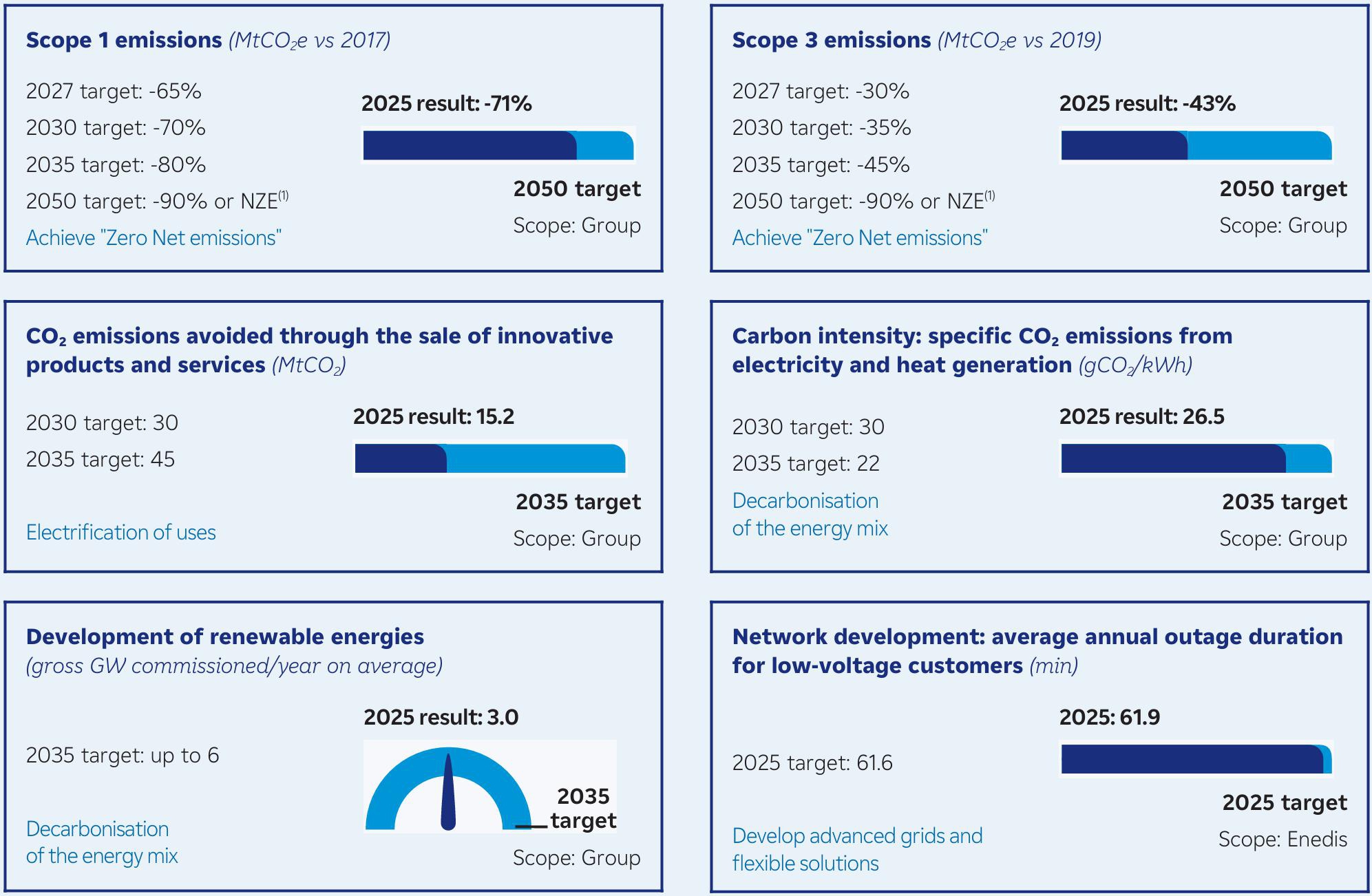
- (1) Scopes 1, 2 and 3. Residual emissions will be offset (with a view to net zero emissions (NZE)) through carbon offset projects.
Operating within planetary boundaries
PROTECTION OF NATURAL
RESOURCESESRS E1, E2, E3, E4, E5Key actions
Adaptation
- Anticipate climate risk: draw up adaptation plans based on recent climate assumptions and scenarios.
- Building resilience: adapting nuclear and renewable generation facilities (including hydropower) and distribution networks.
Nature
- Control and reduce air, water and soil pollution: notably by taking action on air pollutant emissions (conversion of thermal installations to bioliquids, phasing out coal).
- Limiting pressure on terrestrial and aquatic biodiversity: optimising land use and recycling artificialised land for the development of generation infrastructure, improving ecological continuity at hydropower sites facing these challenges.
- Contribute to the resilience of infrastructure and local areas by enhancing positive impacts on biodiversity and ecosystems through the restoration and preservation of natural spaces, drawing on scientific knowledge and structural partnerships.
Water
- Optimise the use of freshwater resources in terms of amount and quality, on sites and throughout the value chain (better quantification of usage, leak treatment, optimisation of operations, water reuse).
- Manage water and hydropower facilities transparently and responsibly, in consultation with stakeholders, to contribute to the resilience of environments and territories.
Resources
- Optimise incoming resource flows, both in terms of energy (development of renewable and recovered energy for heat generation, sustainable biomass supply) and raw materials (reduction of the environmental footprint of nuclear fuel cycle activities, circularity and eco-design in relation to supplies).
- Develop circularity in relation to operational waste (recycling of spent nuclear fuel, recycling of conventional waste, reuse) and decommissioning activities (treatment and recycling of materials).
Key performance indicators 2025 results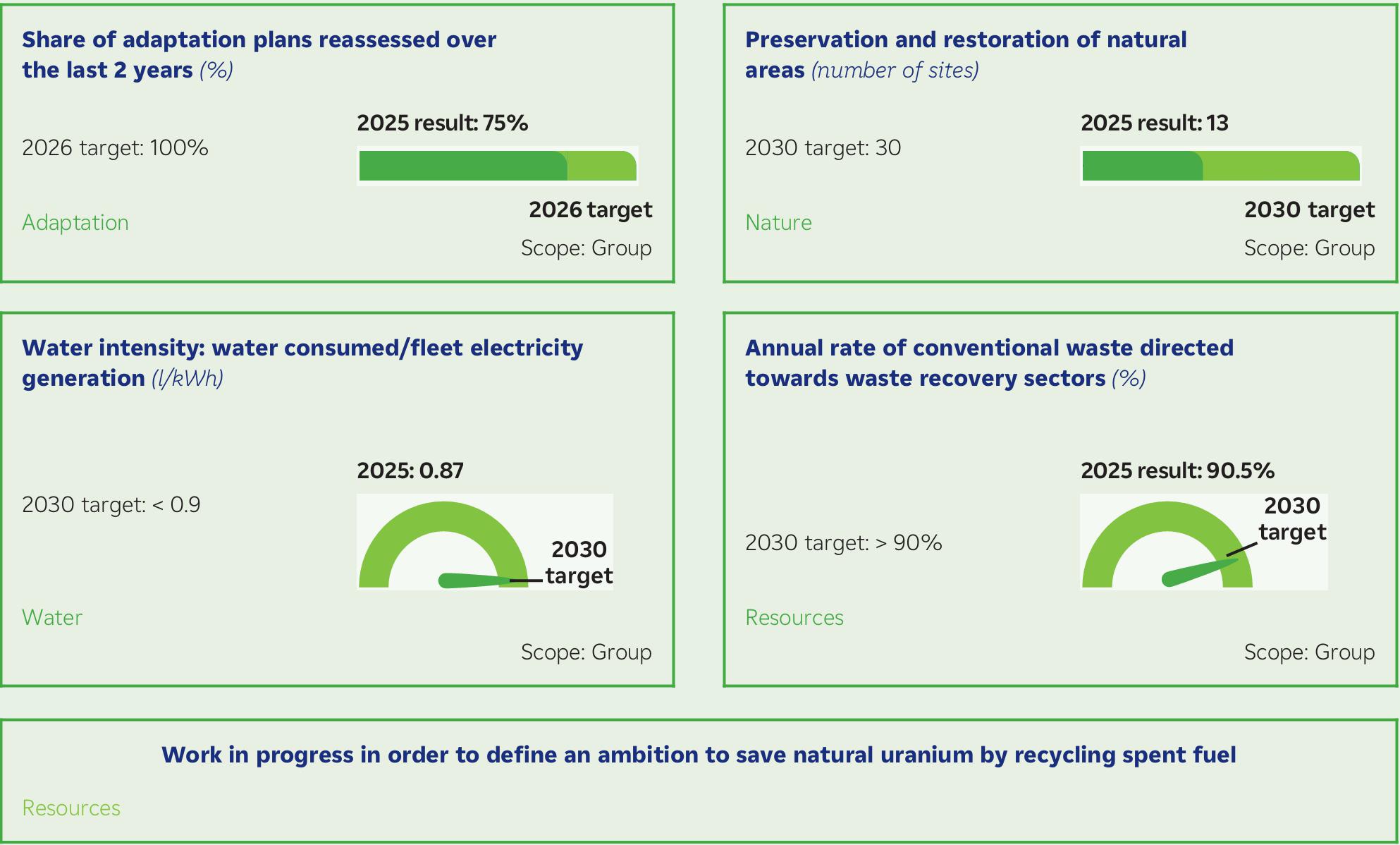
Acting for a just transition
PROTECTION OF THE ENTIRE
VALUE CHAINESRS S1, S2, S3, S4, G1Key actions
Shared vigilance
- Ensure the safety, security and health of all by combating serious and fatal accidents, reducing arduous work tasks, and strengthening crisis management capacity.
- Apply high standards of ethics and integrity by ensuring the compliance of practices, the transparency of lobbying actions, and the effectiveness of whistleblowing mechanisms.
Combat energy poverty
- Promote the social inclusion of the most vulnerable customers through measures to prevent and combat energy poverty, focusing on four key pillars: information and advice, services to help manage consumption, payment assistance and payment terms.
Vitality of local communities
- Contribute to regional development by consolidating the local anchoring of the Group’s activities and backing local projects and initiatives related to its activities. Create positive impacts in terms of local jobs, local procurement, economic and tax value creation.
- Structure dialogue and consultation with stakeholders (local authorities, employees, customers and civil society) in order to incorporate their expectations into strategic decisions and implementation of the Group’s projects, for example through support for industrial conversion (including the establishment of data centres), re-industrialisation and local tenders.
Human rights, inclusion, diversity and impact in the value chain
- Respect and promote the human rights of its employees and the workers in its value chain by fostering social dialogue both locally and at a global level via the renewal of the global CSR agreement.
- Guarantee equality, diversity and inclusion for all by pursuing a strong Diversity Goal notably including concrete gender balance objectives, as well as an agreement on equal rights and opportunities and the professional inclusion of people with disabilities.
- Developing skills by providing support for training, professional development and mobility within the Group.
- Develop employee attractiveness and retention by providing attractive, motivating working conditions, fostering the transfer of knowledge and expertise, and promoting careers in energy transition.
- Manage its impact on workers’ and communities’ rights by ensuring they are respected at every stage of projects, from pre-development to the construction phase.
- Ensure lasting relationships with suppliers by developing dialogue, integrating environmental and social levers into purchasing actions, and structuring the responsible procurement approach within the Group’s Procurement network.
Key performance indicators 2025 results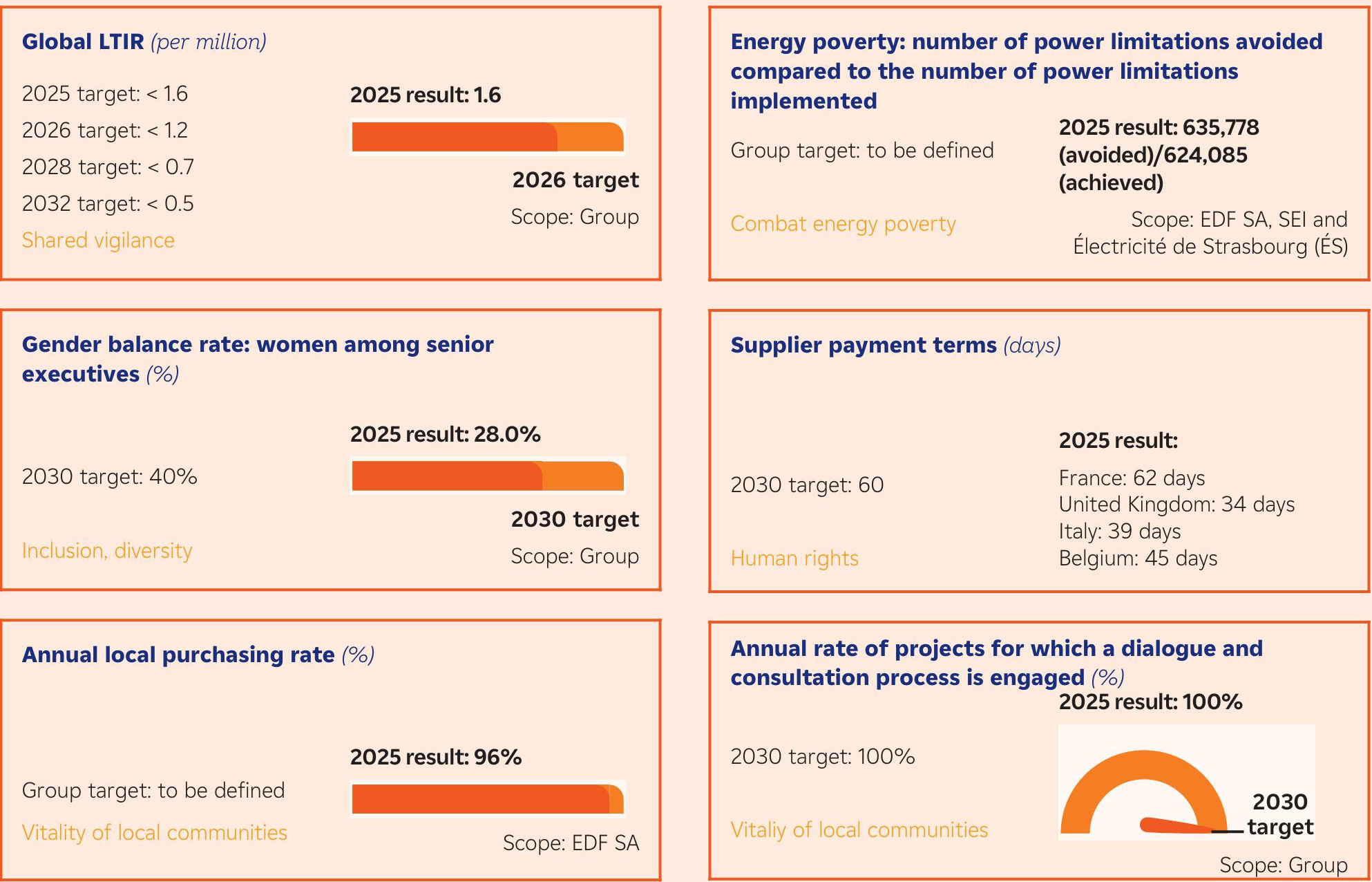
3.1 General information
3.1.1 Basis for establishing the sustainability statement
The Group has endeavoured to apply the normative requirements set by the ESRS(1), as applicable at the date of preparation of the sustainability statement. 2025 is the second year of application of the directive, on an identical scope. According to the Omnibus Directive, the application of the revised and simplified ESRS standards is foreseen for 2026, but this timetable remains subject to change.
In some cases, difficulties in accessing comprehensive data have forced the Group to use certain information on a case-by-case basis:
- partial scopes (see section 3.1.1.1 “Scope”) applied to some data. These partial scopes will be gradually extended to cover the entire Group scope;
- estimates (see sections 3.1.1.3.1 “Assessments concerning the value chain” and 3.1.1.3.2. “Sources of estimation and outcome uncertainty”) that may be refined as the quality of available data improves.
The sustainability information was prepared in accordance with the legal and regulatory requirements resulting from the transposition of the European Directive on the disclosure of information on corporate sustainability (Corporate Sustainability Reporting Directive or “CSRD”, EU No. 2022/2464 transposed in France by Order No. 2023-1142 of 6 December 2023 and Decree No. 2023-1394 of 30 December 2023). The information relating to the taxonomy was established in accordance with Regulation 2020/852 of 18 June 2020 (known as the “Taxonomy Regulation”) and Regulation (EU) 2021/2139 adopted on 4 June 2021. These regulations were supplemented in July 2021 by Regulation (EU) 2021/2178 on the content and presentation of information to be communicated, simplified in January 2026 by the publication of Commission Delegated Regulation (EU) 2026/73. In March 2022, complementary delegated acts (Regulations (EU) 2023/2485 and 2023/2486) were adopted to cover certain activities in the nuclear and gas sectors.
For environmental, social and societal indicators, the scope covered by the sustainability statement is based on the Group’s scope of financial consolidation (see section 6.1 “Consolidated financial statements at 31 December 2025”, note 3 “Scope of consolidation”). This scope includes EDF SA, as well as the controlled subsidiaries (full consolidation), in accordance with international accounting standards (IAS-IFRS). The Group concluded that its reporting scope within the meaning of the ESRS corresponds to its scope of financial consolidation plus, for the indicators prescribed by the ESRS, certain assets under operational control, notably at Dalkia. The entities acquired during the financial year are included, where applicable, in the financial scope of consolidation in the year of acquisition if their acquisition was completed at least six months before the accounting closing date.
The indicators of the sustainability statement relating to the value chain (Scope 3 greenhouse gases only) include equity-accounted investments and non-controlled interests up to the share held by the EDF group.
It should be noted that all the Group’s activities fall within the Energy sector. This sector is defined, according to Delegated Regulation (EU) 2023/2772 of 31 July 2023 and the NACE classification, as a sector with a high climate impact (electricity generation and distribution sector).
The sustainability statement covers all the Group’s activities, its consolidated subsidiaries and its geographic locations. It includes information concerning the upstream and downstream value chain that was identified as material during the identification of impacts, risks and opportunities during the double materiality analysis.
There is no intentional omission of any information related to the Group’s intellectual property, know-how or results of innovations. Moreover, the Group does not make any use of the exemption from publishing information related to imminent developments or matters under negotiation, in accordance with Articles 19 bis (3) and 29 bis (3) of Directive 2013/34/EU.
The table below lists the indicators concerned by a partial collection scope for 2025. Half of these indicators are specific indicators that the Group is working to implement. All indicators are collected from a broad scope that includes at least the main contributors to each indicator. From 2024 to 2025, the collection of indicators was expanded. The indicators “Number and rate of recordable work-related accidents” and “Preservation and restoration of natural areas” are now consolidated at Group level. The scope of the indicators “Local purchasing rate”, “Supplier CSR audits/assessments”, “Solidarity performance” and “Percentage of employees in high-risk positions trained in corruption prevention” was expanded as explained in the table below. Lastly, the indicator “Number and surface area of sensitive sites in terms of biodiversity”, which was not collected in 2024, was collected in 2025. In accordance with the revised ESRS, the Group will organise itself to collect this data across the Group as part of the process initiated in 2024, which will continue to progress in the coming years.
As the totals in the tables, presented in the sustainability statement, are based on unrounded amounts, there may be differences between these amounts and the sum of the rounded amounts of the items which they comprise.
Regulatory
or EDF-specific indicator*Collection scope in 2025 Comments
(including coverage rate in 2025)E3: Freshwater withdrawals for industrial uses* Not collected in 2025 Work carried out in 2025 to define a target. An action plan was rolled out in 2024 to enable the collection of the indicator as of 2026; see section 3.2.4.2.3.2 “Freshwater withdrawal for industrial processes” E3: Recycled/reused water Only examples are presented An action plan has been rolled out since 2024 to define the calculation methods for the indicator, and to reflect the results of the action plan (see section 3.2.4.2.5.2 “Total amount of water recycled and reused”) S1: Gender pay gap and equity ratio EDF SA France, Enedis, Framatome France, Dalkia France, EDF Energy Scope representing ≃ 80% of the workforce in 2025 (see sections 3.3.2.4.1.6 “Remuneration, a performance and attractiveness lever” and 3.3.2.7.2.2.3 “Remuneration”) G1: Percentage of employees in high-risk positions trained in corruption prevention The EDF group with the exception of Enedis and very small subsidiaries (attached to the Commerce Hub) Scope representing ≃ 75% of the workforce in 2025 Group. Training programme, mandatory for all employees, currently being finalised (see section 3.4.4.1 “Anti-corruption programme”) G1: Payment practices: payment terms and legal proceedings France including EDF SA, EDF PEI**, Edvance, G2S, Sofilo, Immobilière du Plateau, Framatome, Enedis, EDF power solutions, Électricité de Strasbourg (ÉS) and Dalkia, United Kingdom including EDF Energy, Dalkia, EDF power solutions, Belgium (Luminus) and Italy (Edison) Scope representing ≃ 90% of Group purchases and at least 80% of trade payables (see section 3.4.3.2 “Payment practices”) S2: Supplier CSR audit/ assessments* EDF SA, Enedis, Dalkia in France (excluding subsidiaries), Edison, Framatome, EDF power solutions, Luminus, Arabelle Solutions Group Procurement network in operation for 1 year and scope representing ≃ 60% of Group purchases (see section 3.3.3.5 “Indicators for workers in the value chain”) S3: Local purchasing rate* EDF SA, Enedis, Dalkia in France (excluding subsidiaries), Edison, Framatome, EDF power solutions, Luminus, Arabelle Solutions Group Procurement network in operation for 1 year and scope representing ≃ 60% of Group purchases (see section 3.3.4.5 “Targets and indicators for affected communities”) S4: Solidarity performance indicator* Scope: France Scope representing ≃ 80% of the Group’s electricity customers (see section 3.3.5.2.5 “Targets and indicators related to the fight against energy poverty”) The time horizons used by the Group are those defined in the ESRS 1 standard. The short-term time horizon corresponds to the reference period of the financial statements, the medium-term horizon extends from the end of the short-term reference period up to five years, and the long-term horizon corresponds to the impacts, targets or expected actions over a period longer than five years. Moreover, targets are often set for 2035 in line with the Group’s strategic project.
For the specific case of climate risk analysis, the EDF group uses scenarios with a horizon of up to 2100 (see section 3.2.2.3 “Business model resilience to climate change: use of climate scenarios”).
The assessment of the impacts and risks of the stakeholders of the EDF group’s value chain, for all subjects, and on the Group’s upstream and downstream activities, was carried out based on internal expertise. This analysis focused mainly on the Group’s tier-one suppliers and customers. This assessment will be completed in the coming years on the basis of the sustainability reports that will be produced by the players in the Group’s value chains.
Regarding the data from the value chain, for this second year, the assessments only concern the greenhouse gas (GHG) footprint (Scope 3). These estimates are inherent to the methodologies for estimating Scope 3 emissions, which are often based on standard emission factors, to the lack of consensus on certain accounting practices, and to regular regulatory changes. Furthermore, a certain degree of uncertainty may be attached to activity data, and emission factors, which convert activity data into CO2 emissions, are themselves subject to variations depending on the sources and contexts of application. In this context, the Group has made its best efforts to comply with the best market practices and methodologies. For other data that may be relevant to collect in the future depending on materiality, this will be based mainly on data disclosed in the sustainability reports of the Group’s suppliers and customers.
The sustainability-related information may be subject to inherent uncertainty due to incomplete scientific or economic knowledge and to the quality of the internal and external data used (e.g. data calculated for the value chain). In addition, certain information such as forward-looking data, missing data (in particular relating to the last days of the year), and the quantification of certain information in terms of sustainability, in particular environmental, are subject to estimates and judgements based on the Group’s experience and internationally recognised sustainability benchmarks as well as on the best available information to date. For example, for certain environmental data on certain specific industrial facilities, direct measurements are not possible and have required the development of calculation models based on a certain number of measured data.
These estimates are sensitive to methodological choices and to the assumptions used. The nature and scope of the estimates used or the limitations on the scope of collection made on a case-by-case basis on certain data are explained in each relevant section of this report, entitled “Details on the indicators”, with regards to the 2025 data communicated. This is the case, for example, for indicators relating to water withdrawal and consumption (see section 3.2.4.2.5 “Indicators related to water withdrawal and consumption”).
The sustainability statement, which introduces metrics aligned with European sustainability standards, did not change significantly in 2025, pending the revised standards in line with the Omnibus Directive.
In the event that changes in methodology or corrections of material errors have resulted in restatements of information from the previous year, the nature of the adjustments made and their impact on the amended information are specified in relation to the indicators concerned in the different sections of the sustainability statement (this is the case in sections 3.2.2 “ESRS E1 – Climate change”, and 3.2.6 “ESRS E5 - Resource use and circular economy”).
Two new targets were added to the sustainability statement: one on the withdrawal of freshwater for industrial use and another on anti-corruption training for exposed persons. The target on the restoration of natural sites was extended both in terms of period and scope.
For more information, see section 3.5.1.2. “Table of all data points arising from other EU legislation”.
For the sake of consistency and to avoid any duplication of information, this report is based on specific references to relevant sections of the Universal Registration Document (URD). This approach makes it possible to centralise information while facilitating its accessibility for stakeholders. The use of these references also meets the requirements of the CSRD in terms of transparency, connectivity and traceability of information.
-
3.2 Environmental information
3.2.1 Environmental management system
The environment is at the heart of the EDF group’s commitments. An environmental management system (EMS) is in place to ensure that the Group’s various activities have the lowest possible environmental impact. The Group obtained its very first ISO 14001 certification in 2002.
The EMS, backed by EDF’s governance bodies, ensures the implementation of the environmental commitments in the Group’s CSR policy (see sections 3.1.2 “Governance” and 3.1.3.6 “Corporate Social Responsibility”, and chapter 4 “Corporate governance”).
In line with the CSR policy’s requirements, each Group entity has established its own environmental management approach, tailored to its specific challenges. While respecting the management independence of network operators, each entity defines its own organisational structure, roles, and responsibilities to fulfil its environmental commitments and effectively manage associated risks. To this end, adequate human and financial resources are allocated.
The EMS operates through Group, entity and function processes, to give stakeholders formal assurance that:
- environmental risks are under control and the EDF group complies with regulations and its commitments: each entity draws up and implements an environmental programme or action plan that takes account of the relevant Group commitments, its own significant environmental aspects and its regulatory obligations, and does so by considering its risks and opportunities;
- the efficiency of its organisations is improving in line with the challenges: each entity being responsible for them;
- its internal control, as well as internal and external audits of its EMS, interfaces with the Group’s EMS;
- mandatory sustainability reporting is performed concerning the environmental activities of the entities: each entity collects and communicates the required environmental information to the Impact Department.
The Impact Department is responsible for the overall coordination of the Group’s EMS as well as for managing interfaces between EDF and its subsidiaries. This includes the operational coordination of environmental management, which is carried out with the active involvement of all entities whose activities have a significant environmental impact at the Group level.
In accordance with the international standard ISO 14001 (2015 version), the Group’s EMS is certified by an external body, the AFNOR. All industrial sites are covered by an EMS, and more than 80% of them are certified.
The latest certification audit campaign, conducted by AFNOR over the period from the beginning of April 2024 to the end of May 2025, confirms that the certified EMS of entities and subsidiaries implemented are effective, relevant and mature, and make it possible to improve performance in all areas of the environment. The environmental commitments integrated into the CSR policy (see section 3.1 “General information”) are broken down into structuring, relevant and ambitious policies (water, carbon, circular economy, biodiversity). The environment is considered to be highly integrated, notably in the support functions and in the regions. The drive for improvement is strong and far-reaching. These audits identified three new cases of non-compliances, those from the previous campaign having been resolved. Progress is mainly expected in the monitoring of indicators in action plans or the use of internal audit reports.
-
3.3 Social information
3.3.1 The Group’s social commitments
Personal well-being and solidarity development are key issues of the Group’s raison d’être. This concerns both its employees and its stakeholders. The four main CSR commitments identified in this respect are the safety and health of all individuals, ethics and human rights, the promotion of equality, diversity and inclusion, and the fight for the prevention of energy poverty and for social innovation.
In 2021, the EDF group published a set of guidelines(1) listing the Group’s commitments and the fundamental requirements for its business relationships in terms of human rights and fundamental freedoms, environmental protection, protection of personal safety and health and business ethics. These EDF group human rights commitments were approved and signed by the Chairman and Chief Executive Officer.
The commitments apply to the activities of EDF SA and all the companies it controls, for all Group employees, with the exception of RTE and Enedis.
The notion of “business relationship” includes suppliers and subcontractors with whom an established commercial relationship is maintained, as well as project partners.
In compliance with contractual obligations, failure to meet these requirements, when repeated and not corrected after observations are made, may result in the termination of relations.
The EDF group does not tolerate any infringement of human rights and fundamental freedoms, either in its activities or in those of its business relationships when their activities are related to this relationship(2).
In accordance with the United Nations Guiding Principles on business and human rights (UNGPs), the EDF group undertakes to respect, at the very least, international standards for the protection and defence of human rights and fundamental freedoms, and in particular the Universal Declaration of Human Rights, the International Covenant on Civil and Political Rights, the International Covenant on Economic, Social and Cultural Rights, and the fundamental conventions of the International Labour Organization (ILO). Since January 2025, the Group has been a member of the TISFD (Taskforce on Inequality and Social-related Financial Disclosures) alliance, whose objective is to foster the emergence of economic practices that promote fairer societies. This alliance brings together around a hundred organisations from various sectors.
If the laws of a country where it operates conflict with these international standards, the EDF group endeavours to find a solution to render it compliant with both the spirit of the international standards and national laws.
To ensure that human rights and fundamental freedoms are respected in its operations, the EDF group has implemented a vigilance approach to identify, assess and prevent any potential infringement of human rights or fundamental freedoms. This vigilance approach has been designed to comply with the French Duty of Vigilance Law and is based on the recommendations of the UN Guiding Principles on business and human rights.
The EDF group pays special attention to the impact of its operations on individuals recognised as vulnerable(3) under international human rights law and investigates, in complete transparency, impartiality and good faith, any alleged infringements of human rights or fundamental freedoms connected to the operations of the Group’s entities, providers and subcontractors.
If an infringement of human rights or fundamental freedoms is proven in the operations of the Group’s entities, the EDF group has agreed to engage in dialogue with the victims and/or their representatives to address the situation, pursuant to the OECD Principles for Multinational Enterprises with which the EDF group complies.
Eight thematic fact sheets break down and contextualise each human rights commitment published in the document “Human rights and fundamental freedoms, safety and health, environment, and business ethics: the EDF group’s commitments and requirements”. These sheets, available in five languages (French, English, Spanish, Italian and simplified Chinese), explain the Group’s commitments, international reference frameworks, definitions relating to these commitments, the main risk factors, the main risk control actions and the available tools, where applicable. They are available on the Group’s intranet and cover the following topics:
- fair and favourable working conditions;
- security forces;
- the fight against harassment and violence at work;
- non-discrimination;
- freedom of association;
- Indigenous populations;
- child labour;
- forced labour.
The Group’s CSR policy also covers the Group’s commitments in terms of the rights of employees and workers in the value chain. These commitments are reflected notably through the items described below.
For further details on the CSR policy, see section 3.1.3.6 “Corporate social responsibility policy” and for governance, in section 3.1.2 “Governance”.
The EDF group is committed to respecting the internationally recognised human rights below, which represent the salient issues identified in risk mapping in view of its activities, and asks its business relationships to respect them.
The EDF group is committed to respecting human rights and fundamental freedoms by complying, at a minimum, with the provisions of the International Labour Organization (ILO) standards (see section 3.3.1.1.1 “Compliance with international standards”).
- (1) www.edf.fr/sites/groupe/files/2023-02/edfgroup_rse_referentiel-ddv-2021_en.pdf
- (2) www.edf.fr/en/the-edf-group/taking-action-as-a-responsible-company/corporate-social-responsibility/well-being-and-solidarity/human-rights
- (3) Vulnerable individuals, groups and communities are those who face a particular risk of being exposed to discrimination and violations of their human rights. People who are disadvantaged, marginalised or excluded from society are often particularly vulnerable. International law grants them special protection, through specific treaties.
In terms of the prevention of discrimination, the EDF group guarantees equal treatment for its employees and is against any form of distinction, exclusion or preference, whether based on presumed race, skin colour, gender, age, religion, political beliefs, national origin, social origin, disability, family status, sexual orientation or gender identity. In the countries where it operates and for its own operations, the EDF group actively promotes equality in the workplace and equal treatment for equal work for the women and men working for the Group and strives to achieve balanced work teams at all levels of the Company. Diversity is encouraged at all staffing levels and employees must be protected from all forms of discrimination or retaliation.
The EDF group does not tolerate any form of harassment or violence, whether within or outside the workplace, relating to the working relationships established in the workplace. The Group is committed to preventing and protecting its employees and interns from all forms of harassment, sexism and violence in the workplace.
The EDF group is against all types of forced labour, as defined in the ILO fundamental conventions as well as any form of human trafficking. In particular, for the projects and operations implemented by the Group, it ensures that all employees have given their free, informed consent for the performance of all their duties. In particular, the EDF group ensures that its intermediaries and recruitment agencies do not use any practices that could result in forced labour. The Group is committed to protecting the free movement of workers and, notably, will not confiscate the travel documents, identity papers or any other personal belongings of workers in any circumstances whatsoever.
The EDF group is against all types of child labour, as defined in the ILO fundamental conventions. The Group commits to not employ anyone under the age of 15 (subject to the exceptions set out in ILO Convention 138) or anyone under the age of 18 for work considered dangerous as provided for in the ILO convention.
The EDF group upholds an individual’s right to freedom of association and the right to collective bargaining as defined by the ILO. The Group recognises that all employees are free to form and/or join the workers’ organisation of their choice and will not interfere with that right.
In accordance with the EDF group’s Global Agreement on Social and Environmental Responsibility, the EDF group undertakes to respect and protect the autonomy and independence of trade unions, in compliance with the laws and regulations in force. It aims to guarantee the effective exercise of trade union rights and recognises the representative trade union organisations in the Company as contact people and partners. The EDF group respects strict neutrality as to whether or not its employees choose to belong to a trade union, and if so, which trade union they wish to be represented by. Employees are not discriminated against because of their union membership and/or activities. Notably, the EDF group sets aside a number of hours dedicated to the performance of trade union functions and mandates, as well as a supervised career path for employees holding representative and/or trade union positions. The EDF group prohibits any harassment, intimidation, sanction or discrimination against an employee because of their trade union activities, and does not discourage employees from joining organisations of their choice. The Group respects the right to collective bargaining and the role of workers’ organisations in the collective bargaining process.
The EDF group complies with ILO standards as well as all applicable laws and regulations on working hours in all countries where it operates.
The EDF group strives to comply with the ILO standards on pay, working conditions and employee benefits. The Group is committed to paying a decent wage, covering the basic needs of its employees and their families, and to providing adequate social security cover for all its employees. When employee accommodation is provided by the Company, the EDF group ensures that decent housing or accommodation is provided in compliance with the ILO standards.
To tackle the industrial and commercial challenges it faces, the Group must remain a socially responsible and committed employer and customer and a benchmark in terms of safety and health.
The EDF group makes safety and health for all its No. 1 priority, whether for our employees, interns, subcontractors or in terms of environmental health, of the development of air quality, of the reduction of noise, visual or light pollution, of commercial offerings related to comfort, and of well-being. The Group’s entities comply with the highest standards defined in the nuclear safety policy, the hydropower safety standards and the Group’s Prevention and Health & Safety Policy. Lastly, each new project is analysed from the point of view of the safety and health of the people involved, and with regard to its impact on the environment and the health of local residents(1).
The Group’s Prevention and Health & Safety Policy was updated in November 2025 and is based on a commitment jointly signed by the Chairman and Chief Executive Officer and all the members of the Executive Committee. This Group policy applies to all the companies controlled by the EDF group, in all the countries in which EDF operates, and to everyone. It concerns its employees, its interns and its subcontractors.
The policy’s priorities are, first and foremost, to eradicate fatal and serious accidents, reduce the overall number of accidents and combat absenteeism, and improve the physical and psychological health of employees at work. The policy aims to anchor throughout the Group the foundation formed by the Group’s life-saving rules and the BEST safety and health management reference framework.
EDF’s Executive Committee reviews safety and health figures and monitors action plans regularly. A Group Strategic Safety and Health Committee oversees the implementation of the policy.
EDF is committed to improving the physical and psychological health of its employees and subcontractors, placing the absolute priority on protecting them and eradicating fatal and serious accidents.
In line with the steps taken at the Group to eradicate serious and fatal accidents, our policy aims to develop a collective safety requirement supported by both Group and subcontractor employees. It reinforces the progress made in collaboration with our service providers by promoting joint actions in the field, such as joint visits and the signing of charters.
The EDF group is committed to protecting the rights of the local communities affected by its operations and arranging, systematically and worldwide, transparent, debated discussions and consultations for each new project relating to a facility drawing on a budget of more than €60 million and having a significant impact on the territories or the environment.
- (1) See in notably the BEST requirements guide for the EDF group for Safety and Health Management, and its self-assessment tool.
The Group recognises the role of human rights and environmental defenders from all walks of life, both among its suppliers and in civil society. It is committed to protecting the exercise of their rights and ensures that it identifies the risks to human rights and environmental activists caused by its business operations and allows them to speak freely about its operations.
The EDF group identifies, for each project, the potential impact on the health, living conditions and environment of local communities, with reference to the performance standards of the International Finance Corporation (World Bank Group) and proposes suitable measures.
The EDF group is committed to respecting the specific characteristics and rights of indigenous peoples as defined in the UN Declaration on the Rights of Indigenous Peoples (UNDRIP) and ILO Convention 169, which provides, in particular, that “indigenous peoples shall not be forcibly removed from their lands or territories. No relocation shall take place without the free, prior and informed consent of the indigenous peoples concerned and after agreement on just and fair compensation”.
The EDF group is aware of the unique issues facing indigenous peoples and is committed to following the best international standards in this area and, more specifically, the UNDRIP (United Nations Declaration on the Rights of Indigenous Peoples), ILO Convention 169 and World Bank standards. In particular, the EDF group recognises the criteria for characterising indigenous peoples included in these standards, including historical and geographic “pre-existence”, “cultural distinctiveness”, “self-identification”, and “non-dominance”. The EDF group upholds the individual and collective rights of indigenous peoples and communities, including their right to self-determination, their right to land, territories and resources, and their right to FPIC (Free Prior and Informed Consent) in its projects and activities, as defined by ILO Convention 169.
Whenever its operations threaten or affect the livelihood of a community, the Group implements compensation and/or restoration measures for their livelihood matching or exceeding the level prior to its operations.
The EDF group is committed to respecting and protecting or safeguarding, in agreement with the populations concerned, any expressions of their culture, religion or heritage present on the land used for its operations.
In terms of the use of security forces, the Group is committed to protecting the safety of its employees and sites in strict compliance with human rights, including those of local communities, and only authorises the use of force for preventive or defensive purposes in a manner proportionate to the nature and severity of the threat.
EDF’s vigilance plan follows the United Nations Guiding Principles on business and human rights (UNGP), the Organization for Economic Cooperation and Development (OECD) Guidelines, the fundamental conventions of the International Labour Organization (ILO) and the UN Universal Declaration of Human Rights.
This vigilance plan and other specific human rights documents were taken into account to identify material impacts, risks and opportunities in relation to consumers and end-users. For more information on these IROs as well as actions to remedy the impacts on human rights (see section 3.3.5 “ESRS S4 - Consumers and end-users”).
Since 2022, a person specialising in business and human rights has been a member of the EDF group’s Stakeholder Council in order to better integrate this expertise within said body (see section 3.1.3.2 “Interests and points of view of stakeholders”).
The Group’s ethics, compliance and duty of vigilance whistleblowing procedure applies to all EDF group entities.
In order to make report-handling more secure and to strengthen the confidentiality and security of personal data, in 2018, the Executive Committee decided to set up a single whistleblowing system for all wrongdoing reported under the Sapin II Law and the Duty of Vigilance Law, as well as wrongdoing reported by employees and external employees, and third-party direct witnesses, alleging harassment and discrimination. This Group system benefits all Group entities, except for the subsidiaries in the regulated sector, Enedis and RTE, which have their own whistleblowing system to uphold their managerial independence.
Whistleblowers may choose to use the Group whistleblowing system or the other channels available to them (manager, human resources, employee representatives, local ethics and compliance officers, mediators, etc.).
The referee body for the EDF group procedure for collecting and processing reports of wrongdoing, appointed by the Executive Committee, is the Group Ethics and Compliance Department (DECG)(1).
- the EDF website(2), which is therefore accessible to everyone (external employees, suppliers and subcontractors and third parties (customers, residents, etc.). The website notably reminds users that the Group’s whistleblowing procedure guarantees protection against any retaliation or discriminatory measures for any whistleblower who meets the conditions set out in the legislation in force. These points are also included in the “Whistleblower Support Guide” and in the EDF Code of Conduct.
- the intranet, with a video on the Group whistleblowing system, the Whistleblowing Support Guide, and the link to the Group platform;
- sites where a sign is also displayed (“How to alert?”) which specifies which employees can report, the facts that may be reported, the respect for confidentiality and the protection of the whistleblower, as well as the procedures for triggering the whistleblowing system (two QR codes provide direct access to the support guide and the outsourced platform).
In addition, each entity’s Ethics and Compliance Manager (EDF Departments and subsidiaries) is in charge of communicating the whistleblowing procedure to employees (relaying information through their own community or during awareness-raising campaigns, notably during the “Ethics & Compliance All Actors” week). With regard to suppliers and subcontractors, the whistleblowing system is included in the CSR Charter between EDF and its suppliers, which is a component of the contract.
The Group whistleblowing system, managed from an independent server that is not connected to EDF’s IS, can be accessed at any time via the EDF group website. The interface is available in several languages (French, English, Italian, Spanish, German, Portuguese, Dutch and Mandarin) in France and abroad, and the whistleblower can report wrongdoing in the language of their choosing.
- (1) Decree of 4 October 2022: the body is tasked with gathering the wrongdoing report and with processing it in compliance with the procedure. This referee is appointed by the Company.
- (2) www.edf.fr/en/the-edf-group/taking-action-as-a-responsible-company/ethics-and-compliance-programme/whistleblowing-system
Locally, it is possible to carry out an alert in writing to the Ethics and Compliance Manager or line manager, human resources and any other authorised functions in the entity’s local implementation note. For certain large international projects, a local whistleblowing system is set up.
- a violation or an attempt to conceal a violation of the law or a regulation falling under the EDF group’s scope of responsibility;
- a violation or an attempt to conceal a violation of an international commitment ratified by France, of a European Union law, or of the Code of Conduct, falling under the EDF group’s scope of responsibility;
- a threat or damage to the general interest falling under the EDF group’s scope of responsibility;
- a risk or serious infringement of human rights and fundamental freedoms, the safety and health of individuals or the environment, falling under the EDF group’s scope of responsibility and its business relations.
Once the report has been submitted, whistleblowers receive confirmation within seven days from the delivery of such report. Whistleblowers can submit reports anonymously in countries where this is authorised. These anonymous reports are admissible as long as the factual elements are sufficiently detailed and precise to demonstrate the reality of the facts reported.
Each whistleblowing report is examined for admissibility by the DECG whistleblowing committee in order to determine, before investigating the actions reported, whether it meets the criteria defined in section 3.3.1.2.3 “Reporting wrongdoing”, and whether the appropriate protective measures can be identified.
During the admissibility phase, the recipient of the alert can discuss with the whistleblower and rely on experts (Group Ethics and Compliance Department, Legal Department, Ethics and Compliance Officers, Duty of Vigilance Managers) to obtain the additional information necessary for the finalisation of the admissibility analysis.
Upon confirmation of the whistleblowing report’s admissibility, the investigating officer appointed signs a specific confidentiality undertaking and has a maximum of three months within which to communicate to the whistleblower the information on the measures envisaged or taken in order to remedy the wrongdoing reported, and on the reasons for those measures.
The investigation of reported facts (verification of the facts, interviews of the persons concerned, search for evidence, etc.) is carried out with the support of business experts, the ethics and compliance officers of the entities or subsidiaries, the support departments (the Ethics and Compliance Department (DECG) the Human Resources Department, the Security and Economic Intelligence Department (DSIE), the Legal Department, the Audit Department, etc.) or, when necessary, external consultants. These experts are bound by the same strict confidentiality obligations (with the prior signature of a confidentiality undertaking).
Upon completion of the investigation into the matter, if the facts reported are found to be true, an action plan is implemented. The whistleblowing report will be closed only upon complete fulfilment of that action plan.
3.3.1.2.6 Protection of whistle-blowers: mechanisms in place to identify, report and investigate non-compliance/unlawful behaviour
The EDF group’s whistleblowing procedure was revised in 2023 to take account of the Waserman Law of 21 March 2022, transposing into French law the European directive on the protection of whistleblowers, and its implementing decree of 4 October 2022. After being validated by the competent authorities, the revised whistleblowing procedure will come into force on 1 June 2023.
This whistleblowing procedure ensures protection against any retaliatory measures or discriminatory measures for any author of an alert. The Group Ethics and Compliance Department is responsible for steering and monitoring the implementation of this procedure, and also keeps archived data to ensure the protection of the whistleblower (see section 3.3.1.2 “The EDF group’s whistleblowing system”).
Whistleblowing results are consolidated and included in the annual ethics and compliance report submitted to the Executive Committee and presented to the EDF Board of Directors’ Corporate Responsibility Committee. The DECG consolidated all admissible alerts made in 2025 at the EDF group, and Enedis (via the Group system or any other channel).
In 2025, 735 admissible alerts were recorded (including 160 in the Group whistleblowing system). More alerts were received from subsidiaries compared to 2024, demonstrating an increased awareness of the system throughout the Group. 468 alerts related to incidents located in France and 267 internationally. 180 related to EDF and 555 to the Group’s subsidiaries. Among them, 46% of the cases reported relate to harassment/discrimination. In 2025, 65% of the alerts processed were sufficiently detailed to give rise to corrective actions or disciplinary sanctions (20 dismissals pronounced for proven harassment). 20% of alerts for which the facts were not proven nevertheless gave rise to actions to improve processes.
- alerts admissible in the Group system: 58% in 2025;
- 2025 results of investigations following alerts: 42% of investigations were non-proven, 40% proven and 18% partially proven;
- safety and health alerts were included in the “Human rights” category;
- the whistleblower’s relationship with the Group (all channels combined): 81% employees, 9% third-parties, 9% external employees, 1% occasional employees.
Measures taken following alerts (all channels combined): 59% corrective, 15% disciplinary and corrective, 23% disciplinary, 3 legal cases, 2 legal and corrective cases, and 3 legal, corrective and disciplinary cases.
As explained in section 3.3.1.2.7 “2025 results”, alerts for acts of harassment/discrimination are monitored in a separate category by the alert system. Certain acts of harassment/discrimination, whether or not reported by the whistleblowing system, may result in fines, penalties and compensation for damages.
These incidents of harassment/discrimination had financial consequences for EDF. More specifically, the amount of compensation paid by EDF in 2025, pursuant to a final court ruling, for the aforementioned offences amounted to €235,500 for discrimination, including harassment. Convictions for discrimination and psychological harassment relate to age discrimination in the context of compulsory retirement imposed pursuant to Article 4 of the SNIEG on “long-term sick” employees who have become unfit for any work, and to a dispute over career progression linked to discrimination on the grounds of gender or disability. In addition, two convictions refer to trade union discrimination.
Fines, sanctions and/or compensation actually paid by a Group entity are taken into account. Provisions and convictions for which an appeal with suspensive effect is pending are therefore excluded.
It collects the number of serious human rights incidents and complaints affecting the Group’s workforce during the reporting period, as well as the total amount of fines, sanctions and compensation for damages resulting from these incidents/complaints.
According to the OECD Guidelines for Multinational Enterprises on Responsible Business Conduct, the following are included as violations of human rights in the context of labour law:
- discrimination in the workplace based on gender, race or ethnic origin, nationality, religion or belief, disability, age, sexual orientation, or other relevant forms of discrimination;
- harassment as a specific form of discrimination;
- forced or compulsory labour;
- human trafficking;
- child labour exploitation;
- failure to maintain a safe and healthy working environment;
- failure to respect the right of workers to form or join trade unions and representative organisations of their own choosing.
Only the violations listed above should be taken into account. This excludes violations related to local regulations that are more restrictive than international law. The 2012 UN Interpretative Guide to Guiding Principle 14 states that “the severity of the impacts will be based on their magnitude, extent and whether or not they are irremediable.” This means that both the severity of the impact (its magnitude) and the number of individuals who are or will be affected (its extent) are taken into account. The “irremediable” aspect is the third important factor, used here to signify any limit on the ability to restore those concerned to a situation at least identical, or similar, to their situation before the negative impact.
As regards the enforceable ILO conventions, as well as the Group’s requirements and commitments in relation to possible impacts, EDF has established a set of guidelines entitled “Human rights and fundamental freedoms, safety and health, environment, and business ethics”, which is available on the EDF website(1).
No serious human rights incidents were recorded in 2025. Fines, sanctions and/or compensation actually paid by a Group entity are taken into account. Provisions and convictions for which an appeal with suspensive effect is pending are therefore excluded. Referrals from OECD National Contact Points (NCPs) are also taken into account.
-
3.4 Information on business conduct
3.4.1 Description of the processes to identify and assess material impacts, risks and opportunities
- systems put in place to ensure ethical business practices;
- relations with suppliers: the quality of the relationship between EDF and its suppliers is at the heart of the success of the Group’s activities;
- crisis management and safety: if an exceptional incident happens, the crisis management measures can be costly, and may be above the costs of repairing the induced damages and the earnings losses due to the disruption in the Group’s supply of goods and services;
- lobbying: the assessment of the EDF group’s lobbying involves an annual review process that may trigger follow-up actions.
During the double materiality analysis carried out in 2023/2024, and after a review in 2025 that did not lead to any changes, the following IROs were identified as material:
Sustainability issues Material impact
(Risk correspondence, section 2.2)/Value chain
Description Time horizon Management of
relationships with
suppliers(see section 3.4.3)


Responsible procurement
The company can help accelerate its suppliers’ consideration of CSR issues, thereby contributing to the evolution of practices across its ecosystem. Medium and long term  (1E)
(1E)Deterioration of the financial health of suppliers
Any failure by the Group to comply with payment deadlines may deteriorate the financial health of certain suppliers. Short and medium term Effectiveness and
integrity of
whistleblowing
systems(see section 3.4.2.5)
(3D)
Infringements of the rights of whistleblowers
The lack of effectiveness or integrity in whistleblowing systems, leading to the identification of whistleblowers, may infringe on the rights of the individuals concerned. Short term Sustainability issues Material risk or
opportunity(Risk correspondence, section 2.2)/Value chain
Description Governance
(see section 3.4.1.6.2)

Public policy opportunities
Public policies aligned with the Group’s strategic orientations and priorities can create market opportunities and make it easier to secure financing sources for the Group.  (3A)
(3A)Public policy risks
Public policies may impose strategic orientations that are not aligned with sustainable investment and divestment decisions consistent with the evolution of the Group’s business model, thereby creating governance and financial risks for the Group. Management of
relationships with
suppliers(see section 3.4.3)
Quality of supplier
relationshipsA long-term, high-quality relationship with suppliers can generate pooled gains on purchasing conditions, for example through framework contracts. (1E)
Dependence on certain
suppliersIncidents in the supplier relationship, or the Group’s excessive dependence on certain suppliers, may affect the continuity of operations. Ethics, compliance
and transparency of
lobbying(see sections 3.4.2 and 3.4.6)
(3D)Business ethics and
transparency of lobbying
practicesLack of transparency in stakeholder engagement practices, or violations of ethics (corruption and anti-competitive practices) and of the Code of Conduct by Group employees or employees in the upstream value chain, may lead to legal (investigations, regulatory non-compliance, litigation), financial (fines) and reputational risks. Safety and crisis
management(1)(see section 3.4.5)
(1B, 1C)Operations and cybersecurity
incidentsThe Group could risk the loss of its operating licence, as well as many other financial consequences, in the event of a serious operating incident or cyberattack. The continuity of nuclear activities could also be called into question if a serious incident were to occur in the context of another nuclear operator’s activities. Public policies, supplier relationships, and ethical issues can have consequences for the Group. Group strategies that are not aligned with public policies can create risks, whereas aligned policies can, conversely, create new opportunities. Whistleblowers, supplier relations, and compliance with the Code of Conduct are also important issues and can have financial and reputational consequences if poorly managed. A cyberattack could also have major financial and operational consequences. On the other hand, a good-quality relationship with loyal suppliers can lead to operational gains, and the company can contribute to improving CSR issues within its ecosystem.
The identification of risks, opportunities and dependencies related to the conduct of business was carried out based on internal and external sources, such as the Group’s risk mapping and SASB sector reports. The Group also identified its business dependencies by conducting a dependency analysis of its value chains.
-
3.5 Appendices and Certification report on sustainability information
3.5.1 Appendices
Disclosure
requirement
metTitle Section Not
applicableESRS 2 General information BP-1 General basis for preparation of the sustainability statement Section 3.1.1 “Basis for establishing the sustainability statement” BP-2 Disclosures in relation to specific circumstances Section 3.1.1 “Basis for establishing the sustainability statement” GOV-1 The role of the governance, management and supervisory bodies Section 3.1.2.1 “The role of the governance, management and supervisory bodies” GOV-2 Information provided to and sustainability issues addressed by EDF’s governance, management and supervisory bodies Section 3.1.2.1 “The role of the governance, management and supervisory bodies” GOV-3 Integration of sustainability-related performance in incentive schemes Section 3.1.2.3 “Integration of sustainability results into remuneration systems” GOV-4 Statement on due diligence Section 3.5.1.5 “Statement on due diligence” GOV-5 Risk management and internal controls over sustainability reporting Section 3.1.2.4 “Risk management and internal controls over sustainability-related information” SBM-1 Strategy, business model and value chain Section 3.1.3.1 “Strategy, business model and value chain” SBM-2 Interests and views of stakeholders Section 3.1.3.2 “Interests and points of view of stakeholders” SBM-3 Material impacts, risks and opportunities and their interaction with strategy and business model Section 3.1.3.3.2 “Material impacts, risks and opportunities identified” and section 3.1.3.4 “The EDF group’s strategy and business model in response to material issues” IRO-1 Description of the processes to identify and assess material impacts, risks and opportunities Section 3.1.3.3.1 “Description of material sustainability issues” IRO-2 Disclosure requirements in ESRS covered by EDF’s sustainability statement Section 3.5.1.1 “List of disclosure requirements met” ESRS E1 Climate change E1.GOV-3 Integration of sustainability-related performance in incentive schemes Section 3.1.2.3 “Integration of sustainability results into remuneration systems” E1-1 Transition plan for climate change mitigation Section 3.2.2.1 “Climate change mitigation” and section 3.2.2.3 “Business model resilience to climate change: use of climate scenarios” E1.SBM-3 Material impacts, risks and opportunities and their interaction with strategy and business model Section 3.2.2 “ESRS E1 – Climate change” and section 3.1.3.4 “The EDF group’s strategy and business model in response to material issues” E1.IRO-1 Description of the processes to identify and assess material climate-related impacts, risks and opportunities Section 3.2.2 “ESRS E1 - Climate change” E1-2 Policies related to climate change mitigation and adaptation Section 3.2.2.1.1 “Policies related to climate change mitigation” and section 3.2.2.2.1 “Climate change adaptation policy” E1-3 Actions and resources in relation to climate change policies Section 3.2.2.1.2 “Actions and resources in relation to climate change policies” E1-4 Targets related to climate change mitigation and adaptation Section 3.2.2.1.3 “Targets and indicators related to climate change mitigation” and section 3.2.2.2.3 “Target and indicator related to climate change adaptation” E1-5 Energy consumption and mix Section 3.2.2.1.3.6 “Energy focus: energy consumption and energy efficiency” E1-6 Gross Scope 1, 2 and 3 GHG emissions and total GHG emissions Section 3.2.2.1.3.1 “Group carbon footprint - annual GHG emissions” E1-7 GHG removals and GHG mitigation projects financed through carbon credits Section 3.2.2.1.2.3.1 “Carbon contribution” E1-8 Internal carbon pricing Section 3.2.2.3.3 “Use of an internal carbon price to guide investments” E1-9 Anticipated financial effects from material physical and transition risks and potential climate-related opportunities Phased implementation ESRS E2 Pollution E2.IRO-1 Description of the processes to identify and assess material pollution-related impacts, risks and opportunities Section 3.2.3 “ESRS E2 – Pollution” E2-1 Policies related to pollution Section 3.2.3.1 “Policies related to pollution control” E2-2 Actions and resources related to pollution Section 3.2.3.2.1 “Actions relating to discharges of pollutants into the air (NOx, SO2, dust)”, Section 3.2.3.3.3 “Actions relating to soil pollution”
Section 3.2.3.4 “Research expenditure and effort allocated to pollution prevention and control actions”
E2-3 Targets related to pollution Section 3.2.3.2.2 “Targets related to discharges of pollutants into the air (NOx, SO2, dust)” E2-4 Pollution of air, water and soil Section 3.2.3.2 “Air pollution: discharges of NOx, SO2, dust” and section 3.2.3.3 “Actions relating to soil pollution” E2-5 Substances of concern and substances of very high concern Non-material E2-6 Anticipated financial effects from pollution-related impacts, risks and opportunities Phased implementation ESRS E3 Water and marine resources E3.IRO-1 Description of the processes to identify and assess material water and marine resources-related impacts, risks and opportunities Section 3.2.4 “ESRS E3 - Water resources” E3-1 Policies related to water and marine resources Section 3.2.4.1 “Policies related to water resources” E3-2 Actions and resources related to water and marine resources Section 3.2.4.2.3 “Actions related to freshwater withdrawals and consumption” and section 3.2.4.3.1 “Actions concerning the multi-use management of freshwater resources
Section 3.2.4.4 “Expenditure and research effort allocated to water resources actions”
E3-3 Targets related to water and marine resources Section 3.2.4.2.4 “Targets related to freshwater withdrawal and consumption” and section 3.2.4.3.2 “Target and indicator related to the multi-use management of freshwater resources” E3-4 Water consumption Section 3.2.4.2 “Water withdrawal and consumption” E3-5 Anticipated financial effects from water and marine resources-related impacts, risks and opportunities Phased implementation ESRS E4 Biodiversity and ecosystems E4.SBM-3 Material impacts, risks and opportunities and their interaction with strategy and business model Section 3.2.5 “ESRS E4 - Biodiversity and ecosystems” E4.IRO-1 Description of processes to identify and assess material biodiversity and ecosystem-related impacts, risks, dependencies and opportunities Section 3.2.5 “ESRS E4 - Biodiversity and ecosystems” E4-1 Transition plan and consideration of biodiversity and ecosystems in strategy and business model Section 3.2.5 “ESRS E4 - Biodiversity and ecosystems” E4-2 Policies related to biodiversity and ecosystems Section 3.2.5.1 “Policies related to biodiversity” E4-3 Actions and resources related to biodiversity and ecosystems Section 3.2.5.2 “Actions and resources related to biodiversity and ecosystems” E4-4 Targets related to biodiversity and ecosystems Section 3.2.5.3 “Targets and indicators related to biodiversity and ecosystems” E4-5 Impact metrics related to biodiversity and ecosystems change Section 3.2.5.3 “Targets and indicators related to biodiversity and ecosystems” E4-6 Anticipated financial effects from biodiversity and ecosystem-related risks and opportunities Phased implementation ESRS E5 Resource use and circular economy E5.IRO-1 Description of the processes to identify and assess material resource use and circular economy-related impacts, risks and opportunities Section 3.2.6 “ESRS E5 – Resource use and circular economy” E5-1 Policies related to resource use and circular economy Section 3.2.6.1 “Policies related to resource use and circular economy” E5-2 Actions and resources related to resource use and circular economy Section 3.2.6.2.1 “Actions and resources related to incoming resources” and section 3.2.6.4 “Expenditures and research effort allocated to actions relating to resource use and the circular economy” E5-3 Targets related to resource use and circular economy Section 3.2.6.2.2 “Target and indicators relating to incoming resources” E5-4 Resource inflows Section 3.2.6.2 “Resource inflows” E5-5 Resource outflows Section 3.2.6.3 “Circular economy – Waste” E5-6 Anticipated financial effects from resource use and circular economy-related risks and opportunities Phased implementation ESRS S1 Own workforce S1.SBM-3 Material impacts, risks and opportunities and their interaction with strategy and business model Section 3.3.2 “ESRS S1 - Own workforce” S1-1 Policies related to own workforce Section 3.3.2.1 “Policies relating to the EDF group’s workforce” S1-2 Processes for engaging with own workforce and workers’ representatives about impacts Section 3.3.2.2 “Interaction process with the EDF group workforce and its representatives” S1-3 Processes to remediate negative impacts and channels for own workforce to raise concerns Section 3.3.2.3 “Repair procedures and channels for EDF group employees to raise concerns” S1-4 Taking action on material impacts on own workforce, and approaches to managing material risks and pursuing material opportunities related to own workforce, and effectiveness of those actions Section 3.3.2.4.1 “Actions and indicators related to the workforce” and section 3.3.2.5.1 “Actions related to skills and training”
Section 3.3.2.6.1 “Actions related to safety and health”.
Section 3.3.2.7.1 Actions related to diversity and gender balance”
S1-5 Targets related to managing material negative impacts, advancing positive impacts, and managing material risks and opportunities Section 3.3.2.5.2 “Targets and indicators related to training and skills development”
Section 3.3.2.6.2 “Targets related to safety and health”
Section 3.3.2.7.2 “Targets and indicators related to diversity and gender balance”
S1-6 Characteristics of EDF’s employees Section 3.3.2.4.1 “Actions and indicators relating to the workforce” and section 3.3.2.7.2 “Target and indicator related to diversity and gender balance” S1-7 Characteristics of non-employees in EDF’s own workforce Phased implementation S1-8 Collective bargaining coverage and social dialogue Section 3.3.2.2.1 “Social dialogue” and section 3.3.2.2.2 “Collective bargaining indicators” S1-9 Diversity metrics Section 3.3.2.7 “Equality, diversity and inclusion” S1-10 Adequate wages Section 3.3.1 “The Group’s social commitments” S1-11 Social protection Phased implementation S1-12 Persons with disabilities Section 3.3.2.7.1.4 “Disability plan, a long-standing commitment” S1-13 Training and skills development Section 3.3.2.5 “Training and skills development” S1-14 Health and safety Section 3.3.2.6 “Safety and health for all” S1-15 Work-life balance Phased implementation S1-16 Remuneration metrics (pay gap and total remuneration) Section 3.3.2.7 “Equality, diversity and inclusion” and section 3.3.2.4.1 “Actions and indicators relating to the workforce” S1-17 Serious cases, complaints and impacts pertaining to human rights Section 3.3.1 “The Group’s social commitments” ESRS S2 Workers in the value chain S2.SBM-3 Material impacts, risks and opportunities and interaction with the strategy and business model Section 3.3.3 “ESRS E2 - Workers in the value chain” S2-1 Policies related to value chain workers Section 3.3.3.1 “Policies related to value chain workers” S2-2 Processes for engaging with value chain workers about impacts Section 3.3.3.2 “Processes for dialogue with workers in the value chain” S2-3 Processes to remediate negative impacts and channels for value chain workers to raise concerns Section 3.3.3.3 “Redress procedures and channels for value chain workers to raise concerns” S2-4 Taking action on significant impacts on value chain workers, and approaches to managing material risks and pursuing material opportunities related to value chain workers, and effectiveness of these actions Section 3.3.3.4 “Actions to manage the material impacts and risks identified for workers in the value chain” S2-5 Targets related to the management of significant adverse impacts, the promotion of positive impacts and the management of significant risks and opportunities Section 3.3.3.5 “Indicators related to workers in the value chain” ESRS S3 Affected communities S3.SBM-3 Material impacts, risks and opportunities and interaction with the strategy and business model Section 3.3.4 “ESRS S3 - Affected communities” S3-1 Policies related to affected communities Section 3.3.4.1 “Policies related to affected communities” S3-2 Processes for engaging with affected communities about impacts Section 3.3.4.2 “Dialogue with affected communities” S3-3 Procedures to address negative impacts and channels for affected communities to raise concerns Section 3.3.4.3 “Remedy procedures and channels for affected communities to raise concerns” S3-4 Actions regarding significant impacts on affected communities, approaches to manage significant risks and seize significant opportunities for the affected communities, and effectiveness of these actions Section 3.3.4.4 “Actions to manage material risks and opportunities for affected communities” S3-5 Targets related to the management of significant adverse impacts, the promotion of positive impacts and the management of significant risks and opportunities Section 3.3.4.5 “Targets and indicators for affected communities” ESRS S4 Consumers and end-users S4.SBM-3 Material impacts, risks and opportunities and interaction with the strategy and business model Section 3.3.5 “ESRS S4 – Consumers and end-users” S4-1 Policies related to consumers and end-users Section 3.3.5.1.1 “Policy on electricity continuity and supply for consumers and end-users”
Section 3.3.5.2.1 “Policy on combating energy poverty”
Section 3.3.5.3.1 “Policy on the respect for privacy/the protection of personal data of consumers and end-users”
S4-2 Processes for engaging with consumers and end-users about impacts Section 3.3.5.1.2 “Dialogue process related to electricity continuity and supply for consumers and end-users”
Section 3.3.5.2.2 “Dialogue process on combating energy poverty”
Section 3.3.5.3.2 “Dialogue process with consumers and end-users in relation to privacy/personal data protection”
S4-3 Processes to remediate negative impacts and channels for consumers and end-users to raise concerns Section 3.3.5.1.3 “Procedures for remedying negative impacts and channels for raising concerns related to electricity continuity and supply”
Section 3.3.5.2.3 “Procedures for remedying negative impacts and channels for raising concerns about energy poverty”
Section 3.3.5.3.3 “Procedures for remedying negative impacts and channels for consumers and end-users to raise their privacy/data protection concerns”
S4-4 Taking action on significant impacts on consumers and end-users, and approaches to managing material risks and pursuing material opportunities related to consumers and end-users, and effectiveness of these actions Section 3.3.5.1.4 “Actions to manage identified impacts and risks related to electricity continuity and supply”
Section 3.3.5.2.4 “Actions to manage the impacts and risks identified in relation to the fight against energy poverty”
Section 3.3.5.3.4 “Actions to manage the impacts and risks identified for consumers and end-users in relation to privacy/personal data protection”
S4-5 Targets related to the management of significant adverse impacts, the promotion of positive impacts and the management of significant risks and opportunities Section 3.3.5.1.5 “Targets and indicators related to electricity continuity and supply”
Section 3.3.5.2.5 “Targets and indicators related to the fight against energy poverty”
Section 3.3.5.3.5 “Targets and indicators related to privacy/personal data protection”
ESRS G1 Business conduct G1.GOV-1 The role of the governance, management and supervisory bodies Section 3.1.2.1 “The role of the governance, management and supervisory bodies” G1-1 Corporate culture and business conduct policies Section 3.4.2 “Governance and business conduct policies” G1-2 Management of relationships with suppliers Section 3.4.3 “Sustainable and balanced relationships with suppliers” G1-3 Prevention and detection of corruption and bribery Section 3.4.4 “Prevention and detection of corruption” G1-4 Incidents of corruption or bribery Section 3.4.4.3 “Incidents of corruption identified” G1-5 Political influence and lobbying activities Section 3.4.6.1 “EDF’s commitment to transparent, responsible lobbying” G1-6 Supplier payment practices Section 3.4.3 “Sustainable and balanced relationships with suppliers” Data points arising from other EU legislation 

Section ESRS 2 GOV-1 21 d) Gender balance in governance bodies X X Section 4.2 “Members and functioning of the Board of Directors” and section 3.1.2.1.1 “Board of Directors” ESRS 2 GOV-1 21 e) Percentage of independent directors X Section 4.2 “Members and functioning of the Board of Directors” ESRS 2 GOV-4 30 Statement on due diligence X Section 3.5.1.5 “Statement on due diligence” ESRS 2 SBM-1 40 d) i) Involvement in activities related to fossil fuel activities X X X Section 3.2.7 “Green taxonomy” ESRS 2 SBM-1 40 d) ii) Involvement in activities related to chemical production X X Not applicable ESRS 2 SBM-1 40 d) iii) Involvement in activities related to controversial weapons X X Not applicable ESRS 2 SBM-1 40 d) iv) Involvement in activities related to cultivation and production of tobacco X Not applicable ESRS E1-1 14 Transition plan to reach climate neutrality by 2050 X Section 3.2.2.1.1 “Policies related to climate change mitigation” ESRS E1-1 16 g) Companies excluded from the “Paris Agreement” benchmarks X X Section 3.2.2.1.3.2 “A carbon trajectory compatible with 1.5°C” ESRS E1-4 34 GHG emission reduction targets X X X Section 3.2.2.1.3 “Targets and indicators related to climate change mitigation” ESRS E1-5 38 Energy consumption from fossil sources disaggregated by sources (only high climate impact sectors) X Section 3.2.2.1.3.6 “Energy focus: energy consumption and energy efficiency” ESRS E1-5 37 Energy consumption and mix Section 3.2.2.1.3.6 “Energy focus: energy consumption and energy efficiency” ESRS E1-5 40-43 Energy intensity associated with activities in high climate impact sectors X Section 3.2.2.1.3.6 “Energy focus: energy consumption and energy efficiency” ESRS E1-6 44 Gross Scope 1, 2 and 3 GHG emissions and total GHG emissions X X X Section 3.2.2.1.3.1 “Group carbon footprint - annual GHG emissions” ESRS E1-6 53-55 Gross GHG emissions intensity X X X Section 3.2.2.1.3.1 “Group carbon footprint - annual GHG emissions” ESRS E1-7 56 GHG removals and carbon credits X Section 3.2.2.1.3.1 “Group carbon footprint - annual GHG emissions” ESRS E1-9 66 Exposure of the benchmark portfolio to climate-related physical risks X Phase-in provision ESRS E1-9 66 a) Disaggregation of monetary amounts by acute and chronic physical risk X Phase-in provision ESRS E1-9 66 c) Location of significant assets at material physical risk X Phase-in provision ESRS E1-9 67 c) Breakdown of the carrying value of its real estate assets by energy-efficiency classes X Phase-in provision ESRS E1-9 69 Degree of exposure of the portfolio to climate-related opportunities X Phase-in provision ESRS E2-4 28 Amount of each pollutant listed in Annex II of the E- PRTR Regulation (European Pollutant Release and Transfer Register) emitted to air, water and soil X Section 3.2.3.2.3 “Indicators relating to discharges into the air (NOx, SO2, dust)” ESRS E3-1 9 Water and marine resources X Section 3.2.4 “ESRS E3 - Water resources” ESRS E3-1 13 Dedicated policy X Section 3.2.4.1 “Policies related to water resources” ESRS E3-1 14 Sustainable oceans and seas X Non-material ESRS E3-4 28 c) Total percentage of water recycled and reused X Section 3.2.4.2.5 “Indicators relating to water withdrawal and consumption” ESRS E3-4 29 Total water consumption in m3 per net turnover on own operations X Section 3.2.4.2.5 “Indicators relating to water withdrawal and consumption” ESRS 2- SBM 3 – E4 16a) X Section 3.2.5 “ESRS E4 - Biodiversity and ecosystems” ESRS 2- SBM 3 – E4 16b) X Section 3.2.5 “ESRS E4 - Biodiversity and ecosystems” ESRS 2- SBM 3 – E4 16c) X Not applicable ESRS E4-2 24 b) Sustainable land/agriculture practices or policies X Section 3.2.5.1 “Policies related to biodiversity” ESRS E4-2 24 c) Sustainable oceans/seas practices or policies X Section 3.2.5.1 “Policies related to biodiversity” ESRS E4-2 24 d) Policies to address deforestation X Section 3.2.5.1 “Policies related to biodiversity” ESRS E5-5 37 d) Non-recycled waste X Section 3.2.6.3.3 “Waste indicators” ESRS E5-5 39 Hazardous waste and radioactive waste X Section 3.2.6.3.3 “Waste indicators” ESRS 2- SBM3 – S1 14 f) Risk of incidents of forced labour X Section 3.3.1.1.2 “The rights of Group employees and workers in the value chain” and section 3.3.2 “ESRS S1 - Own workforce” ESRS 2- SBM3 - S1 14 g) Risk of incidents of child labour X Section 3.3.1.1.2 “The rights of Group employees and workers in the value chain” ESRS S1-1 20 Commitments to implement a human rights policy X Section 3.3.1.1.1 “Compliance with international standards” ESRS S1-1 21 Due diligence policies on issues addressed by the fundamental International Labour Organization Conventions 1 to 8 X Section 3.3.1.1.1 “Compliance with international standards” ESRS S1-1 22 Processes and measures for preventing trafficking in human beings X Section 3.3.1.1.1 “Compliance with international standards” ESRS S1-1 23 Workplace accident prevention policy or management system X Section 3.3.1.1.2 “The rights of Group employees and workers in the value chain” and section 3.3.2.1.2 “Prevention and Safety & Health Policy” ESRS S1-3 32 c) Grievance/complaints handling mechanisms X Section 3.3.1.2 “The EDF group’s whistleblowing system” ESRS S1-14 88 b) c) Number of fatalities and number and rate of work-related accidents X X Section 3.3.2.6.3 “Safety and health indicators” ESRS S1-14 88 e) Number of days lost to injuries, accidents, fatalities or illness X Section 3.3.2.6.3 “Safety and health indicators” ESRS S1-16 97 a) Unadjusted gender pay gap X X Section 3.3.2.7.2.2 “Other indicators related to diversity, gender balance” ESRS S1-16 97 b) Ratio of total annual remuneration of the highest-paid person to the median level of total annual remuneration (excluding the highest-paid individual) X Section 3.3.2.4.1.6 “Remuneration, a performance and attractiveness lever” ESRS S1-17 103 a) Incidents of discrimination X Section 3.3.1.2.8 “Focus on serious human rights incidents for the Company’s workforce”, section 3.3.1.2 “The EDF group’s whistleblowing system” and section 3.3.1.2.7 “2025 results” ESRS S1-17 104 a) Non-respect of UNGPs on Business and Human Rights principles and OECD guidelines X X Section 3.3.1.2.8 “Focus on serious human rights incidents for the Company’s workforce” ESRS 2- SBM3 – S2 11 b) Significant risk of child labour or forced labour in the value chain X Section 3.3.3 “ESRS S2 - Workers in the value chain” ESRS S2-1 17 Commitments to implement a human rights policy X Section 3.3.3.1 “Policies related to value chain workers” ESRS S2-1 18 Policies related to value chain workers X Section 3.3.3.1 “Policies related to value chain workers” ESRS S2-1 19 Non-respect of UNGPs on Business and Human Rights principles and OECD guideline X X Section 3.3.1.2 “The EDF group’s whistleblowing system” and section 3.3.1.2.7 “2025 results” ESRS S2-1 19 Due diligence policies on issues addressed by the fundamental International Labour Organization Conventions 1 to 8 X Section 3.3.1.2 “The EDF group’s whistleblowing system” and section 3.3.1.2.7 “2025 results” ESRS S2-4 36 Human rights issues and incidents identified upstream or downstream of the value chain X X Section 3.3.1.2 “The EDF group’s whistleblowing system” and section 3.3.1.2.7 “2025 results” ESRS S3-1 16 Commitments to implement a human rights policy X Section 3.3.4.1 “Policies related to affected communities” ESRS S3-1 17 Non-respect of UNGPs on Business and Human Rights, ILO principles or OECD guidelines X X Section 3.3.1.2 “The EDF group’s whistleblowing system” and section 3.3.1.2.7 “2025 results” ESRS S3-4 36 Human rights issues and incidents X Section 3.3.1.2 “The EDF group’s whistleblowing system” and section 3.3.1.2.7 “2025 results” ESRS S4-1 16 Consumer and end-user policies X Sections 3.3.5.1.1 “Policy on electricity continuity and supply for consumers and end-users” and 3.3.5.2.1 “Policy on combating energy poverty for consumers and end-users” ESRS S4-1 17 Non-respect of UNGPs on Business and Human Rights principles and OECD guidelines X X Section 3.3.5.1.1 “Policy on electricity continuity and supply for consumers and end-users” ESRS S4-4 35 Human rights issues and incidents X Section 3.3.1.2 “The EDF group’s whistleblowing system” and section 3.3.1.2.7 “2025 results” ESRS G1-1 10 b) Non-respect of United Nations Convention against Corruption X Not applicable ESRS G1-1 10 d) No policy in place to protect whistleblowers X Not applicable ESRS G1-4 24 a) Fines for violation of anti-corruption and anti-bribery laws X X Section 3.4.4.3 “Incidents of corruption identified” ESRS G1-4 24 b) Standards of anti-corruption and anti-bribery X Section 3.4.4.1 “Anti-corruption programme” Relevant information Disclosure
requirement(1)Cross-references to other parts of the URD Strategy of the EDF group BP-2 Section 1.3 “Group strategy and objectives” and section 1.3.2 “Strategic priorities” Changes in the Group’s strategy BP-2 Section 1.2.3 “Significant events” The EDF group’s business model (as well as assets, resources and value creation) BP-2 Section 1.1 “Key figures and business model” and section 1.4 “Description of the Group’s activities” Risk factors of the EDF group GOV-5 Chapter 2 “Risks and control framework” General risks of the Group GOV-5 Section 2.2 “Risks to which the Group is exposed” General mapping of Group risks GOV-5 Section 2.2 “Risks to which the Group is exposed” The EDF group’s risk management and internal control systems GOV-5 Section 2.1 “Risk management and business control” The Group Executive Committee Commitments Committee (CECEG) authorises the Group’s most significant investments and commitments GOV-5 Section 2.1.3.4 “Approval of capital commitments” Scope of consolidation BP-1 Section 6.1 “Consolidated financial statements at 31 December 2025”, note 3 “Scope of consolidation” Composition, missions and powers, skills and expertise, functioning of the Board of Directors of EDF GOV-1 Section 4.2 “Members and functioning of the Board of Directors” Members of the Board of Directors GOV-1 Section 4.2.1 “Members of the Board of Directors” Board of Directors’ Committees GOV-1 Section 4.2.3 “Board of Directors’ Committees” Members of the Executive Committee GOV-1 Section 4.3.1 “Members of the Executive Committee” Training channels for the Board of Directors on social and environmental responsibility GOV-1 Section 4.2.2.7 “Information and training of Directors” Impacts, risks and opportunities, all sustainability issues addressed by the Corporate Responsibility Committee GOV-1 Section 4.2.3.5 “Corporate Responsibility Committee” The list of significant impacts, risks and opportunities was presented to the Risk and Audit Committee and the Corporate Responsibility Committee GOV-1 Section 4.2.3.7 “Joint meetings of the Board of Directors’ Committees” Role and missions of the Climate Officer of the Board of Directors GOV-1 Section 4.2.3.5 “Corporate Responsibility Committee” Review of the Group’s climate transition plan by the Strategy Committee GOV-1 Section 4.2.3.1 “Strategy Committee” Expectations and interests of stakeholders in the Group’s strategy and objectives SBM-2 Section 1.3.1 “Environment and strategic challenges” To map its CSR issues, EDF has been relying on a materiality analysis for several years. The first materiality analysis was carried out in 2014 and has been revised on several occasions. This exercise, based on documentary studies, interviews and workshops, involved representatives from the various stakeholder categories of the Group. Between 2023 and 2024, the Group revised its analysis to obtain the double materiality analysis in accordance with the methodological requirements of the ESRS standards. In 2025, the analysis was updated following the methodology described in section 3.5.1.4.2.
- a sustainability issue is financially material if it generates risks and/or opportunities that could affect the Company’s financial position in the short, medium and long term;
- a sustainability issue is material from an impact point of view when it concerns actual or potential positive or negative impacts of the Company on people and the environment in the short, medium or long term.
Thus, this analysis allows for the identification of the sustainability issues and the material impacts, risks or opportunities (IROs) for the EDF group.
The purpose of updating the double materiality is to detect any changes to be made with regard to the results of the analysis of the previous financial year. This update is based on:
- the correspondence between the risks identified via the annual risk mapping exercise (see section 3.1.3.5 “Correspondence between the IROs and the main risks to which the Group is exposed”) and the IROs of the double materiality;
- regular monitoring of reviews of emerging issues identified by various internal and external stakeholders.
The double materiality analysis began in September 2023 after the definition of a process validated and conducted by the Impact Department. The overall process ensured compliance with the CSRD requirements, while ensuring consistency with the Group’s CSR issues and risk mapping. The process included three major steps: capitalisation on existing resources to establish the value chain and relevant sustainability topics, identification of the resulting Impacts, Risks and Opportunities (IROs) and, lastly, assessment of the materiality of these IROs.
Capitalisation on existing resources Identification of the IROs Assessment of the IROs PHASE 1 PHASE 2 PHASE 3 PHASE 4 PHASE 5 PHASE 6 Identification of ESG topics Documentary review & risk register Preliminary list of IROs Review of the IROs by the business lines Assessment of the IROs Challenge & validation EDF has integrated CSR into its processes and strategy for many years, enabling the Group to enhance its double materiality analysis. In order to meet the requirements of the CSRD, EDF used its documents and previously conducted work to frame the scope of the materiality assessment and the IRO identification process. The main stages of this phase are:
- the mapping of EDF’s value chains, including upstream and downstream business relationships, in close collaboration with the Group’s Strategy Department;
- a review of the challenges as defined in the ESRS and presented in ESRS 1 AR16, and a review of additional topics specific to the sector and relevant to EDF and its value chain;
- a documentary review of elements such as key CSR sector standards and frameworks (such as SASB(1), GRI(2), OPCC(3), WBCSD(4), etc.), previous materiality studies, analysed external documents (National Commission for Public Debate, RepRisk, academic studies, etc.), and peer publications.
EDF therefore defined a set of sustainability topics to provide a framework for identifying impacts, risks and opportunities. This list made it possible to identify the IROs relevant to the Group and to ensure that all topics were covered.
- a thorough review of documentation, in particular the Group’s risk mapping; 78 internal and external documents (notably from the IPCC(5), WBCSD, SASB, WWF(6), OFB(7), ADEME, TNFD, RepRisk, etc.) contributed to the initial identification of IROs. This document review makes it possible to identify a wide range of impacts, risks and opportunities, expressed by the Group’s internal and external stakeholders, thus avoiding a representativeness bias compared to a purely interview-based approach;
- analysis of the Group’s value chains and its dependencies;
- interviews with internal experts from the Group’s various business lines.
The initial preparation and iterative review of the initial list of IROs represented more than 17 interviews and workshops involving more than 50 participants. The same process was followed regardless of the standard considered. The internal stakeholders involved in the review of the list of IROs were selected for their expertise on each sustainability issue. The managers of each of the Group’s technology division were involved in reviewing the entire list of environmental IROs. The duty of vigilance teams contributed to the identification of the IROs, in order to ensure alignment between the duty of vigilance process and the double materiality assessment process. The CSRD Project Governance Committee reviewed the entire list of IROs identified.
The IROs were assessed according to the materiality thresholds defined by the EDF group. EDF used EFRAG’s ID 177 explanation to link its double materiality analysis to the various disclosure requirements. The IRO assessments remain relevant and up to date this year; the materiality of the information remains unchanged.
EDF’s Group Risk Department participated in determining the overall methodology and establishing the detailed criteria and thresholds for assessing the materiality of risks and opportunities.
These criteria were developed based on the business risk management approaches available at the time of the analysis. They include the following items, rated on a scale from 1 to 5 (1 being the lowest and 5 being the highest level):
Positive impact Negative impact Risk Opportunities Magnitude and extent of a positive impact
Severity of a negative impact Magnitude of the financial effects
Level determined by the highest level between: Extent of financial impact on the Group, determined by the highest level among financial, reputational, strategic, customer satisfaction and social climate consequences (only for risk) Magnitude and extent of the positive impact Severity: magnitude, extent and irremediable nature of the negative impact Probability Probability (1-5)
NB: a score of 5 is assigned to the actual impacts by default
Probability (1-5) The probability criteria for the IROs are assessed according to five levels, ranging from “minimal” to “absolute”. Each level is defined according to a method combining qualitative and quantitative aspects, so, for example, the minimum probability level corresponds to a very unlikely or estimated IRO of less than 1%; the absolute probability level corresponds to a very probable or proven IRO, or estimated at a probability of 75% or more.
Each IRO is assessed according to its probability (scale of 1 to 5) and its severity (scale of 1 to 5). An IRO with an absolute severity level (level 5) will be considered as material. For other IROs, a score combining probability and severity is determined:
- if the score exceeds a quantitative materiality threshold defined in agreement with the Group’s Risk Department, then this IRO is considered as material;
- if the score is below the defined materiality threshold, then this IRO is considered as non-material.
- (1) SASB, Sustainability Accounting Standards Board.
- (2) GRI, Global Reporting Initiative.
- (3) OPCC, Observatoire pyrénéen du changement climatique.
- (4) WBCSD, World Business Council for Sustainable Development.
- (5) IPCC, Intergovernmental Panel on Climate Change.
- (6) WWF, World Wide Fund for Nature.
- (7) OFB, Office français de la biodiversité.
The assessment of the probability, magnitude and extent of a positive impact, the severity of a negative impact or the magnitude of financial effects requires differentiation between gross and net levels:
- the gross level is the level taking into account all the existing provisions on the Group’s assets and therefore does not take into account the new measures taken by the organisation to reduce the severity of the negative impact (for example: new effluent treatment units, waste management policy, etc.) or the magnitude of the financial effects associated with a risk. From a financial point of view, the gross level is considered before the new expenses incurred to reduce the severity of the negative impact;
- the net level is the level that considers the effectiveness of the actions undertaken. From a financial point of view, the net level considers the expenses incurred to reduce the severity of the negative impact.
- for potential impacts, and risks and opportunities: gross rating;
- for actual impacts, the gross or net notion is not applicable: the rating was carried out based on the impacts observed.
- an in-depth discussion with thematic experts and managers at the Group, notably the operating functions and the teams of the Group’s departments: Strategy, Performance, Impact, Investment and Finance (DP2IF), Risks, Human Resources and the teams in charge of the duty of vigilance;
- the review of the results of the assessment of the IROs by the EDF group’s Stakeholder Council, representing the external stakeholders, and the members of the SEC, meeting jointly, in particular regarding social issues;
- on the governance side, the review of the assessment results by the CSRD Project Governance Committee, the CSR Strategy Committee, and subsequently, the specialised committee of the Board of Directors.
The same process was followed regardless of the standard considered. The internal stakeholders involved in reviewing the list of IROs varied depending on the standard considered as well as the type of IROs. Separate workshops were held to review the rating of impacts on the one hand, and risks and opportunities on the other.
The magnitude and extent of a positive impact or the severity of a negative impact are divided into five levels, ranging from “minimal” to “absolute”. The severity of a negative impact is determined based on its magnitude, extent and irremediable nature. The criteria for each level are generally defined in a qualitative manner. The irremediable nature of a negative impact includes a quantitative part in the assessment criteria. For example, the minimum severity level of the irremediable nature corresponds to a negative impact that can be easily remedied within one year; the absolute severity of the irremediable nature corresponds to a negative impact that cannot be remedied within 30 years or more.
In the case of a potential negative impact on human rights, the severity of the impact outweighs its likelihood.
EDF engaged in dialogue with its internal subject-matter experts and managers, particularly those from the Group Strategy, Group Risk, Performance, Impact, Investment and Finance (DP2IF) departments, Human Resources and business experts, through workshops to determine and assess the materiality of its potential or actual impacts, whether positive or negative. The initial list of IROs was reviewed, edited and completed according to an iterative process, mainly including the following internal teams:
- for environmental IROs, teams from the Impact Department, including experts representing nature to consider the themes of ESRS environmental standards, as well as representatives from the main sectors affected by the identified impacts, risks and opportunities;
- for the social IROs, the Impact Department teams, along with Duty of vigilance reporting teams, the EDF group’s Human Resources Department teams and the members of the SEC meet jointly. These teams are responsible for collecting the expectations of the affected stakeholders, i.e. Group employees and workers in the upstream and downstream value chains, as well as affected communities and customers and users;
- for the governance IROs, the Impact Department teams and the Group’s Ethics and Compliance teams. These teams were tasked with collecting the expectations of affected stakeholders, i.e. whistleblowers, suppliers and partners, public authorities, and civil society.
The impacts were formulated and assessed taking into account the expectations of the affected stakeholders (including those of nature, considered as a silent stakeholder).
The impact assessment process according to their magnitude, extent, likelihood and irremediable nature is based on rating criteria aligned with the UN Guiding Principles and the OECD Guidelines on assessment of impacts on sustainable development.
The criteria for the magnitude of financial effects for risks and opportunities are divided into five levels ranging from “minimal” to “absolute”. They are defined separately for risks and opportunities, for each level in a qualitative way.
- through a document review, in particular on the basis of the Group risk mapping, and direct stakeholder engagement;
- as part of the development of the value chain mapping, where key inputs were identified using the six capitals model of the Integrated Reporting Council. These main dependencies of EDF contributed to the creation of the risks and opportunities list;
- as part of the process of preparing the risks and opportunities list, where all identified impacts were examined to determine if associated risks and/or opportunities existed.
Lastly, the risks and opportunities identified and their ratings were validated by internal experts during CSRD Governance Committee meetings.
Each risk and opportunity was assessed based on the probability and consequence criteria of the associated financial effects, leveraging existing ratings performed by the Company’s risk management system. The existing data relating to the expected financial effects were considered in the determination of the rating, while the quantitative assessment of the financial consequence of each risk and opportunity was not undertaken as part of the double materiality analysis.
The vigilance plan is included in section 3.6 “Vigilance plan” and references are made to it where relevant.
The table below provides a cross-reference table of the information provided in this sustainability statement concerning the Group’s due diligence process.
Elements of the due diligence
processSection a) embedding due diligence in governance, strategy and business model 3.1.2.1 The role of the governance, management and supervisory bodies 3.6.2 Governance, oversight and stakeholder involvement (Vigilance Plan) b) engaging with affected stakeholders 3.1.3.2 Interests and views of stakeholders 3.3.1.2 The EDF group’s whistleblowing system 3.3.2.2 Interaction process with the EDF group workforce and its representatives 3.3.4.2 Dialogue with affected communities 3.3.4.4.2 Projects in France and internationally c) identifying and assessing negative impacts on people and the environment 3.5.1.4 Double materiality assessment process 3.3.1.2 The EDF group’s whistleblowing system 3.6.6 Salient risks and risk prevention and mitigation measures (the elements of the annual report are included in the corresponding prevention and mitigation measures) d) taking action to address negative impacts on people and the environment 3.2.2.1.2 Actions and resources in relation to climate change policies 3.2.2.2.2 Actions and resources in relation to climate change adaptation policies 3.2.3.2.1 Actions relating to discharges of pollutants into the air (NOx, SO2, dust) 3.2.4.3.1 Actions concerning the multi-use management of water resources 3.2.4.2.3 Actions related to freshwater withdrawal and consumption 3.2.5.2 Actions and resources related to biodiversity and ecosystems 3.2.6.2.1 Actions and resources related to incoming resources 3.2.6.3.1 Actions and resources related to waste 3.3.2.4.1 Actions and indicators related to the workforce 3.3.2.5.1 Actions related to skills and training 3.3.2.6.1 Actions related to safety and health 3.3.2.7.1 Actions related to diversity and gender balance 3.3.3.4 Actions to manage the material impacts and risks identified for workers in the value chain 3.3.4.4 Actions to manage material risks and opportunities for affected communities 3.3.5.1.4 Actions to manage identified impacts and risks related to electricity continuity and supply 3.3.5.2.4 Actions to manage the impacts and risks identified in relation to the fight against energy poverty e) tracking the effectiveness of these efforts 3.1.2.4 Risk management and internal controls over sustainability-related information 3.2.2.1.3 Targets and indicators related to climate change mitigation 3.2.2.2.3 Target and indicators related to climate change adaptation 3.2.3.2.2 Targets related to discharges of pollutants into the air (NOx, SO2, dust) 3.2.3.2.3 Indicators relating to discharges into the air (NOx, SO2, dust) 3.2.4.3.2 Target and indicator relating to the multi-use management of freshwater resources 3.2.4.2.4 Targets related to freshwater withdrawal and consumption 3.2.4.2.5 Indicators related to water withdrawal and consumption 3.2.5.3 Targets and indicators related to biodiversity and ecosystems 3.2.6.2.2 Target and indicators related to incoming resources 3.2.6.3.2 Waste target 3.2.6.3.3 Waste indicators 3.3.2.5.2 Targets and indicators related to training and skills development 3.3.2.6.2 Targets related to safety and health 3.3.2.6.3 Safety and health indicators 3.3.2.7.2 Target and indicator related to diversity and gender balance 3.3.2.7.2.2 Other indicators related to diversity, gender balance 3.3.3.5 Indicators related to workers in the value chain 3.3.4.5 Targets and indicators for affected communities 3.3.5.1.5 Targets and indicators related to electricity continuity and supply 3.3.5.2.5 Targets and indicators related to the fight against energy poverty -
3.6 Vigilance plan
3.6.1 The EDF group’s CSR commitment and duty of vigilance framework
French Law No. 2017-399 of 27 March 2017 on the duty of vigilance of parent companies and ordering companies introduced, in Article L. 225-102-4 of the French Commercial Code, the obligation to draw up and implement a vigilance plan.
This plan must include “reasonable vigilance measures to identify risks and prevent serious violations of human rights and fundamental freedoms, the safety and health of individuals and the environment” that may result from the activities of the Company and its controlled subsidiaries, as well as the activities of suppliers or subcontractors with which it has an established business relationship, insofar as their activities are connected to that relationship.
-
 risk mapping
to identify, analyse and rank risks;
risk mapping
to identify, analyse and rank risks;
-
 procedures
for regular evaluation of the situation of controlled subsidiaries, subcontractors and suppliers based on the risk mapping;
procedures
for regular evaluation of the situation of controlled subsidiaries, subcontractors and suppliers based on the risk mapping;
-
 appropriate
action for risk mitigation or serious harm prevention;
appropriate
action for risk mitigation or serious harm prevention;
-
 a whistleblowing
mechanism for reporting the existence or occurrence of risks;
a whistleblowing
mechanism for reporting the existence or occurrence of risks;
-
 a system for monitoring
the measures implemented and evaluating their effectiveness.
a system for monitoring
the measures implemented and evaluating their effectiveness.
The Group’s vigilance plan sets out these five measures as follows:
- 3.6.1 The EDF group’s CSR commitment and duty of vigilance framework
- 3.6.2 Governance, oversight and stakeholder involvement
- 3.6.3 EDF’s key characteristics regarding the duty of vigilance law
- 3.6.4 Duty of vigilance risk mapping methodology
- 3.6.5 Main improvements to the EDF group’s vigilance plan in 2025 (the annual report items are presented under the vigilance approach)
- 3.6.6 Salient risks and risk prevention and mitigation measures (the elements of the annual report are included in the corresponding prevention and mitigation measures)
-
>3.6.6.2 Human rights and fundamental freedoms
-
>3.6.6.3 Environment
-
>3.6.6.4 Safety and health
-
>3.6.6.5 Suppliers and subcontractors
- 3.6.7 Group whistleblowing system
- 3.6.8 Monitoring system
The elements of the annual report are integrated into the prevention and mitigation measures relating to each area of the duty of vigilance. For the report on the vigilance approach, the main actions are described in section 3.6.5 “Main improvements to the EDF group’s vigilance plan in 2025”.
For reasons of clarity, since the 2023 financial year, the Group has also published a stand-alone vigilance plan. This document is available on the website www.edf.fr after the publication of EDF’s Universal Registration Document.
The Group’s reference standards for its commitments and requirements with respect to the environment, human rights, and safety and health
EDF’s vigilance plan follows the UN Guiding Principles on Business and Human Rights (UNGP), the OECD Guidelines for Multinational Enterprises, and the International Labour Organization (ILO) conventions guaranteeing fundamental principles and rights at work and combating discrimination, the UN International Bill of Human Rights, the Declaration on the Rights of the Child, as well as the Declaration on the Elimination of All Forms of Discrimination against Women.
In this context, the Group published on its website its duty of vigilance framework entitled “Human rights and fundamental freedoms, safety and health, environment, business ethics: the EDF group’s commitments and requirements”(1). This framework brings together the commitments and requirements of the EDF group (EDF and the companies it controls, see section 3.6.3 “EDF’s key characteristics as regards the duty of vigilance law”) and the fundamental requirements of its business relationships in terms of respect for human rights and fundamental freedoms, protection of the environment, guaranteeing the safety and health of people, and business ethics. These commitments were approved and signed by the Chairman and Chief Executive Officer and apply to the activities of EDF SA and all the companies it controls, for all Group employees, with the exception of RTE and Enedis. The notion of “business relationship” includes suppliers and subcontractors with whom an established commercial relationship is maintained, as well as project partners. In compliance with contractual obligations, a breach of these requirements, repeated and not corrected after observations are made, may lead to the termination of the relationship (see also section 3.3.1 “Group social commitments”).
This reference framework refers to and cross-references all of the Group’s internal policies, which are prescriptive and apply to all controlled entities. Group entities are responsible for rolling out, or incorporating into their own policies, the requirements associated with these policies as well as the operational procedures to comply with them. The obligations in terms of the duty of vigilance are backed by these guidelines, policies and procedures, including:
- the policies relating to the themes covered by the duty of vigilance: Corporate Social Responsibility (CSR), safety and health, nuclear safety;
- (1) Published in French and English on the edf.fr website (www.edf.fr/sites/groupe/files/2023-02/edfgroup_rse_referentiel-ddv-2021_en.pdf).
- those that are indirectly associated but essential for the due implementation of the law: risk management and internal control, project management, ethics and compliance, as well as the Supplier and procurement policy;
- the Group’s guidelines, instructions and charters:
-
>the vital rules and the BEST reference framework in terms of safety and health in relation to the Prevention and Health & Safety Policy (see section 3.3.2.6.1 “Actions related to safety and health - The basis of safety and health management”),
-
>the Ethics Charter, the Ethics and Compliance Code of Conduct (see section 2.1.3.1 “The Group Ethics and Compliance programme”), as well as the instruction relating to the assessment of third parties,
-
>the CSR Charter between EDF and its suppliers (see section 3.3.3.1.2 “Supplier and Procurement Policy”),
-
>the Group’s global framework agreement on social and environmental responsibility (see section 3.3.2.1.1 “Corporate Social Responsibility”).
The Group’s vigilance approach is based on an assessment and a roll-out as part of the Group’s policies, guidelines, procedures, instructions and charters that address environmental, human rights and safety and health issues, or on key processes such as risk mapping, internal control, procurement and project management.
EDF’s vigilance plan reports on the various steps taken for each of the Group’s CSR issues and commitments throughout chapter 3 of this document as follows:
Salient risks related to the duty of vigilance Issues and commitments of the EDF group Area Type of risk Risk Descriptions of mitigations and actions for 2025 in the various sections of the Sustainability Report, including ESRS 2 General Information Human rights and fundamental freedoms Cross-cutting Risks of harassment and discrimination. S1 Own workforce
S2 Workers in the value chain
Activities and projects - Risks related to land issues given the need for fair compensation and the implementation of sustainable livelihood restoration programmes.
- Risk of inadequate consultation with local communities, particularly indigenous communities.
- Risks related to the use of security forces.
S3 Affected communities Activities and projects Risk of infringement of workers’ rights, notably risks related to decent working and housing conditions. S1 Own workforce
S2 Workers in the value chain
Activities and projects Risk of forced labour by subcontractors. S2 Workers in the value chain Environment Cross-cutting Greenhouse gas emissions with effects on the climate: direct and indirect emissions. E1 Climate change Cross-cutting Discharges with potential effects on air quality/with potential effects on air, water and soil. E2 Pollution Cross-cutting Consumption with potential effects on:
- raw material resources
- waste generation
- freshwater resources
E2 Pollution
E3 Water resources
E4 Biodiversity and ecosystems
E5 Resource use and circular economy
Cross-cutting Potential impact on ecosystems:
- ecosystem degradation
- overexploitation of upstream natural resources
E4 Biodiversity and ecosystems Human safety and health Employees and subcontractors Risk of work-related accidents and work-related illnesses (asbestos, chemicals, ionising radiation and noise) S1 Own workforce
S2 Workers in the value chain
Employees and subcontractors Musculoskeletal diseases and anxiety-depressive disorders, including stress S1 Own workforce
S2 Workers in the value chain
Local residents Risk of industrial accidents, in particular nuclear and hydropower accidents. S3 Affected communities
E2 Pollution
E3 Water resources
Local residents Risk of health damage due to impacts on air quality. S3 Affected communities
E2 Pollution
Suppliers and subcontractors Purchase category Risks of harm to human rights, the environment or the safety and health of people, caused by commercial relationships established with suppliers in the most significant purchasing categories, rated by the entities in 2025 (see section 3.6.6.5.1 “Identifying salient risks”). G1 Business conduct
S2 Workers in the value chain
S3 Affected communities
E1 Climate change
E2 Pollution
E3 Water resources
E4 Biodiversity and ecosystems
E5 Resource use and circular economy
-
-
4. Corporate governance
4.1 Corporate Governance Code
EDF adheres(1) to the AFEP-MEDEF Corporate Governance Code(2), subject to the specific laws and regulations applicable to the Company.
These specific laws and regulations result from the company’s status as a public company and, in particular, Order no. 2014-948 of 20 August 2014 on the governance and capital transactions of companies with public shareholdings, its implementing regulations and Decree no. 53-707 of 9 August 1953.
- the composition of the Board of Directors (see section 4.2.1 “Members of the Board of Directors”);
- the rules governing the appointment of EDF’s Chairman and Chief Executive Officer and the rules for exercising Executive Management (see section 4.2.2.2 “Appointment and powers of the Chairman and Chief Executive Officer” and section 4.2.2.4 “Balance of powers”); and
- the rules for setting the remuneration of the Chairman and Chief Executive Officer (see section 4.6.1.1 “Remuneration of the Chairman and Chief Executive Officer”).
In addition to these specificities, the table below sets out the AFEP-MEDEF Code recommendations that are not applied by the Company, and provides explanations:
AFEP-MEDEF Code recommendation The Company’s position Explanations Company shares held by directors and corporate officers
Recommendation 21:
“Unless otherwise stipulated by law, the director should personally be a shareholder and, by virtue of the provisions in the articles of association or the internal rules, hold a minimum number of shares that is significant in relation to the remuneration awarded to them.If he or she does not hold these shares when assuming office, he or she should use his or her compensation to acquire them.”
Recommendation 24:
“The Board of Directors sets a minimum number of shares that executive corporate officers must hold in registered form until the end of their term of office. […] As long as this minimum holding requirement has not been met, corporate officers shall allocate to this purpose a portion of the options exercised or performance shares granted, as determined by the Board.”
Directors and corporate officers do not hold Company shares In accordance with Article L. 111-67 of the French Energy Code, the French State holds 100% of the Company’s share capital. The State’s shareholding may be reduced, in proportions below a limit set by decree, by the share capital held by the Company’s employees and by former employees who are members of the Company’s group savings plan. -
4.2 Members and functioning of the Board of Directors
- * Excluding Directors representing the employees.
- ** Membership of the Board as of 31 December 2025.
4.2.1 Members of the Board of Directors
Pursuant to Articles 4 and 6 of Order no. 2014-948 of 20 August 2014, EDF is administered by a Board of Directors composed of between three and eighteen members, including members appointed by the General Meeting, some of whom are nominated by the French State, a State Representative appointed by the Minister in charge of the Economy among public employees and one third of employee representatives elected in accordance with the provisions of Law no. 83-675 of 26 July 1983 on the democratisation of the public sector(1).
On the date of filing of this Universal Registration Document, the Board of Directors comprised eighteen members:
- eleven Directors appointed by the General Meeting, including five on the recommendation of the French State;
- six Directors elected by the employees;
- one Representative of the French State.
The Government Commissioner(2), the Head of the State’s General Economic and Financial Control Mission to the Company(3) and the Secretary of EDF’s Central Social and Economic Committee attend meetings of the Board of Directors in an advisory capacity.
Since 1 January 2025 and until the date of filing of this Universal Registration Document, the following changes and events occurred in the composition of the Board of Directors:
Name Director/Category Nature of the event Date of Event Luc Rémont Chairman and Chief Executive Officer Termination of office 5 May 2025 Bruno Crémel Director appointed by the General Meeting Resignation 5 May 2025 Marie-Christine Lepetit Director appointed by the General Meeting on the recommendation of the French State Expiry of the term of office 5 May 2025 Michèle Rousseau Director appointed by the General Meeting on the recommendation of the French State Expiry of the term of office 5 May 2025 Bernard Fontana Director appointed by the General Meeting Appointment 5 May 2025 Catherine Lagneau Director appointed by the General Meeting on the recommendation of the French State Appointment 5 May 2025 Valerie Bros* Director appointed by the General Meeting on the recommendation of the French State Appointment 5 May 2025 Bernard Fontana Chairman and Chief Executive Officer Appointment by ministerial decision (interim) and then by decree of the President of the French Republic 5 May 2025 Matthieu Chabanel Director appointed by the General Meeting Co-optation by the Board of Directors 25 September 2025 Anne-Marie Descôtes Director appointed by the General Meeting on the recommendation of the French State Resignation 9 February 2026 Martin Briens Director appointed by the General Meeting on the recommendation of the French State Co-optation by the Board of Directors 19 February 2026 At the General Meeting of 5 May 2025, the terms of office of Nathalie Collin and Delphine Gény-Stephann were renewed for a period of four years, i.e. until the end of the General Meeting to be called to approve the financial statements for the financial year ending 31 December 2028.
In application of Article L. 225-18-1 of the French Commercial Code, the Order of 20 August 2014 and Order no. 2024-934 of 15 October 2024, EDF is subject to the regulations on balanced gender representation in Boards of Directors and Supervisory Boards, and must therefore respect a proportion of at least 40% of directors of each gender on the Board.
At 31 December 2025, EDF’s Board of Directors had nine women, of which three among the Directors elected by the employees, i.e. a proportion of women of 50% of the total.
In accordance with the recommendations of the AFEP-MEDEF Code, on 16 December 2020 the Board defined a policy on gender diversity in management bodies applicable to the Company, which sets out the objectives of the Group’s gender diversity goals (Ambition mixité) adopted by the Executive Committee, and which includes a number of commitments aimed at removing the ‘glass ceiling’ for women managers in terms of access to Management Committees and executive levels (see section 3.3.2.7.1.1 “Actions related to gender balance” and 3.3.2.7.2.1 “Obligations resulting from the Rixain Law: percentage of women among senior executives”).
Every year, the Corporate Responsibility Committee and the Board of Directors review the results achieved for this policy when the report on the gender equality policy is presented (see section 4.2.3.5 “Corporate Responsibility Committee”). At their meetings of 16 April 2025 and 20 May 2025, they examined the measures put in place and the results obtained by the Company in the implementation of this policy.
- (1)The election and status of the directors representing the employees, mentioned in section I of Article 7 of the Order of 20 August 2014, are subject to the same provisions as those applicable to employee representatives in companies subject to the Law of 26 July 1983 (chapters II and III of section II of the Law).
- (2)Article 15 of the Order of 20 August 2014.
- (3)This remit exercises the French State’s economic and financial supervision of EDF, in accordance with Article 8 of Decree no. 55-733 of 26 May 1955. It can exercise extensive supervisory procedures.
See section 3.3.2.7.2.1 “Obligations resulting from the Rixain Law: percentage of women among senior executives”.
In accordance with the recommendations of the AFEP-MEDEF Code, the Board of Directors regularly re-examines the desirable balance of its membership and the composition of its Committees. It defines a diversity policy applicable to members of the Board, based on criteria such as age, gender balance, and professional qualifications and experience.
After consulting the Appointments, Remuneration and Governance Committee, on 14 February 2019 the Board of Directors defined a diversity policy taking into account the Group’s strategy and consisting of seeking skills and experience adapted to its challenges.
This policy was updated on 17 February 2021, taking into account the expectations expressed by the directors during the external assessment of the Board of Directors carried out at the end of 2020.
Since then, each time a director leaves the Board or their term of office is renewed, the Appointments, Remuneration and Governance Committee examines the candidates, taking into account the objectives sought in terms of age, parity, professional experience, complementary profiles and the maintenance of a sufficient proportion of Independent Directors on the Board. This proportion is defined as at least one third of Directors, as recommended by the AFEP-MEDEF Code for companies with a controlling shareholder (see section 4.2.3.6 “Appointments, Remuneration and Governance Committee”).
The directors newly appointed in 2025 were selected on the basis of these criteria, relating to knowledge of public companies, the industrial sector and issues related to network activities.
The graphs below present the mapping of the functional, sectoral, CSR and climate expertise identified by the directors (self-assessment at 31 December 2025).
The table below summarises the main information concerning the members of the Board of Directors at the date of filing of this Universal Registration Document.
PERSONAL
INFORMATIONEXPERIENCE ROLE WITHIN THE BOARD PARTICIPATION IN COMMITTEES 







Directors appointed by the General Meeting Bernard Fontana*
Chairman and Chief Executive Officer64 M French 3 05/05/2025 GM 2029 <1 C Matthieu Chabanel** 50 M French 0 ▲ 25/09/2025 GM 2027(1) <1 ■ ■ Nathalie Collin 61 F French 0 ▲ 22/07/2021 GM 2029(2) 4.5 ■ ■ ■ C Bruno Even 58 M French 0 ▲ 11/06/2024 GM 2027 1.75 ■ ■ Claire Pedini 60 F French 0 ▲ 12/05/2016 GM 2027 9.68 ■ C ■ Philippe Petitcolin 73 M French 2 ▲ 16/05/2019 GM 2027 6.67 ■ ■ C Directors appointed by the General Meeting on the recommendation of the French State Martin Briens*** 54 M French 0 19/02/2026 GM 2027 <1 ■ Valérie Bros**** 55 F French 0 05/06/2025 GM 2029 <1 ■ Gilles Denoyel 71 M French 0 16/05/2019 GM 2027 6.67 ■ C C Delphine Gény-Stephann 57 F French 1 12/05/2022 GM 2029 3.83 ■ ■ Catherine Lagneau 43 F French 0 05/2025 GM 2029 <1 ■ ■ Director representing the French State Alexis Zajdenweber 49 M French 2 23/09/2022 20/11/2026 3.42 ■ ■ ■ Directors elected by the employees Christophe Béguinet 60 M French 0 23/11/2023 22/11/2027 2.25 ■ ■ ■ Aurélie Frionnet 48 F French 0 23/11/2023 22/11/2027 2.25 ■ ■ ■ Fabrice Guyon 52 M French 0 16/02/2023 22/11/2027 3.08 ■ ■ ■ Gérald Lacoste 49 M French 0 23/11/2023 22/11/2027 2.25 ■ ■ ■ Sandrine Lhenry 51 F French 0 28/07/2021 22/11/2027 4.5 ■ ■ ■ Cécile Pichot 51 F French 0 23/11/2023 22/11/2027 2.25 ■ ■ ■ - *Bernard Fontana is the only executive member of the Board of Directors.
- **Matthieu Chabanel was co-opted by the Board of Directors on 25 September 2025, replacing Bruno Crémel for the remainder of his term of office.
- ***Martin Briens was co-opted by the Board of Directors on 19 February 2026, replacing Anne-Marie Descôtes for the remainder of her term of office.
- ****Valérie Bros was appointed by the General Meeting of 5 May 2025, with her term of office taking effect on 5 June 2025.
- ■Member of the Committee.
- CChairman of the Committee.
- ▲Independence as defined by the AFEP-MEDEF Code criteria.
- (1)GM 2027: Ordinary General Meeting called to approve the financial statements for the financial year ending 31 December 2026.
- (2)GM 2029: Ordinary General Meeting called to approve the financial statements for the financial year ending 31 December 2028.
Personal information on the directors and their appointments are shown in the table below and are provided as at 19 February 2026, unless otherwise stated.
64 years
Date of appointment to the Board
5 May 2025
Expiry of current term of office
General Meeting called to approve the financial statements for the financial year ending 31 December 2028
Key skills:
- Executive management
- Industry/Energy/Nuclear
- International strategy
Bernard Fontana Chairman and Chief Executive Officer(1)
Principal position held in the Group
Chairman and Chief Executive Officer of EDF
Committees
Chairman:

Bernard Fontana holds a degree from École polytechnique and École nationale supérieure des techniques avancées de Paris. He first spent his career in the chemicals (SNPE), steel (ArcelorMittal and APERAM) and construction materials (Holcim) sectors. He was Chief Executive Officer of APERAM before being appointed CEO of Holcim on 1 February 2012. On 1 September 2015, Bernard Fontana was appointed Deputy CEO of AREVA NP, and, on 1 July 2016, Chairman of the Management Board and CEO of Framatome (formerly AREVA NP). He was also a member of the Board of Directors of GIFEN Services until 2025, after having been its Chairman for four years, as well as a member of the governance of GIFEN from its creation in 2018 to 2025, and a member of the French High Committee for Transparency and Information on Nuclear Safety (Haut comité pour la transparence et l’information sur la sécurité nucléaire - HCTISN). On 1 April 2024, Bernard Fontana was appointed Group Senior Executive Vice- President in charge of EDF’s Industry and Services Unit, then, in October 2024, Chairman of Arabelle Solutions.
Since 5 May 2025, Bernard Fontana has been Chairman and Chief Executive Officer of the EDF group. He is also a Director of Thales and SSAB.
Other current appointments Appointments outside the Company which expired during the last five years Office/Position
Within the GroupTitle Country Within the Group
- Chairman of the Management Board of Framatome (France)
- Chairman of the Management Board of Arabelle Solutions (France)
- Chairman of the Board of Directors of Arabelle Solutions UK (United Kingdom)
- Chairman of the Supervisory Board of Jeumont Electric (France)
- Vice-Chairman of the Supervisory and Steering Committee of Edvance (France)
Outside the Group
- Member of Groupement des industriels français de l’énergie (GIFEN - France)
- Director (Representative of Framatome) of Gifen Services (France)
- Member of the French High Committee for Transparency and Information on Nuclear Safety (Haut comité pour la transparence et l’information sur la sécurité nucléaire - HCTISN)
Chairman and Chief Executive Officer EDF France Chairman of the Board of Directors Arabelle Solutions France G Chairman of the Supervisory Board Framatome France G Director Edison SpA Italy G/L Director EDF Energy Holdings United Kingdom G Chairman of the Board of Directors EDF group Foundation France G Outside the Group Director Thales France L Director SSAB Sweden L - (1)Bernard Fontana was appointed Chairman and Chief Executive Officer of EDF, initially on an interim basis by ministerial decision on 5 May 2025, then by decree of the President of the French Republic on 7 May 2025.
- G: EDF group company – L: listed company.
54 years
Date of appointment to the Board
19 February 2026
Expiry of current term of office
General Meeting called to approve the financial statements for the financial year ending 31 December 2026
Martin Briens Director appointed by the General Meeting on the recommendation of the French State
Principal position held outside the Company
Secretary General of the French Ministry for Europe and Foreign Affairs
Committees
Member:
Secretary General of the French Ministry for Europe and Foreign Affairs since 9 February 2026, Martin Briens had been Ambassador of France to Italy since July 2023. He was previously director of the civil and military cabinet of the Minister of the Armed Forces, from 2017 to 2022.
A career diplomat who joined the Ministry for Europe and Foreign Affairs in 1996, after graduating from École nationale d’administration (Victor Schoelcher class), he has served in Beijing (1999-2003) and Washington (2003-2006), and at the Permanent Representation of France to the United Nations in New York (2010-2013), as Deputy Permanent Representative.
In Paris, he served as Deputy Director of the Centre for Analysis and Prediction (2006-2007), Deputy Director of Nuclear Disarmament and Non-Proliferation (2007-2010), Deputy Director of the Office of the Minister of Foreign Affairs and International Development (2013-2016) and Director of Strategy at the Ministry of Defence (2016-2017).
Other current appointments Appointments which expired during the last five years Office/Position Title Country None
Director Orano France 
55 years
Date of appointment to the Board
5 June 2025(1)
Expiry of current term of office
General Meeting called to approve the financial statements for the financial year ending 31 December 2028
Key skills:
- Industry
- Executive management
- International
Valérie Bros Director appointed by the General Meeting on the recommendation of the French State
Principal position held outside the Company
General Secretary of Burelle SA, Chief Executive Officer of Sofiparc SA
Committees
Member:

An alumna of École nationale d’administration (ENA), a graduate of École des hautes études commerciales (HEC) and a laureate of Institut des études politiques de Paris (IEP), Valérie Bros also holds a law degree (University of Paris 1 Panthéon Sorbonne) and an LLM in international taxation (University of Paris Sud 11 Sceaux).
From 1996 to 2000, she began her career at the Treasury Department within the Ministry of the Economy and Finance and then, between 2000 and 2005, held various positions as an advisor in ministerial cabinets or at the Permanent Representation of France to the European Union in Brussels where she became Minister-Counsellor for Economic and Financial Affairs and Head of the Financial Mission between 2006 and 2010. Counsellor at the French Court of Auditors between 2010 and 2014, she was appointed Director of the “Concessions and Territories” Business Unit of Enedis in 2014 and then Group Director of EDF SA in charge of the operational integration of Framatome in 2018. From 2019 to 2024, she was General Secretary, Legal and Compliance Director of OPMobility (formerly Plastic Omnium). After having held the position of Deputy Director of the Prime Minister’s Office between October and December 2024, she was a Senior Counsellor at the Court of Auditors between December 2024 and May 2025.
Since 1 June 2025, Valérie Bros has been General Secretary of Burelle and Chief Executive Officer of Sofiparc. She was a member of the French Competition Authority (Autorité de la concurrence - ADLC) from 2019 to 2024, and since September 2025 she is a reserve colonel in the French Air Force.
Other current appointments Appointments which expired during the last five years Office/Position Title Country - Director of Fondation Janson de Sailly
Chief Executive Officer and Director Sofiparc SA France Director Burelle Participations SA France Member of the Board French Competition Authority France - (1)Valérie Bros was appointed by the General Meeting of 5 May 2025, with her term of office taking effect on 5 June 2025.
50 years
Date of appointment to the Board
25 September 2025
Expiry of current term of office
General Meeting called to approve the financial statements for the financial year ending 31 December 2026
Key skills:
- Corporate executive management
- Engineering - Maintenance
- Labour relations (CSR)
Matthieu Chabanel Director appointed by the General Meeting
Principal position held outside the Company
Chairman and Chief Executive Officer of SNCF Réseau
Committees
Member:

A graduate of École polytechnique and École nationale des ponts et chaussées, Matthieu Chabanel began his career in the field of water resources management at the Seine Normandy Water Agency. In 2006, he joined the Ministry of Transport as Deputy to the Deputy Director of Ports, Waterways and Coastlines, before taking charge of the Sub-Directorate of Ports and River Transport in 2008. In August 2010, Matthieu Chabanel was appointed Technical Advisor for Transport, Infrastructure and Urban Planning in the Prime Minister’s Office. In April 2012, he joined Réseau Ferré de France as Deputy Chief Executive Officer responsible for commercial relations, regulation and network planning. In 2014, in the context of the creation of SNCF Réseau, Matthieu Chabanel became Deputy Chief Executive Officer in charge of Maintenance and Works. In 2018, he was appointed Deputy Chief Executive Officer and was responsible for the company’s industrial and technical performance. Lastly, from 2020 to June 2022, he was Deputy Chief Executive Officer in charge of Projects, Maintenance and Operations, with responsibility for all of the company’s operational teams. He became Chairman and Chief Executive Officer of SNCF Réseau in October 2022.
Other current appointments Appointments which expired during the last five years Office/Position Title Country None Chairman and Chief Executive Officer SNCF Réseau France Chairman of the Board SNCF Gares et Connexions France 
61 years
Date of appointment to the Board
22 July 2021
Latest renewal
5 May 2025
Expiry of current term of office
General Meeting called to approve the financial statements for the financial year ending 31 December 2028
Key skills:
- Executive management, Bank/Finance
- CSR/Human resources
- Digital/Digital intelligence
Nathalie Collin Director appointed by the General Meeting
Principal position held outside the Company
Deputy CEO and CEO of the Consumer and Digital Division of La Poste Group
Committees
Chairwoman:

Member:

Nathalie Collin has a master’s degree in business and tax law from Pantheon-Assas Paris 2 University and is a graduate of ESSEC. Having been a consultant at Arthur Andersen from 1987 to 1990 and 1992 to 1993 and Chief Financial Officer at the Cité Mondiale des Vins et Spiritueux from 1990 to 1992, she became Chief Financial Officer for France at Interleaf in 1993, and subsequently Interleaf’s Chief Financial Officer for Europe and Executive Vice-President, Finance in 1995. From 1997 to 2009, she held several positions at EMI Music France, becoming Chair of the Management Board in 2002. She was Co-Chair of the Management Board of French daily newspaper Libération from 2009 to 2011, and then Executive Vice-President of Le Nouvel Observateur press group from 2011 to 2014. In 2014, she joined La Poste Group as Deputy Chief Executive Officer in charge of Digital Technology and Communications, before becoming Chief Executive Officer of the General Public and Digital Technology Division in March 2021. Nathalie Collin was a member of the French Economic, Social and Environmental Council (Conseil économique social et environnemental) and the French National Digital Council (Conseil national du numérique) up to 2021. She is a Director of GeoPost, Docaposte, CNP Assurances, and the French National Institute for Research in Digital Science and Technology (Institut national de recherche en sciences et technologies du numérique - INRIA) and a member of the Supervisory Board of ESSEC Business School.
Other current appointments Appointments outside the Company which expired during the last five years Office/Position Title Country - Director of La Banque Postale (France)
- Member of the Mediapost Steering Committee (France)
Deputy Chief Executive Officer La Poste France Director GeoPost France Director CNP Assurances France Director French National Institute for Research in Digital Sciences and Technologies (Institut national de recherche en sciences et technologies du numérique - INRIA) France Member of the Steering Committee Docaposte France Member of the Steering Committee LP11 France Member of the Supervisory Board Essec Business School France 
71 years
Date of appointment to the Board
16 May 2019
Latest renewal
28 June 2023
Expiry of current term of office
General Meeting called to approve the financial statements for the financial year ending 31 December 2026
Key skills:
- Bank/Finance
- Senior civil service
- CSR/Governance
Gilles Denoyel Director appointed by the General Meeting on the recommendation of the French State
Principal position held outside the Company
Chairman of the Board of Directors of Dexia and Dexia Holding
Committees
Chairman:
 *
*Member:
A graduate of Mines ParisTech Engineering School and the Paris Institute of Political Studies (IEP), and an alumnus of the National School of Administration (ENA), Gilles Denoyel was appointed Inspector of Public Finances at the French Ministry for the Economy and Finance in 1981 before joining the Treasury Department in 1985, where he was successively in charge of the CIRI (Interministerial Committee for Industrial Restructuring), the Financial Markets Bureau, the Insurance Sub-Directorate and finally the privatisation programme. In 1996, he joined the CCF group as Chief Financial Officer, then General Secretary in charge of Strategy and Operations, then Senior Executive Vice-President in charge of Finance: in this capacity, he played a significant part in CCF’s integration into the HSBC group. In 2004, he was appointed Director and Deputy Chief Executive Officer, successively in charge of central functions, asset management and insurance, and then of all risk and control functions and relations with regulatory authorities. From 2015 to 2016, he was HSBC’s International Institutional Relations President for Europe. He was also Chairman of the group of banks under foreign control in France from 2006 to 2016 and Treasurer of the Association française des banques (French banking association) from 2004 to 2016. A member of the Supervisory Board of Rothschild & Cie from May 2020 to December 2023, Gilles Denoyel has been Chairman of the Board of Directors of Dexia and Dexia Holding since May 2018 and a member of the Supervisory Board of Memo Bank since January 2018. He was also a member of the Board of Directors of Institut Aspen France from 2013 to 2025.
Other current appointments Appointments which expired during the last five years Office/Position Title Country - Director of Institut Aspen France
- Member of the Supervisory Board of Rothschild & Cie (France)
Chairman of the Board of Directors Dexia Holding Belgium Chairman of the Board of Directors Dexia France Member of the Supervisory Board Memo Bank France 
58 years
Date of appointment to the Board
11 June 2024
Expiry of current term of office
General Meeting called to approve the financial statements for the financial year ending 31 December 2026
Key skills:
- Executive management
- Industry
- Defence
Bruno Even Director appointed by the General Meeting
Principal position held outside the Company
Chief Executive Officer of Airbus Helicopters and member of the Airbus Group Executive Committee
Committees
Member:
A former student of École polytechnique, and holder of a Master of Science (aeronautics and space) from ISAE-SUPAERO, Bruno Even joined the French Ministry of Defence in 1992 to develop the space segment of the Helios satellite. In 1997, he was appointed Technical Advisor to the Director of Strategic Affairs, Security and Disarmament at the French Ministry of Foreign Affairs, then joined the Safran Group in 1999, where he held various management positions at Helicopter Engines (formerly Turbomeca) before being appointed CEO of Safran Electronics & Defense (formerly Sagem) in 2013 and then CEO of Safran Helicopter Engines in 2015. He has been Chief Executive Officer of Airbus Helicopters and a member of the Airbus Group Executive Committee since April 2018.
Other current appointments Appointments which expired during the last five years Office/Position Title Country None Chief Executive Officer Airbus Helicopters France 
57 years
Date of appointment to the Board
12 May 2022
Latest renewal
5 May 2025
Expiry of current term of office
General Meeting called to approve the financial statements for the financial year ending 31 December 2028
Key skills:
- Industry
- Strategy
- CSR/Governance
Delphine Gény-Stephann Director appointed by the General Meeting on the recommendation of the French State
Principal position held outside the Company
Consultant
Committees
Member:

An engineering graduate of the École Polytechnique and École nationale des ponts et chaussées with an MBA from the Collège des ingénieurs, Delphine Gény-Stephann started her career in 1994 at the Treasury Department of the French Ministry for the Economy and Finance. In 1999, she joined the French State Shareholdings Agency and the Boards of Directors of several public companies. In 2005 Delphine Gény-Stephann joined the High-Performance Materials Department of Saint-Gobain group, where she consecutively held the positions of Director of Development and Financial Director of the Ceramic Materials activity. In 2013, she was made Mergers & Acquisitions manager and was appointed External Venturing Director of the group. In 2014, she became Managing Director of Planning and Strategy for Compagnie de Saint-Gobain and a member of the group’s General Management Committee, before becoming Chief Executive Officer of the Silicon Carbide and Quartz activity. In November 2017, she was appointed Secretary of State to the Minister for the Economy and Finance, a position she held until October 2018. Delphine Gény-Stephann has been a consultant since 2019 and has been advising the Advisory Council set up by Morgan Stanley in its Paris office since the end of 2022. She is also a Director of Thales and Eagle Genomics, a member of the Steering Committee and the Mission Committee of GENEO Partenaires SAS, and a member of the Supervisory Committee of Holding d’infrastructures des métiers de l’environnement SAS (parent company of the Saur Group).
Other current appointments Appointments which expired during the last five years Office/Position Title Country None Director Thales France L Director Eagle Genomics United Kingdom Member of the Supervisory Board Holding d’infrastructures des métiers de l’environnement SAS France Member of the Steering Committee and the Mission Committee GENEO Partenaires SAS France 
43 years
Date of appointment to the Board
5 May 2025
Expiry of current term of office
General Meeting called to approve the financial statements for the financial year ending 31 December 2028
Key skills:
- Executive management
- Social dialogue/CSR
- Research and innovation
Catherine Lagneau Director appointed by the General Meeting on the recommendation of the French State
Principal position held outside the Company
Chairwoman and Chief Executive Officer of the French Geological and Mining Research Bureau (Bureau de recherches géologiques et minières - BRGM)
Committees
Member:
An alumna of École normale supérieure de Paris, from which she holds a degree in mathematics applied to finance, and an engineer from École des mines de Paris, specialising in Business and Public Administration, Catherine Lagneau joined the Regional Directorate of Industry, Research and the Environment (DRIRE) of Lorraine in 2007, as Head of the Industrial and Technological Development Division. In 2010, she was appointed Deputy Regional Director, Head of the Enterprise, Employment and Economy Division at the Regional Directorate for Enterprises, Competition, Consumption, Labour and Employment (DIRECCTE) of Lorraine, which she left in 2012 to become Deputy Director of École des Mines d’Alès. From 2017 to 2023, she was Deputy Director of École des Mines de Paris. She also joined the General Council of the Economy at the Ministry of the Economy and Finance, in charge of managing the Corps des Mines and monitoring careers, while being an ambassador for mid-sized companies to the Deputy Minister for Industry. Catherine Lagneau also participated in the drafting of the report on the Senior Civil Service submitted in 2020. She was also a director of Bpifrance until 2023. She has been Chairwoman of the French Geological and Mining Research Bureau since 1 September 2023.
Other current appointments Appointments which expired during the last five years Office/Position Title Country - Director of Bpifrance
Chairwoman and Chief Executive Officer BRGM France 
60 years
Date of appointment to the Board
12 May 2016
Latest renewal
28 June 2023
Expiry of current term of office
General Meeting called to approve the financial statements for the financial year ending 31 December 2026
Key skills:
- Human resources/Human issues
- Climate/Environment
- Communication/Investor relationships
Claire Pedini Director appointed by the General Meeting
Principal position held outside the Company
Senior Vice-President, Human Resources and Corporate Social Responsibility, Saint-Gobain Group – Member of the Executive Committee of Saint-Gobain
Committees
Chairwoman:
Member:

A graduate of top business school HEC and holder of a master’s degree in media management from École supérieure de commerce de Paris, Claire Pedini joined Total in 1988 as a Management Controller. She became Head of the Group’s IPO and listing on the New York Stock Exchange in 1991, then Head of Financial Communications in 1992, Head of the Press Department in 1994 and Head of the New Information Technologies Department in 1997. In 1998, she joined Alcatel as Chief of Financial Information and Shareholder Relations, becoming successively Vice-President, Investor Relations and Public Affairs in 2001, Deputy Chief Financial Officer in 2004, Senior Vice- President, Human Resources and Corporate Communications and member of the Executive Committee in 2006, Senior Vice-President, Human Resources, Corporate Communications and Real Estate in 2007, and Executive Vice-President, Human Resources and Transformation at Alcatel-Lucent in 2009. Claire Pedini was a Director of Arkema from 2010 to 2016. Appointed Deputy Managing Director in charge of Human Resources for the Saint-Gobain Group in June 2010, she was then Senior Vice-President, Human Resources and Digital Transformation until January 2019. She is currently Deputy Managing Director in charge of Human Resources and Corporate Social Responsibility.
Other current appointments Appointments which expired during the last five years Office/Position Title Country None Deputy Chief Executive Officer Saint-Gobain France L 
73 years
Date of appointment to the Board
16 May 2019
Latest renewal
28 June 2023
Expiry of current term of office
General Meeting called to approve the financial statements for the financial year ending 31 December 2026.
Key skills:
- Executive management
- Industries (long cycle)
- R&D Innovation
Philippe Petitcolin Director appointed by the General Meeting
Principal position held outside the Company
Corporate director
Committees
Chairman:
Member:
Philippe Petitcolin has a degree in Mathematics and is a graduate of the CPA Paris business school. He began his career as Export Manager for Europrim, and then became Export Zone Manager for the Alcatel-Alstom subsidiary Filotex. In 1982, he was appointed Aeronautical Sales Manager for Chester Cable in the United States. He returned to Filotex as Export Manager in 1984. In 1988, he joined Labinal as Deputy Sales Manager before being appointed Sales and Marketing Manager of the Aeronautical Systems Division, then becoming its General Manager in 1995. From 1999 to 2001, he was head of Labinal’s Filtrauto division and Head of the Friction Materials business following Filtrauto’s takeover by Valeo. In May 2001, he took on the position of Chief Executive Officer of Labinal (now Safran Electrical & Power) and became the company’s Chairman and Chief Executive Officer in November 2004. In 2006, he was appointed Chairman and Chief Executive Officer of Snecma (now Safran Aircraft Engines). From 2011 to 2013, he was Chairman and Chief Executive Officer of Safran’s defence and security activities, and Chairman & Chief Executive Officer of Safran Electronics & Defense. From July 2013 to July 2015, he was Chairman and Chief Executive Officer of Safran Identity & Security. He was appointed Director and Chief Executive Officer of Safran in April 2015, a position he held until 31 December 2020. On the same date, he became a member of the Board of the European association The Aerospace and Defence Industries (ASD). He is Chairman of the Board of Directors of Alstom and Director of Pernod Ricard and KNDS.
Other current appointments Appointments which expired during thelast five years Office/Position Title Country - Chairman of the Supervisory Board of Diot Siaci (France)
- Director of Suez (France)
- Chairman of the Board of KNDS (Netherlands)
- Director of Belcan Corporation (United States)
Chairman of the Board of Directors Alstom France L Director Pernod Ricard France L Director KNDS Netherlands 
49 years
Date of appointment to the Board
23 September 2022
Latest renewal
21 November 2022
Expiry of current term of office
20 November 2026
Key skills:
- Senior civil service
- Finance/Audit Accounting/M&A
- Governance
Alexis Zajdenweber Director representing the French State
Principal position held outside the Company
Commissioner for the French State Shareholdings Agency
Committees
Member:
A graduate of Institut d’études politiques (IEP) de Paris and an alumn of École nationale d’administration (ENA), Alexis Zajdenweber began his career in 2003 as Deputy Chief of the savings and financial markets office of the Treasury Department at the French Ministry for the Economy, Finance and Industry. In 2006, he became Deputy Chief of the corporate financing and development office of the Treasury and economic policy department. In 2007, he was seconded as advisor on competition and State aid, company law and corporate governance to the economic, financial and monetary affairs office at France’s permanent representation to the European Union in Brussels. He returned to the General Treasury Department in 2009 as Head of the banking services and payment methods office, and in 2011 became Head of the investments, anti-financial crime and sanctions office. In July 2012, he was appointed Advisor in charge of the financial sector in the staff of the Minister for the Economy and Finance. In 2014, he joined the French State Shareholdings Agency (APE) as assistant director in charge of Energy shareholdings. In May 2017, he joined the Presidency of the French Republic as economic, finance and industry advisor. Alexis Zajdenweber was appointed Commissioner for the French State Shareholdings Agency has headed this agency since September 2022. He is a Director of Bpifrance, Renault, SNCF and Thales
Other current appointments Appointments which expired during the last five years Office/Position Title Country None Director Bpifrance France Director Renault France L Director SNCF France Director Thales France L 
60 years
Date of appointment to the Board
23 November 2023
Expiry of current term of office
22 November 2027
Key skills:
- Strategy
- International
- Energy
Christophe Béguinet Director elected by the employees
Principal position held outside the Company
Project manager in the Talent and Managerial Dynamics Department of Enedis
Committees
Member:
Christophe Béguinet is a graduate of the Institut national des sciences et techniques du nucléaire and the École nationale supérieure de physique in Grenoble, and began his career in Research and Development in the nuclear industry in 1991. He then contributed to implementation of the earliest European energy policies, involving separation of the producers’ transmission networks. He joined the EDF GDF Services Department before contributing to the Company’s adaptation to the rise of the internet in 1999, in the Strategy Department. In 2001, he joined the Customer Division and worked to prepare EDF for the opening up of markets for businesses and then for individuals. He was Sales Director (SME-business customers) for the Centre Val de Loire, Poitou-Charentes and Limousin regions in 2013 before joining Enedis, where he was a member of the Supervisory Board representing the employees from 2017 to 2022. Christophe Béguinet is also a lecturer in the energy economics master’s degree programme at the University of Montpellier. He is sponsored by the CFDT trade union. Other current appointments Appointments which expired during the last five years Office/Position Title Country - Member representing employees on the Supervisory Board of Enedis (France)
Director Institut national polytechnique de Grenoble France Director Maison de l’Europe de Paris France Director Confrontations Europe France Member European Economic and Social Committee EU (France) 
48 years
Date of appointment to the Board
23 November 2023
Expiry of current term of office
22 November 2027
Key skills:
- Energy/Nuclear
- Strategy
- Climate/Environment
Aurélie Frionnet Director elected by the employees
Principal position held outside the Company
Project manager in EDF’s Nuclear and Thermal Fleet Division
Committees
Member:
An engineering graduate of Institut national des sciences appliquées (INSA) in Lyon with a postgraduate qualification in civil engineering, Aurélie Frionnet began her career in 2000 as a works engineer at OTV, a Vivendi Group subsidiary that constructs drinking water and waste water treatment plants. In 2001, she joined EDF’s National Electricity Generation Equipment Centre (CNEPE) as a project engineer for the safety review carried out on the entire nuclear fleet following the 1999 storm. In 2005, she joined the National Nuclear Equipment Centre (CNEN) where she held successive positions as a design and management engineer in the fields of civil engineering, then nuclear safety for EPR projects in France and in the United Kingdom. In 2015, she joined the Group’s Strategy Division where she was in charge of strategic studies concerning nuclear, hydro and fossil-fired thermal power. Since 2021, she has been a project manager in the Nuclear and Thermal Fleet Division, working on the resilience and adaptation of the generation fleet to long-term climate hazards. In 2025, she obtained the Sciences Po-IFA Company Director Certificate. Aurélie Frionnet is sponsored by the CFE-CGC trade union.
Other current appointments Appointments which expired during the last five years Office/Position Title Country None Director Groupe Immobilière 3F France 
52 years
Date of appointment to the Board
16 February 2023
Lastest renewal
23 November 2023
Expiry of current term of office
22 November 2027
Key skills:
- Energy/Nuclear
- CSR/Social component
- Stakeholder relations
Fabrice Guyon Director elected by the employees
Principal position held outside the Company
Project manager in charge of regional action at the Chinon nuclear power plant (EDF)
Committees
Member:
Holder of an industrial control and automatic regulation HND (BTS CIRA), Fabrice Guyon started his career at EDF in 1992, as an apprentice in the control department of the Chinon nuclear power plant. From 1994 to 2012, he held various positions in the Chinon plant operations department (operator, nuclear reactor operator, lock-out/tag-out officer, technical manager and deputy operations manager). As a union representative since 2012, he has served as local Union representative, Vice Secretary of the European Works Council, coordinator for the French Group Works Council and coordinator at EDF’s Nuclear and Thermal Fleet Division between 2012 and 2023. He is a member of the Electricity Sector social dialogue. Fabrice Guyon is currently in charge of regional action at the Chinon nuclear power plant. He is sponsored by the CGT trade union.
Other current appointments Appointments which expired during the last five years None None 
49 years
Date of appointment to the Board
23 November 2023
Expiry of current term of office
22 November 2027
Key skills:
- Energy/Nuclear
- Finance/Audit Accounting
- CSR/Social component
Gérald Lacoste Director elected by the employees
Principal position held outside the Company
Project manager in charge of monitoring and support in the EDF group’s Communication Division
Committees
Member:
Gérald Lacoste began his professional career at EDF-Gaz de France Services in the customer service area in 1998. In 2003, he graduated from École supérieure de gestion, having specialised in auditing and accounting, and joined EDF’s Group Purchasing Division where he held various positions in finance and management. In 2016, he was elected as an employee representative and then continued his trade union career at EDF’s head office in 2019 as Secretary of the Social and Economic Committee, CFE-CGC Union Coordinator of the French Group Works Council, and member of the European Works Council. He was part of the federal team of CFE-CGC Energies from 2019 to 2023. Gérald Lacoste has been in charge of steering and support in the EDF group’s Communication Division since January 2024. He obtained the corporate director certification issued by the IFA and Sciences Po Paris in December 2025. Gérald Lacoste is sponsored by the CFE-CGC trade union.
Other current appointments Appointments which expired during the last five years None None 
51 years
Date of appointment to the Board
28 July 2021
Lastest renewal
23 November 2023
Expiry of current term of office
22 November 2027
Key skills:
- Media/Communication/Industry
- CSR/Social component
- Human resources/Human issues
Sandrine Lhenry Director elected by the employees
Principal position held outside the Company
Project manager in EDF’s Nuclear and Thermal Fleet Division
Committees
Member:
A graduate of the Conservatoire national des arts et métiers (CNAM) with a master’s degree in HR & CSR from the Sorbonne business school, Sandrine Lhenry began her career in the Electricity and Gas Industries (IEG sector) in 1999 at EDF Gaz de France Distribution, in customer services. Between 2014 and 2017 she was in charge of the social dialogue for the IEG sector, as part of the management team of the national FO union’s national energies et mines federation. She then served as Deputy General Secretary of the FO federation from 2017 to 2020. Having been a project manager in the Communication & CSR Department of Enedis until 2022, she is currently a project manager in the Nuclear and Thermal Fleet Division. Sandrine Lhenry is sponsored by the FO union.
Other current appointments Appointments which expired during the last five years Office/Position Title Country None Full member Conseil Supérieur de l’Énergie (French High Energy Council) France Alternate member Conseil National de la Transition Energétique (National Council for Energy Transition) France 
51 years
Date of appointment to the Board
23 November 2023
Expiry of current term of office
22 November 2027
Key skills:
- Energy/Nuclear
- Human resources/Human issues
- CSR/Social component
Cécile Pichot Director elected by the employees
Principal position held outside the Company
Project Manager in the Programme and Strategy Division, Nuclear and Thermal Fleet Department (DiPS/DPNT)
Committees
Member:
Holder of a Master’s degree in Health, Safety and Environment, Cécile Pichot has almost 30 years of experience in safety, quality and risk management in sensitive industrial environments. In 1997, she began her career as a quality manager in a company specialising in logistics interventions in asbestos and radioactive environments. She then joined the Retail branch of EDF-GDF Services, where she supported the regional agencies before joining EDF’s nuclear power plant in Chinon. She then moved on to the responsibilities of project manager in radioactive transport, then quality coordinator, contributing in particular to the implementation of the Integrated Management System (IMS) from 2009. Between 2013 and 2022, at the Chinon nuclear power plant and at the Decommissioning Projects and Waste Division, she provided independent expertise on the transport of dangerous goods, the environment and radiation protection. She then joined EDF Operational Technical Unit (UTO), where she was responsible for the qualification of a portfolio of suppliers working on the fleet in operation and the Nuclear New Build. In 2025, she obtained the Sciences Po-IFA Company Director Certificate. Now a project manager in the Programme and Strategy Department of the Nuclear and Thermal Fleet Division, Cécile Pichot is also involved in public life as a municipal councillor for the city of Bourgueil. She is sponsored by the CGT trade union.
Other current appointments Appointments which expired during the last five years None None -
4.3 Executive Management
The Chairman and Chief Executive Officer is assisted by an Executive Committee which includes representatives of all the Group’s lines of business.
This Committee is a decision-making body, a forum for discussion and a consultative body on the Group’s operational and strategic matters. It examines all the substantive and current matters of significance to the Group, tracks the operating objectives and results and contributes to management and forecasting of the major challenges for the EDF group. It reviews and authorises significant projects, particularly the Group’s investment or divestment projects for amounts above certain thresholds, in accordance with the governance of the Group’s listed subsidiaries where appropriate.
In order to strengthen the preparation and monitoring of projects, a Commitments Committee of the Executive Committee authorises the Group’s largest investments and commitments(1). No investment project may be submitted for review by the Board of Directors without having first been approved by this Committee.
As at the filing date of this Universal Registration Document, the Executive Committee comprises fourteen members and a Secretary.
4.3.1 Members of the Executive Committee
As at the filing date of this Universal Registration Document, the members of the Executive Committee were as follows:
Names Duties Bernard Fontana Chairman and Chief Executive Officer Béatrice Bigois Group Senior Executive Vice-President in charge of Customers, Services and Regions Béatrice Buffon Group Senior Executive Vice-President in charge of the Activities of EDF power solutions Xavier Gruz Group Senior Executive Vice-President in charge of the Project Management of Nuclear New Build Véronique Lacour Group Senior Executive Vice-President in charge of Transformation and Operational Effectiveness Claude Laruelle Group Senior Executive Vice-President in charge of the Performance Impact, Investment and Finance Division Thierry Le Mouroux Group Senior Executive Vice-President in charge of the Projects and Industrial Partnerships Division Cédric Lewandowski Group Senior Executive Vice-President in charge of the Nuclear and Thermal Fleet Division Nicolas Machtou Group Senior Executive Vice-President in charge of the Group General Secretariat Simone Rossi Group Senior Executive Vice-President, Chief Executive Officer of EDF Energy Elisabeth Terrail Group Senior Executive Vice-President in charge of the Human Resources Division Alain Tranzer Group Senior Executive Vice-President in charge of the Nuclear Engineering Division Xavier Ursat Group Senior Executive Vice-President in charge of the Strategy, Technologies, Innovation and Development Division Emmanuelle Verger Group Senior Executive Vice-President in charge of Hydropower Activities -
4.4 Conflicts of interest and interests of corporate officers and executives
4.4.1 Conflicts of interests
To the Company’s knowledge, as at the filing date of this Universal Registration Document, there were no potential conflicts of interest concerning EDF between the duties of the members of the Company’s Board of Directors and Executive Management and their private interests or other duties (for information on the conflict of interest rules applicable to Directors, see section 4.2.2.8 “Obligations and duties of Directors”).
Subject to the specific laws and regulations applicable to the composition of the Company’s Board of Directors (see section 4.2.1 “Members of the Board of Directors”), to the Company’s knowledge, no arrangements or agreements have been entered into with shareholders, customers, suppliers or other parties under which a member of the Board of Directors or Executive Management has been appointed in that capacity.
-
4.5 Remuneration and benefits of the corporate officers
This section presents details of the total remuneration and benefits of all kinds paid during the 2024 and 2025 financial years or allocated in respect of the same financial years to corporate officers by the Company and the companies included in its scope of consolidation as defined by Article L. 233-16 of the French Commercial Code.
4.5.1 Remuneration of corporate officers
The components of the remuneration of the Chairman and Chief Executive Officer are set by the Company’s Board of Directors, after the Appointments, Remuneration and Governance Committee has issued its opinion, and are submitted to the French Minister for the Economy for approval following consultation with the relevant Ministers (see section 4.2.3.6 “Appointments, Remuneration and Governance Committee”). The remuneration of the Chairman and Chief Executive Officer must be within the limits specified by Decree 2012-915 of 2 July 2012 on State control over the remuneration of executives of public companies, which amended Decree 53-707 of 9 August 1953 and sets a maximum gross annual remuneration of €450,000.
The Appointments, Remuneration and Governance Committee, meeting on 6 February 2025, recommended that the Board of Directors maintain the principles and criteria for determining the components of Luc Rémont’s remuneration in his capacity as Chairman and Chief Executive Officer for the 2025 financial year, and therefore to set his annual fixed remuneration at €450,000 gross, i.e. the ceiling provided for by the Decree of 9 August 1953 as amended. At its meeting of 20 February 2025, the Board of Directors decided to maintain Luc Rémont’s annual fixed remuneration for the 2025 financial year at €450,000 gross, while noting, as it has done since 2022, that the ceiling introduced in 2012 in the Decree of 9 August 1953 has not been raised since that date. Luc Rémont, having waived the right to use a company car, receives no benefits in kind. Due to the termination of his duties as Director and as Chairman and Chief Executive Officer of EDF on 5 May 2025, Luc Rémont’s remuneration for the 2025 financial year is calculated pro rata temporis from 1 January 2025 to 5 May 2025. Luc Rémont was covered by the social protection schemes (health cover and provident cover) set up by EDF for the benefit of the Company’s non-statutory executives and senior managers.
On the proposal of the Appointments, Remuneration and Governance Committee, made on 5 May 2025, the Board of Directors, at its meeting of the same day, decided, subject to his appointment as Chairman and Chief Executive Officer of EDF, to set Bernard Fontana’s annual fixed remuneration at €450,000 gross for the 2025 financial year. This remuneration is calculated pro rata temporis from the date of appointment. Bernard Fontana, having waived the right to use a company car, receives no benefits in kind. He is covered by the social protection schemes (health cover and provident cover) set up by EDF for the benefit of the Company’s non-statutory executives and senior managers.
At its meeting of 17 February 2026, the Appointments, Remuneration and Governance Committee recommended that the Board of Directors maintain the principles and criteria for determining the components of the remuneration of the Chairman and Chief Executive Officer for the 2026 financial year, and consequently set his annual fixed remuneration at €450,000 gross, i.e. the maximum allowed by the Decree of 9 August 1953 as amended. The Board of Directors, meeting on 19 February 2026, decided to maintain the annual fixed remuneration of the Chairman and Chief Executive Officer at €450,000 gross for the 2026 financial year. Bernard Fontana, having waived the right to use a company car, receives no benefits in kind. The Chairman is covered by the social protection schemes (health cover and provident cover) set up by EDF for the benefit of the Company’s non-statutory executives and senior managers.
The tables below present the components of the remuneration for the 2024 and 2025 financial years of:
- Luc Rémont, Chairman and Chief Executive Officer of EDF until 5 May 2025;
- Bernard Fontana from his appointment as Chairman and Chief Executive Officer of EDF, including the period of his interim duties, i.e. from 5 May 2025.
Table 1 – Summary of the remuneration, options and shares awarded to the executive corporate officer
(in euros) 2025
financial year2024
financial yearLuc Rémont, Chairman and Chief Executive Officer Remuneration awarded for the financial year (see details in table 2) 155,114 450,000 Value of multi-year variable remuneration awarded during the financial year none none Value of the options awarded during the financial year(1) none none Value of the bonus shares awarded during the financial year(1) none none TOTAL 155,114 450,000 (in euros) 2025
financial year2024
financial yearBernard Fontana, Chairman and Chief Executive Officer Remuneration awarded for the financial year (see details in table 2) 296,591 n/a Value of multi-year variable remuneration awarded during the financial year none n/a Value of the options awarded during the financial year(1) none n/a Value of the bonus shares awarded during the financial year(1) none n/a TOTAL 296,591 N.A Table 2 - Summary of the remuneration of all kinds due or paid to the executive corporate officer for the 2024 and 2025 financial years
2025 financial year 2024 financial year (in euros) Amounts due for
the financial yearAmounts paid
during the
financial yearAmounts due for
the financial yearAmounts paid
during the
financial yearLuc Rémont, Chairman and Chief Executive Officer Fixed remuneration 155,114 155,114 450,000 450,000 Variable remuneration none none none none Multi-year variable remuneration none none none none Exceptional remuneration none none none none Remuneration for services as Director none none none none Benefits in kind 0 0 0 0 TOTAL 155,114 155,114 450,000 450,000 2025 financial year 2024 financial year (in euros) Amounts due for
the financial yearAmounts paid
during the
financial yearAmounts due for
the financial yearAmounts paid
during the
financial yearLuc Rémont, Chairman and Chief Executive Officer Remuneration for services as Director none none none none Employment contract n/a n/a n/a n/a Signing allowance n/a n/a n/a n/a Severance pay or end-of-service allowance n/a n/a n/a n/a Non-competition clause n/a n/a n/a n/a Supplementary pension scheme n/a n/a n/a n/a Remuneration paid or awarded by a company included in the scope of consolidation none none none none TOTAL 0 0 0 0 2025 financial year 2024 financial year (in euros) Amounts due for
the financial yearAmounts paid
during the
financial yearAmounts due for
the financial yearAmounts paid
during the
financial yearBernard Fontana, Chairman and Chief Executive Officer Fixed remuneration 296,591 296,591 n/a n/a Variable remuneration none none n/a n/a Multi-year variable remuneration none none n/a n/a Exceptional remuneration none none n/a n/a Remuneration for services as Director none none n/a n/a Benefits in kind 0 0 n/a n/a TOTAL 296,591 296,591 N/A N/A 2025 financial year 2024 financial year (in euros) Amounts due for
the financial yearAmounts paid
during the
financial yearAmounts due for
the financial yearAmounts paid
during the
financial yearBernard Fontana, Chairman and Chief Executive Officer Remuneration for services as Director none none n/a n/a Employment contract n/a n/a n/a n/a Signing allowance n/a n/a n/a n/a Severance pay or end-of-service allowance n/a n/a n/a n/a Non-competition clause n/a n/a n/a n/a Supplementary pension scheme n/a n/a n/a n/a Remuneration paid or awarded by a company included in the scope of consolidation none none n/a n/a TOTAL 0 0 N/A N/A The Chairman and Chief Executive Officer is covered by the social protection schemes (health cover and provident cover) set up by EDF for the benefit of the Company’s non-statutory executives and senior managers.
After consulting the Appointments, Remuneration and Governance Committee, the Board of Directors proposes a fixed annual sum to the General Meeting which is submitted to the Minister for the Economy for approval, to be distributed to the Directors under the allocation rules defined by the Board (see “Remuneration of Directors – 2025 and 2026 financial years” below).
In accordance with Law no. 83-675 of 26 July 1983 on the democratisation of the public sector, the directors representing the employees receive a credit of hours to exercise their mandate, and the Chairman and Chief Executive Officer receives no remuneration for his services as a director.
Pursuant to Article 6 of Order no. 2014-948 of 20 August 2014, the remuneration allocated in respect of their office to the directors appointed by the General Meeting on the proposal of the State, and who are public servants of the State, is paid in full to the State budget.
For those who are not public officials, a decree from the Minister of the Economy and Finance(1) specifies that the Company pays 15% of the remuneration allocated to them in respect of their office into the French State budget, the remaining 85% being paid to the director.
Pursuant to Article 4 of the Order of 20 August 2014, any remuneration for to the Representative of the State in respect of the performance of his or her office is paid into the State budget.
Since the 2024 financial year, the remuneration system for directors has evolved into a system of fully variable remuneration “per meeting”, taking into account the attendance of directors at the meetings of the Board of Directors and its Committees, and their functions as either committee member or chairman.
This system complies with the recommendations of the AFEP-MEDEF Code, which recommends a predominant variable portion and remuneration proportional to the number of meetings held, thus reflecting the investment and commitment of the directors.
The General Meeting of 5 May 2025 set, at €675,000, the amount of the annual fixed amount referred to in Article L. 225-45 of the French Commercial Code to be allocated to the members of the Board of Directors as remuneration for the 2025 financial year, in accordance with the allocation rules adopted by the Board of Directors on 10 June 2024 and confirmed at the Board meeting of 20 February 2025.
No exceptional remuneration or other remuneration was paid to the Directors during the 2025 financial year by the Company or by a company included in its scope of consolidation as defined by Article L. 233-16 of the French Commercial Code
On the proposal of the Appointments, Remuneration and Governance Committee, the Board of Directors, at its meeting of 19 February 2026, decided to submit to the General Meeting to be convened to approve the financial statements for the 2025 financial year an annual budget of €475,600 for the 2026 financial year, in respect of the annual fixed sum to be distributed among the directors as remuneration for their terms of office pursuant to Article L. 225-45 of the French Commercial Code, and confirmed the rules, applicable since the 2024 financial year, for the distribution among the directors of this sum.
There are no plans for any exceptional remuneration or other remuneration to be paid to Directors during the 2026 financial year by the Company or by a company included in its scope of consolidation as defined by Article L. 233-16 of the French Commercial Code.
- (1) The Order of 5 January 2018, amending the Order of 18 December 2014 issued pursuant to Article 6-V of the Order of 20 August 2014.
Summary table of the remuneration awarded and paid to directors – for the 2024 and 2025 financial years (gross amounts in euros)
(in euros) Amounts awarded in respect
of the 2025 financial year
and paid in July 2025 and
February 2026Amounts awarded in respect
of the 2024 financial year
and paid in July 2024 and
February 2025Total amount of remuneration allocated by the General Meeting of EDF SA 675,000(1) 675,050(2) Including 100% of a variable portion based on attendance and positions held by directors (Committee member or Chairman) 675,000(3) 596,050(3) Including additional remuneration in respect of participation in the Working Group and/or the Ad Hoc Committee n/a 79,000(4) Total amount of remuneration awarded by EDF SA 509,750 615,550 Including 100% of a variable portion based on attendance and positions held by directors (Committee member or Chairman) 509,750 536,550 Including additional remuneration in respect of participation in the Working Group and/or the Ad Hoc Committee n/a 79,000(4) Christophe Béguinet(5) n/a n/a Valérie Bros(6) 16,350 n/a Matthieu Chabanel(7) 6,700 n/a Nathalie Collin 58,650 54,850 Bruno Crémel(8) 20,500 77,150 Including additional remuneration in respect of participation in the Working Group and/or the Ad Hoc Committee n/a 34,000 Gilles Denoyel 54,150 43,650 Anne-Marie Descôtes 35,250 29,800 Bruno Even(9) 44,000 19,700 Bernard Fontana(10) n/a n/a Aurélie Frionnet(5) n/a n/a Delphine Gény-Stephann 44,850 44,000 Fabrice Guyon(5) n/a n/a Gérald Lacoste(5) n/a n/a Catherine Lagneau(11) 21,800 n/a Marie-Christine Lepetit(12) 28,900 69,550 Colette Lewiner(13) n/a 40,500 Including additional remuneration in respect of participation in the Working Group and/or the Ad Hoc Committee n/a 17 00 Sandrine Lhenry(5) n/a n/a Claire Pedini 45,700 72,200 Including additional remuneration in respect of participation in the Working Group and/or the Ad Hoc Committee n/a 16,000 Philippe Petitcolin 66,700 65,000 Cécile Pichot(5) n/a n/a Luc Rémont(10) n/a n/a Michèle Rousseau(14) 18,850 49,000 Alexis Zajdenweber 47,350 50,150 Including additional remuneration in respect of participation in the Working Group and/or the Ad Hoc Committee n/a 12,000 - (1) The annual amount of the remuneration to be allocated to the members of the Board of Directors was set at €675,000 by the General Meeting of 5 May 2025.
- (2) The annual amount of the remuneration to be allocated to the members of the Board of Directors was set at €675,050 by the General Meeting of 11 June 2024.
- (3) The directors are remunerated up to the limit of this amount, taking into account their attendance at Board of Directors and Committee meetings as well as the specific positions they hold therein (committee member or chairman), in accordance with the rules adopted by the Board on 10 June 2024 for the 2024 financial year and on 20 February 2025 for the 2025 financial year.
- (4) The annual amount of the remuneration of the directors for 2024 includes additional remuneration, for a total amount of €79,000, paid to the directors who are members of the Working Group responsible for the EDF group’s company project, in accordance with the rules set by the Board of Directors on 12 June 2023.
- (5) The directors representing the employees exercise their mandate free of charge in accordance with the Law of 26 July 1983 on the democratisation of the public sector.
- (6) On the proposal of the French State, the General Meeting of 5 May 2025 appointed Valérie Bros as director, to replace Marie-Christine Lepetit, with effect from 5 June 2025.
- (7) Matthieu Chabanel was co-opted as a director, to replace Bruno Crémel, by the Board of Directors on 25 September 2025. His appointment will be submitted for ratification to the next Ordinary General Meeting of EDF.
- (8) Bruno Crémel resigned from her duties as director of EDF on 5 May 2025.
- (9) Bruno Even was appointed as a director, replacing Colette Lewiner, by the General Meeting of 11 June 2024.
- (10) The Chairman and Chief Executive Officer receives no remuneration for his services as a director. Bernard Fontana was appointed Chairman of the Board of Directors and Chief Executive Officer of EDF by decree of the President of the French Republic on 7 May 2025, after having performed his duties on an interim basis since 5 May 2025, following the termination on that date of Luc Rémont’s duties as Chairman and Chief Executive Officer of EDF.
- (11) Catherine Lagneau was appointed as a director to replace Michèle Rousseau, on the proposal of the French State, by the General Meeting of 5 May 2025.
- (12) Expiry of the term of office as Director of EDF of Marie-Christine Lepetit recorded by the General Meeting of 5 May 2025.
- (13) Colette Lewiner resigned from her duties as a director of EDF on 11 June 2024, which was noted by the General Meeting of the same day.
- (14) Expiry of the term of office as Director of EDF of Michèle Rousseau recorded by the General Meeting of 5 May 2025.
-
5. Financial performance and outlook
5.1 Review of the financial situation and results 2025
5.1.1 Economic environment
Figures are rounded to one decimal place. 2025/2024 variations are calculated from the exact amounts.
Spot electricity prices in France ranged between -€118.0/MWh and €473.3/MWh. The average spot price was €3.3/MWh higher than in 2024. This increase was essentially driven by the first quarter of 2025, when spot prices reached an average €99.8/MWh, compared to an average €62.9/MWh in the first quarter of 2024.
- slightly higher electricity output totalling 544TWh(2) (around +1% from 2024), including a rise in nuclear and solar power production, despite the lower hydropower output;
- slightly higher gas prices (+3.5% between 2024 and 2025 for the PEG spot index, the reference index for gas in France) and a marked rise in carbon rights prices (+11.9% on average compared to 2024 for the price of CO2 delivered in December of year Y);
- stable demand: consumption in 2025 (unadjusted for weather effects and load-shedding) totalled 440.7TWh (+0.6TWh compared to 2024).
France registered many hours of negative or zero spot prices in 2025, at times when renewable energy output was high and demand was low in a general context of larger installed renewable energy capacities. Specifically, there were 735 hours of negative or zero spot prices in 2025, compared to 560 hours in 2024.
Other European countries were also affected by the rise in commodity prices, pushing spot electricity prices upwards in 2025.
France United Kingdom Italy Belgium Average 2025 forward baseload price under the 2026 annual contract (€/MWh) 60.9 90.5 106.4 85.0 Variation in average forward baseload price under the Y+1 annual contracts, 2025/2024 -20.5% -3.9% -1.5% -0.1% Forward baseload price under the 2026 annual contract at 29 December 2025 (€/MWh) 50.8 85.8 102.4 77.5 Average 2025 forward peakload price under the 2026 annual contract (€/MWh) 69.3 101.4 112.0 n.a. Variation in average forward peakload price under the Y+1 annual contracts, 2025/2024 -23.1% -4.4% -2.6% n.a. Forward peakload price under the 2026 annual contract at 29 December 2025 (€/MWh) 53.5 95.1 107.1 n.a. Figures are rounded to one decimal place. 2025/2024 variations are calculated from the exact amounts.
Average annual contract forward prices for baseload and peakload electricity (next-year delivery) were down in 2025 in France, and in all other Western European countries.
In France, the average annual contract baseload price for next-year delivery (CAL 2026) stood at €60.9/MWh for 2025, down by €15.8 compared to 2024 (CAL 25). This price fluctuated between €47.9/MWh and €75.0/MWh, ending the year at €50.8/MWh (for comparison, in 2024 the 2025 calendar product reached a peak of €90.3/MWh).
The forward price for 2026 delivery mainly followed movements in gas, coal and CO2 prices in 2025, but the decrease in gas prices observed in the final quarter was more pronounced than the decrease in the production cost for electricity and gas, due to the contrasting effects of falling gas prices and rising CO2 prices.
-
(1)
France: average day-ahead EPEXSPOT
price;
Belgium: average day-ahead Belpex price;
United Kingdom: average day-ahead Nordpool price;
Italy: average day-ahead GME price. - (2) Source: RTE – Provisional figures at 2 January 2026.
- (3) France, Italy, Belgium, United Kingdom: year-ahead EEX price.
The differential with the annual year-ahead calendar product prices in Germany, Europe’s most liquid market, ranged between €-17.3/MWh and €-38.3/MWh, and continued the rising trend observed in the second half-year of 2024. This was due to market actors responding to realised spot prices, with French spot prices an average €28.3/MWh lower than German spot prices over 2025.
The average temperature in France in 2025 was 13.5°C, +0.2°C higher than in 2024 and +0.8°C above normal. Four months stand out in particular: April and June were respectively +1.4°C and +3.5°C warmer in 2025 than 2024, while February and October were respectively 2.7°C and 1.1°C cooler. Year-on-year differences in the other months remained within a range of ±1°C.
Compared to normal temperatures, the months of June (+2.8°C), December (+1.8°C), August (+1.5°C) and April (+1.4°C) showed differences of over 1°C.
There was a general shortfall of precipitation in 2025, and below-normal snowfall across all mountain ranges, except in January. This situation was in sharp contrast to 2024, when water reserves were at the highest level in twenty years. For EDF’s installations, the hydro coefficient for 2025 was 0.96, compared to 1.26 in 2024.
The low hydraulicity conditions of 2025, combined with substantial hydropower output at the very end of the year (as temperatures dropped below seasonal norms from 26 December), explain the decrease in water reserves. Hydropower stocks stood at 55.2% of full capacity at 1 January 2026 (compared to 68.8% at 1 January 2025), 8.2 points below the historical average(1).
-
5.3 Events after the approval of the financial statements
- On 16 March 2026(1), the EDF Group announced that it had finalised the sale of the Norte Fluminense combined-cycle gas-fired power plant in Brazil to Âmbar Energia, a subsidiary of the J&F SA group. The value of the transaction, completed after all the necessary regulatory approvals had been obtained, is 1.4 billion Brazilian reais, or approximately €230 million.
- On 27 March 2026(2), EDF and TotalEnergies signed a 12-year Nuclear Power Allocation Contract (CAPN), effective from 1 January 2028, to secure a low-carbon electricity supply for TotalEnergies’ French refining and chemicals sites. EDF will allocate a share of the capacity of its nuclear fleet to the Group, covering approximately 60% of its estimated requirements of 400MW. This contract will enable EDF to share the risks and costs associated with the variability of generation, whilst EDF remains solely responsible for the operation of its assets.
-
5.4 Change in market prices to the end of February 2026
The spot price of electricity for the period January–February 2026 averaged €74.7/MWh baseload and €84.4/MWh peakload, ranging from - €0.09/MWh to €244.39/MWh.
The fall in spot prices compared to January and February 2025 was due to lower average demand, attributable notably to mild temperatures in February, combined with an increase in renewable power output(3), notably of wind power, which pulled residual demand down(4).
The French calendar product for delivery the following year fell by nearly €13.1/MWh compared with its level at the end of February 2025, closing the month at €50.04/MWh. Most of the decline occurred during 2025 (the 2027 calendar baseload price at 31 December 2025 was €50.65/ MWh) and, since the start of 2026, the price has fluctuated between €48.75/MWh and €52.89/MWh in line with movements in gas and CO2 prices. The price of the French calendar futures contract has now remained consistently below the prices of its Italian, Swiss, Belgian, German and Spanish counterparts. It should be noted that the France-Germany spread on the 2027 contract reached -€36.1/MWh on 27 January 2026, its lowest level ever. This discrepancy stems from differences between the two countries’ electricity generation mixes, the surplus in France’s supply-demand balance, and limitations on export capacity at the interconnections.
In January–February 2026, spot gas prices for the PEG index averaged €32.6/MWh, down by €16.6/MWh compared to the same period of 2025. Gas prices fell sharply over 2025, due to lower European demand faced with an increased supply of LNG. However, these January and February prices were buoyed up by various factors: cold temperatures in January bolstered demand and led to significant drawdowns from European stocks; a winter storm in the United States disrupted LNG exports; and rising Asian demand competed with European demand for LNG. At the end of February, the price of gas for delivery to France on a baseload basis for 2027 stood at €26.3/MWh, up by €1.45/MWh from 31 December 2025 (€24.81/MWh).
The price of CO2 emission certificates for delivery in December 2026 closed at €70.3/t at the end of February, stable compared to its level at the end of February 2025. Following a sharp rise in 2025 that continued until 15 January 2026 (€92.24/t), the price fell sharply during the second half of January and in February, as the market reacted to speeches targeting climate policy or the EU ETS more specifically (notably by the US President in Davos in January, and the German Chancellor in Antwerp on 11 February 2026).
In March 2026, the energy markets were significantly impacted by the conflict in the Middle East. Gas prices principally responded to the closure of shipping lanes in the Strait of Hormuz, through which nearly a fifth of the world’s LNG passes, the suspension of LNG production by the Qatari company QatarEnergy, and the bombings affecting the Iranian South Pars gas field and the Qatari gas liquefaction facilities in the North Field. Against a backdrop of low European stocks and fierce competition with Asia to attract cargo ships, gas prices for delivery in 2026 and 2027 have risen sharply in Europe: the baseload gas price for 2027 delivery in France was €45.96/MWh at the close of trading on 19 March.
The French calendar product for delivery in 2027 rose in the wake of gas prices, albeit moderately, to reach €56.96/MWh on 19 March.
- (1) See EDF’s press release of 16 March 2026 “The EDF Group sells the Norte Fluminense CCGT power plant in Brazil”.
- (2) See EDF’s press release of 27 March 2026 “TotalEnergies signs a long-term partnership with EDF to secure the supply of low-carbon electricity to its Refining & Chemicals sites in France”.
- (3) Wind, solar, run-of-river hydro, cogeneration and biomass generation.
- (4) Consumption remaining after deduction of unavoidable renewable energy generation.
-
6. Financial statements
6.1 Consolidated financial statements at 31 December 2025
The Group’s consolidated financial statements for the year ended 31 December 2025, prepared in accordance with IAS-IFRS, are presented below. They will be submitted for approval at the General Shareholders’ Meeting.
Consolidated income statement
(in millions of euros) Notes 2025 2024 Sales 5.1 113,266 118,690 Fuel and energy purchases 5.2 (56,881) (54,217) Other external expenses(1) (13,953) (13,548) Personnel expenses(1) 5.3 (15,163) (14,166) Taxes other than income taxes 5.4 (3,407) (4,142) Other operating income and expenses 5.5 5,394 3,906 Operating profit before depreciation and amortisation 5 29,256 36,523 Net changes in fair value on energy and commodity derivatives, excluding trading activities 17.5 (611) 443 Net depreciation and amortisation (12,451) (11,970) (Impairment)/reversals 9.7 (4,165) (1,835) Other income and expenses 6 1,075 (4,834) Operating profit 13,104 18,327 Cost of gross financial indebtedness 7.1 (3,377) (4,094) Discount effect 7.2 (3,428) (3,190) Other financial income and expenses 7.3 5,230 6,352 Financial result 7 (1,575) (932) Income before taxes of consolidated companies 11,529 17,395 Income taxes 8 (3,641) (4,887) Share in net income of associates and joint ventures 11 670 (683) Net income of discontinued operations - 29 CONSOLIDATED NET INCOME 8,558 11,854 EDF net income 8,367 11,406 EDF net income - continuing operations 8,367 11,378 EDF net income - discontinued operations - 28 Net income attributable to non-controlling interests 191 448 Net income attributable to non-controlling interests - continuing operations 191 447 Net income attributable to non-controlling interests - discontinued operations - 1 - (1) Other external expenses and personnel expenses are reported net of capitalised production costs. At 31 December 2025, the portion of the change in inventories and capitalised production relating to personnel expenses, which was previously included in “other external expenses”, is deducted from “personnel expenses”, with no impact on operating income before depreciation and amortisation. The comparative figures for 2024 have been restated accordingly (see notes 5 and 5.3).
-
6.2 Statutory Auditors’ report on the consolidated financial statements
This is a translation into English of the statutory auditors’ report on the consolidated financial statements of the Company issued in French and it is provided solely for the convenience of English-speaking users.
This statutory auditors’ report includes information required by European regulation and French law, such as information about the appointment of the statutory auditors or verification of the information concerning the Group presented in the management report and other documents provided to shareholders.
This report should be read in conjunction with, and construed in accordance with, French law and professional auditing standards applicable in France.
In compliance with the engagement entrusted to us by your annual general meeting, we have audited the accompanying consolidated financial statements of Electricité de France S.A (“EDF”, “The Company” or “the Group”) for the year ended December 31, 2025.
In our opinion, the consolidated financial statements give a true and fair view of the assets and liabilities and of the financial position of the Group as at December 31, 2025 and of the results of its operations for the year then ended in accordance with International Financial Reporting Standards as adopted by the European union.
We conducted our audit in accordance with professional standards applicable in France. We believe that the audit evidence we have obtained is sufficient and appropriate to provide a basis for our opinion.
Our responsibilities under those standards are further described in the Statutory Auditors’ Responsibilities for the Audit of the Consolidated Financial Statements section of our report.
We conducted our audit engagement in compliance with independence requirements of the French Commercial Code (code de commerce) and the French Code of Ethics (code de déontologie) for statutory auditors, for the period from January 1st, 2025 to the date of our report and specifically we did not provide any prohibited non-audit services referred to in Article 5(1) of Regulation (EU) No 537/2014 or in the French Code of ethics (code de déontologie) for statutory auditors.
In accordance with the requirements of Articles L.821-53 and R.821-180 of the French Commercial Code (code de commerce) relating to the justification of our assessments, we inform you of the key audit matters relating to risks of material misstatement that, in our professional judgment, were of most significance in our audit of the consolidated financial statements of the current period, as well as how we addressed those risks.
These matters were addressed in the context of our audit of the consolidated financial statements as a whole and in forming our opinion thereon, and we do not provide a separate opinion on specific items of the consolidated financial statements.
Valuation of provisions related to nuclear generation in France – back-end of the nuclear cycle, plant decommissioning and last cores – and dedicated assets
As at December 31, 2025, the provisions recorded to cover obligations relating to nuclear power plants for which EDF is the operator in France total €54,344 million, including €31,557 million with respect to the back-end of the nuclear cycle (management of spent fuel and radioactive waste) and €22,787 million with respect to the decommissioning of nuclear power plants and last cores.
The valuation of these provisions depends on the regulatory and industrial context which is described in Notes 1.2.4.2 and 14.1.1. It requires defining technical and financial assumptions and using complex calculation models.
They are updated and the assumptions taken into consideration in the models are reviewed at least once a year. The selected assumptions reflect management’s best estimate at the reporting date of the impacts of the applicable regulation, the implementation of decommissioning, spent fuel management removal, and disposal of radioactive waste and storage processes. They also take into account the changes in the main financial parameters, inflation and discounting. As every year, the incurred expenses as well as the fuels used during the period are also reflected in the changes in provisions.
Furthermore, in accordance with the provisions of the French law of June 28, 2006 on the sustainable management of radioactive materials and waste, and its implementing regulations on securing the financing of nuclear liabilities, the Company is required to allocate so-called “dedicated” assets to secure the financing of its long term obligations. The law sets the realizable value of these assets which should allow the Company’s commitments relating to the decommissioning of nuclear power plants and long-term storage of radioactive waste in France to be covered (Note 14.1.2 to the consolidated financial statements).
Dedicated assets include (i) yield assets, made up of infrastructure assets, including CTE securities, and real estate assets; (ii) so-called growth assets, made up of listed equity funds and unlisted equity funds; and (iii) so-called fixed-income assets, made up of listed bonds or listed bond funds, unlisted debt funds, receivables and cash.
The realizable value of these dedicated assets amounts to €42,468 million (or a net carrying amount of €39,736 million) as of December 31, 2025.
We considered the valuation of provisions related to nuclear generation in France and dedicated assets to be a key audit matter due to:
- the sensitivity of the assumptions on which the valuation of these provisions is based, notably in terms of assumptions and industrial scenarios considered for decommissioning, spent fuel reprocessing, storage, costs, uncertainties and other risks, inflation and long-term discount rates, as well as the depreciation periods of nuclear power plants in operation, and forecast cash outflows; the modification of these parameters can lead to a material revision in the provisioned amounts;
- the negative impacts on the financial position of the Company (cash earmarked to increase the amount of dedicated assets) in the event of an increase in nuclear provisions in France, a decrease in the realizable values of dedicated assets or changes in the legal coverage rate of nuclear provisions for dedicated assets,
It being specified that the valuation of provisions covers and includes uncertainties related to the fact that certain scenarios and technical solutions have never been implemented.
We have analysed the measures for recognizing provisions related to nuclear generation in France. We gained an understanding of the industrial scenarios for decommissioning nuclear power plants and the technical solutions adopted in terms of management of spent fuel and radioactive waste. We have assessed the compliance of the methods for determining the provisions with regard to applicable accounting, legal and regulatory measures.
We have verified the calculation models adopted by the Company and assessed the assumptions adopted in terms of cost, forecast cash outflows, fieldwork progress when compared to incurred costs and financial parameters (discount and inflation rates).
Our work also consisted in verifying the type of costs used to determine provisions and assessing the reconciliation of forecast costs and forecast cash outflows with industrial scenarios as well as the available studies and quotes, based on the current year change in assumptions.
- margins for uncertainties and risks included in the provisions, to take into account the maturity of the projects and the degree of control over decommissioning techniques to be implemented, as well as the identified specific execution risks;
- the series and mutualisation effects adopted in the quotes for decommissioning nuclear power plants in operation, and feedbacks from the preparation of the dismantling of the nuclear power plants of Fessenheim since 2021, so that it can be considered on the other nuclear power plants.
Concerning the inflation and discount rates and their calculation methods adopted by management described in note 14.1.1.5 to the consolidated financial statements, we have verified their compliance with applicable accounting standards and regulatory measures, since 2020. We have reconciled the data used for this purpose with available market data or expertise-based documentation.
Concerning the securing of financing for certain of these provisions through dedicated assets, we have reconciled the realizable value of the dedicated assets in the portfolio, as disclosed in the note 14.1.2.4 to the consolidated financial statements, with the available certificate of depository statements, and available external data and valuations performed by external experts engaged by the Company and we have reviewed these valuations with the help of our experts.
Finally, we have verified the reconciliation of information on the determination of these provisions with the consolidated financial statements and the appropriateness of the disclosures given in the Notes, notably regarding the sensitivity of the valuation of provisions to changes in macro-economic and technical assumptions (Note 14.1.1.5 to the consolidated financial statements).
Valuation of goodwill, intangible assets with indefinite useful live, property, plants and equipments used in generation
As at December 31, 2025, the goodwill, intangible assets and tangible assets (except for assets under concessions) have respectively a net book value of €6,972 million and €125,118 million and represent significant amounts of the Group’s consolidated financial statements.
The notes 1.2.4.4 and 9.7 to the consolidated financial statements describe the methodologies adopted and applied to determine if indicators exist showing that an asset may be subject to an impairment loss and the methods for performing impairment tests. Note 19.2.2. to the consolidated financial statements also describes how the impairment tests took into consideration climate and environmental matters. The tests and the determination of recoverable amounts are carried out at the cash-generating unit (CGU) level or groups of CGU. They are carried out annually at the CGU level for those holding intangible assets with indefinite lives or goodwill. The recoverable amount corresponds, for the majority of these CGU or groups of CGU, to the value in use determined based on the discounted value of future cash flows. Those tests led, as described in note 9.7 to the consolidated financial statements, to the accounting of a total impairment for €4,165 million, including €3,552 million for the nuclear assets under construction of Hinkley Point C (HPC).
We considered the valuation of goodwill and intangible and tangible assets of generation and retail activities in France and in the United Kingdom to be a key audit matter due to:
- their materiality at closing date. Their net book values amount to respectively €3,546 million and €96,213 million;
- the sensitivity of valuations to macro-economic and industry assumptions, in terms of decarbonation and energy efficiency policies and power price, as well as mid-term financial assumptions (discount and inflation rates) and cost-to completion for assets under construction;
- the estimates and judgments that these evaluations require from Management.
- Analyzing the determination of the CGUs or groups of CGUs at which impairment tests of goodwill, intangible and tangible assets are performed;
- Substantiating the existence of impairment indicators;
- Understand the process used by Management to develop estimated and assumptions for impairment testing and assess the; appropriateness of the valuation model with the assistance of internal experts in valuation;
- Verifying, for the CGU tested, that the discounted future cash flow projections correspond to those generated by the assets included in these CGU and that they were consistent with (i) the CGU budget data for the first years, and, beyond, with the Group’s long-term assumptions, (ii) past performances, and (iii) the expected operating life of the assets;
- Examining by conducting interviews with Management, the different underlying assumptions (economic growth, price of raw material and CO2, electricity demands, production capacities and interconnections and changes in energetic mix) on which the medium and long-term price assumptions are based, by substantiating them with external studies carried out by experts in energy and by verifying their consistency with the European targets for decarbonation;
- Regarding the HPC nuclear asset under construction, review the revised project schedule and the updated construction cost estimate. We have notably i) conducted interviews with the program management and the group management to assess the governance and the process implemented, ii) verified the construction cost assumption by comparing them with available external data and contracts signed and iii) reviewed the analysis and documentation elements pertaining to project and program risks;
- Verifying with the assistance of our internal experts, the methods used to determine discount rate assumptions, based on the weighted average cost of capital by geographical area and by activity, and in particular the consistency of the risk-free rates and risk premiums adopted by Management with the underlying market assumptions;
- Comparing the value of assets tested with accounting data;
- Checking the arithmetical accuracy of impairment tests.
Finally, we have verified that Notes 1.2.4.4 and 9.7 to the consolidated financial statements provide appropriate disclosure in particular in terms of assumptions adopted to perform impairment tests and sensitivity analyses.
Deferred tax assets on tax loss carryforwards amount to €4,973 million as at 31 December 2025. They include €3,419 million in connection with the France tax group loss for 2022.
As described in note 8 to the consolidated financial statements, the Group determines deferred tax at a level of a tax entity or tax group and recognizes deferred tax assets only when it is probable that the tax entity or tax group will have sufficient taxable profit to utilize the benefit of the assets on a foreseeable future. As at 31 December 2025, according to the accounting Group policy, this foreseeable future corresponds to a period of 10 years for the French tax group.
We considered the valuation and the accounting of deferred tax assets in connection with tax loss carryforwards in France, to be a key audit matter, due to their materiality at closing date, the sensitivity of the assumptions to estimate their expected recoverability, and the justification of the accounting, in particular in terms of future taxable profits and management judgment.
- assessing the documentation used by Management to estimate the probability that the Group could use within a 10-year horizon its tax losses carried forward generated to date, in particular with regard to the ability of the France tax group to generate future taxable profits;
- reviewing the process for preparing the 2026 budget established by Management and approved by the Board of Directors and the mid-term plan for 2027-2028 prepared by Management and presented to the Board of Directors, as well as the underlying assumptions of the Group’s internal financial trajectory;
- assessing the relevance of the methods for extrapolating tax results beyond the financial year 2028;
- comparing the earnings projections for previous fiscal years with the actual results for the fiscal years concerned, to assess the reliability of the process for preparing tax earnings projections;
- analysing the reversal of the main timing differences over the projection horizon;
- Assessing the appropriateness of the information provided regarding deferred tax assets in note 8 of the appendix to the consolidated financial statements.
We have also performed, in accordance with professional standards applicable in France, the specific verifications required by laws and regulations of the Group’s information given in the management report of the Board of Directors.
We have no matters to report as to their fair presentation and their consistency with the consolidated financial statements.
Format of presentation of the consolidated financial statements intended to be included in the annual financial report
We have also verified, in accordance with the professional standard applicable in France relating to the procedures performed by the statutory auditor relating to the annual and consolidated financial statements presented in the European single electronic format, that the presentation of the consolidated financial statements intended to be included in the annual financial report mentioned in Article L.451-1-2, I of the French Monetary and Financial Code (code monétaire et financier), prepared under the responsibility of the Chief Executive Officer, complies with the single electronic format defined in the European Delegated Regulation No 2019/815 of 17 December 2018. As it relates to consolidated financial statements, our work includes verifying that the tagging of these consolidated financial statements complies with the format defined in the above delegated regulation.
Based on the work we have performed, we conclude that the presentation of the consolidated financial statements intended to be included in the annual financial report complies, in all material respects, with the European single electronic format.
We have no responsibility to verify that the consolidated financial statements that will ultimately be included by your company in the annual financial report filed with the AMF are in agreement with those on which we have performed our work.
We were appointed as statutory auditors of Electricité de France S.A by the General meeting of June 6, 2005 for KPMG S.A. and by the General meeting of June 28, 2023 for PricewaterhouseCoopers Audit.
As at December 31, 2025 KPMG S.A. Audit was in its 21st year of total uninterrupted engagement and PricewaterhouseCoopers Audit was in the 3rd year of engagement.
Responsibilities of Management and Those Charged with Governance for the Consolidated Financial Statements
Management is responsible for the preparation and fair presentation of the consolidated financial statements in accordance with International Financial Reporting Standards as adopted by the European Union and for such internal control as management determines is necessary to enable the preparation of consolidated financial statements that are free from material misstatement, whether due to fraud or error.
In preparing the consolidated financial statements, management is responsible for assessing the Company’s ability to continue as a going concern, disclosing, as applicable, matters related to going concern and using the going concern basis of accounting unless it is expected to liquidate the Company or to cease operations.
The Risk and Audit Committee is responsible for monitoring the financial reporting process and the effectiveness of internal control and risks management systems and where applicable, its internal audit, regarding the accounting and financial reporting procedures.
Our role is to issue a report on the consolidated financial statements. Our objective is to obtain reasonable assurance about whether the consolidated financial statements as a whole are free from material misstatement. Reasonable assurance is a high level of assurance, but is not a guarantee that an audit conducted in accordance with professional standards will always detect a material misstatement when it exists. Misstatements can arise from fraud or error and are considered material if, individually or in the aggregate, they could reasonably be expected to influence the economic decisions of users taken on the basis of these consolidated financial statements.
As specified in Article L.821-55 of the French Commercial Code (code de commerce), our statutory audit does not include assurance on the viability of the Company or the quality of management of the affairs of the Company.
As part of an audit conducted in accordance with professional standards applicable in France, the statutory auditor exercises professional judgment throughout the audit and furthermore:
- Identifies and assesses the risks of material misstatement of the consolidated financial statements, whether due to fraud or error, designs and performs audit procedures responsive to those risks, and obtains audit evidence considered to be sufficient and appropriate to provide a basis for his opinion. The risk of not detecting a material misstatement resulting from fraud is higher than for one resulting from error, as fraud may involve collusion, forgery, intentional omissions, misrepresentations, or the override of internal control.
- Obtains an understanding of internal control relevant to the audit in order to design audit procedures that are appropriate in the circumstances, but not for the purpose of expressing an opinion on the effectiveness of the internal control.
- Evaluates the appropriateness of accounting policies used and the reasonableness of accounting estimates and related disclosures made by management in the consolidated financial statements.
- Assesses the appropriateness of management’s use of the going concern basis of accounting and, based on the audit evidence obtained, whether a material uncertainty exists related to events or conditions that may cast significant doubt on the Company’s ability to continue as a going concern. This assessment is based on the audit evidence obtained up to the date of his audit report. However, future events or conditions may cause the Company to cease to continue as a going concern. If the statutory auditor concludes that a material uncertainty exists, there is a requirement to draw attention in the audit report to the related disclosures in the consolidated financial statements or, if such disclosures are not provided or inadequate, to modify the opinion expressed therein.
- Evaluates the overall presentation of the consolidated financial statements and assesses whether these statements represent the underlying transactions and events in a manner that achieves fair presentation.
- Obtains sufficient appropriate audit evidence regarding the financial information of the entities or business activities within the Group to express an opinion on the consolidated financial statements. The statutory auditor is responsible for the direction, supervision and performance of the audit of the consolidated financial statements and for the opinion expressed on these consolidated financial statements.
We submit a report to the Risk and Audit Committee which includes in particular a description of the scope of the audit and the audit program implemented, as well as the results of our audit. We also report, if any, significant deficiencies in internal control regarding the accounting and financial reporting procedures that we have identified.
Our report to the Risk and Audit Committee includes the risks of material misstatement that, in our professional judgment, were of most significance in the audit of the consolidated financial statements of the current period and which are therefore the key audit matters that we are required to describe in this report.
We also provide the Risk and Audit Committee with the declaration provided for in Article 6 of Regulation (EU) N° 537/2014, confirming our independence within the meaning of the rules applicable in France such as they are set in particular by Articles L.821-27 to L.821-34 of the French Commercial Code (code de commerce) and in the French Code of Ethics (code de déontologie) for statutory auditors. Where appropriate, we discuss with the Risk and Audit Committee the risks that may reasonably be thought to bear on our independence, and the related safeguards.
-
6.3 EDF SA financial statements at 31 December 2025
NB: Most figures in the tables are reported in millions of euros. The resulting approximation can lead to slight differences in totals or movements and changes.
Income statement
(in millions of euros) Notes 31/12/2025 31/12/2024 Net Sales 3 63,392 72,335 Increase in production held in inventory 113 99 Capitalised production 1,787 1,807 Subsidies 4 11,804 6,928 Reversals of depreciation, amortisation and operating provisions 5 3,676 3,188 Gains of sales of property, plant and equipment and intangible assets 11 – Other operating income 6 912 1,244 Total Operating income (I) 81,695 85,601 Purchases of raw materials and other supplies 7 27,935 29,054 Change in inventories 7 – 249 Other purchases and external expenses(1) 7 19,848 18,885 Taxes other than income taxes 8 2,518 2,466 Salaries and wages 4,650 4,540 Social contributions 3,091 2,935 Depreciation and amortisation 5,774 5,724 Depreciation and amortisation of fixed assets 9 5,334 4,989 Impairment of fixed assets 5 193 401 Impairment of current assets 5 247 334 Provisions 5 2,070 6,081 Book value of property, plant and equipment and intangible assets sold 13 – Other operating expenses 6 6,124 3,612 Total Operating expenses (II) 72,023 73,546 Operating profit (loss) (I – II) 9,672 12,055 Income from investment(2) 4,080 4,719 Income from other securities and receivables related to fixed assets(2) 1,836 1,952 Other interest and similar income(2) 1,008 970 Reversals from provisions and impairment 11,565 1,338 Foreign exchange gains 1,759 2,804 Gains on sales of financial assets 3,135 – Net gains on sales of marketable securities and cash instruments 221 107 Total financial income (III) 23,604 11,890 Depreciation, amortisation and provisions 3,653 4,969 Interest and similar expenses(3) 4,285 5,279 Foreign exchange losses 2,205 2,957 Book value of financial assets sold 2,400 – Net expenses on sales of marketable securities and cash instruments 228 495 Total financial expenses (IV) 12,771 13,700 Financial result (III – IV) 10 10,833 (1,810) Profit or loss before income taxes and exceptional items (I – II + III – IV) 20,505 10,245 Exceptional income (V) 841 1,926 Exceptional expenses (VI) 720 1,223 Exceptional result (V – VI) 11 121 703 Income taxes (VII) 12 (1,068) (1,083) Total income (I + III + V) 106,140 99,417 Total expenses (II + IV + VI – VII) 86,582 89,552 PROFIT OR LOSS (I – II + III – IV + V – VI + VII) 19,558 9,865 (1) Including: - Equipment lease payments – – - Real estate lease payments – – (2) Income concerning related entities: 15.4 6,526 7,243 (3) Interest concerning related entities: 15.4 (1,543) (2,101) -
6.4 Statutory Auditors’ report on the financial statements
This is a free translation into English of the Statutory Auditors’ report issued in French and is provided solely for the convenience of English speaking readers. This report includes information specifically required by European regulations or French law, such as information about the appointment of Statutory Auditors. This report should be read in conjunction with, and construed in accordance with, French law and professional auditing standards applicable in France.
In compliance with the engagement entrusted to us by your General Meeting, we have audited the accompanying financial statements of Electricité de France SA (“EDF” or “the Company”) for the year ended 31 December 2025
In our opinion, the financial statements give a true and fair view of the assets and liabilities and of the financial position of the Company at 31 December 2025 and of the results of its operations for the year then ended in accordance with French accounting principles.
We conducted our audit in accordance with professional standards applicable in France. We believe that the audit evidence we have obtained is sufficient and appropriate to provide a basis for our opinion.
Our responsibilities under these standards are further described in the “Responsibilities of the Statutory Auditors relating to the audit of the financial statements” section of our report.
We conducted our audit engagement in compliance with the independence rules provided for in the French Commercial Code (Code de commerce) and the French Code of Ethics (Code de déontologie) for Statutory Auditors for the period from 1 January 2025 to the date of our report, and, in particular, we did not provide any non-audit services prohibited by Article 5(1) of Regulation (EU) No. 537/2014.
Without qualifying our opinion, we draw your attention to the matters set out in Notes 1.1 to the parent company financial statements, which sets out the effects related to the change in accounting methods resulting from the first-time application of ANC Regulation No. 2022-06.
In accordance with the requirements of Articles L.821-53 and R.821-180 of the French Commercial Code relating to the justification of our assessments, we inform you of the key audit matters relating to the risks of material misstatement that, in our professional judgement, were the most significant in our audit of the financial statements, as well as how we addressed those risks.
These matters were addressed as part of our audit of the financial statements as a whole, and therefore contributed to the opinion we formed as expressed above. We do not provide a separate opinion on specific items of the financial statements.
Measurement of provisions related to nuclear generation in France – back-end of the nuclear cycle, plant decommissioning and last cores – and dedicated assets
Description of risk
At 31 December 2025, the provisions recorded to cover obligations relating to nuclear power plants for which EDF is the operator in France amounted to €54,344 million, of which €31,577 million related to the back-end of the nuclear cycle (management of spent fuel and radioactive waste) and €22,787 million related to the decommissioning of nuclear power plants and last cores.
Measurement of these provisions depends on the regulatory context which is described in Notes 1.2.2 and 22.2.1 to the financial statements. It requires defining technical and financial assumptions and using complex calculation models.
These are updated and the assumptions used in the models are reviewed at least once a year. The assumptions used reflect Management’s best estimate at the reporting date of the impacts of the applicable regulations and the implementation of decommissioning, spent fuel management and radioactive waste storage and disposal processes. They also take into account changes in the main financial parameters, i.e., inflation and discounting. As in previous years, changes in provisions also reflect expenses and fuel costs incurred during the year.
Furthermore, in accordance with the provisions of the French law of 28 June 2006 on the sustainable management of radioactive materials and waste, and its implementing regulations on securing the financing of nuclear liabilities, the Company is required to allocate so-called “dedicated” assets to secure the financing of its long-term obligations. The law stipulates that the realisable value of the dedicated assets must be greater than the value of the provisions corresponding to the discounted cost of the obligations financed by these assets (see Note 22.2.1.6 to the financial statements).
Dedicated assets include (i) so-called yield assets, comprising infrastructure assets, including CTE securities and property; (ii) so-called growth assets, comprising listed and unlisted equity funds; and (iii) so-called fixed income assets, comprising listed bonds or listed bond funds, unlisted debt funds, receivables and cash.
Their realisable value was €42,468 million (for a net carrying amount of €34,723 million) at 31 December 2025.
We deemed the measurement of the provisions relating to nuclear generation and of the dedicated assets to be a key audit matter owing to:
- the sensitivity of the assumptions on which the measurement of these provisions is based, particularly in terms of assumptions and industrial scenarios for decommissioning, spent fuel reprocessing and waste storage, the costs, uncertainties and contingencies taken into account, inflation and long-term discount rates, the depreciation period of nuclear power plants in operation and forecast cash outflows; a change in these parameters could lead to a material revision in the amounts provisioned; and
- the negative impacts on the Company’s financial position (cash earmarked to increase the amount of dedicated assets) in the event of an increase in nuclear provisions in France, a decrease in the realisable value of dedicated assets or a change in the regulatory coverage rate of nuclear provisions by dedicated assets,
It being specified that the measurement of provisions covers and includes uncertainties related to the fact that certain scenarios and technical solutions have never been implemented.
How our audit addressed this risk
We analysed the measures for recognizing provisions related to nuclear generation in France. We gained an understanding of the industrial scenarios for decommissioning nuclear power plants and the technical solutions adopted for managing spent fuel and radioactive waste. We assessed the compliance of the methods for determining the provisions with regard to the applicable accounting, legal and regulatory requirements.
We verified the integrity of the calculation models used by the Company and assessed the assumptions used in terms of costs, forecast cash outflows, progress of field work compared to expenses incurred and financial parameters (discount and inflation rates).
We also verified the type of costs used to determine the provisions and assessed the reconciliation of forecast costs and forecast cash outflows were consistent with the industrial scenarios used as well as the available studies and quotes, taking into account changes during the year.
We also assessed the appropriateness of:
- margins for risk and uncertainties included the provisions to take account of maturity of the project and the degree of control over the decommissioning techniques to be performed, as well as the specific implementation isks identified;
- the series and pooling effects used in the quotes to calculate the cost of decommissioning nuclear power plants in operation, and feedback from the preparation to decommission the reactors at the Fessenheim power plant from 2021 onwards, with a view to taking them into account for other nuclear power plants.
With regard to the inflation and discount rates and the methods used by Management to calculate them, as described in Note 22.2.1.5 to the financial statements, we verified their compliance with accounting standards and the regulatory framework applicable since 2020. We reconciled the data used for this purpose with available market data and benchmarks.
With regard to dedicated assets, we reconciled their realisable value shown in Note 22.2.1.6.5 to the parent company financial statements with depositary statements, stock market values or, where applicable, valuations carried out by external experts appointed by the Company, and reviewed these valuations with the help of our experts.
Lastly, we verified the reconciliation of data relating to the determination of provisions with the financial statements and the appropriateness of the disclosures provided in the notes to the financial statements, in particular regarding the sensitivity of the measurement of provisions relating to nuclear power generation to changes in macro-economic and technical assumptions (see Note 22.2.1.5.3 to the financial statements).
Description of risk
At 31 December 2025, the net carrying amount of equity investments was €59,244 million. Equity investments are recorded at acquisition cost, including transfer taxes, fees, commissions and legal costs directly related to the acquisition.
As stated in Note 15 to the financial statements, equity investments are measured at the end of each reporting period on the basis of their value in use. When the carrying amount of equity investments is greater than their value in use, an impairment loss is recorded corresponding to the difference.
The value in use is mainly calculated:
- by reference to the value of the entity’s consolidated shareholders’ equity in the consolidated financial statements;
- where the value of consolidated shareholders’ equity is lower than the net carrying value of the investments, this value in use is supplemented by positive value margins based on:
-
>discounted cash flows, calculated using the best information available at the reporting date. For the first few years, the cash flow corresponds to the Budget and then to the Medium-Term Plan (MTP). Beyond the MTP timeframe, cash flows are estimated on the basis of long-term assumptions developed as part of a financial trajectory and scenario process that is updated annually;
-
>the average of the EBITDA multiples of a panel of;comparable entities;
-
>or a market-based valuation.
Estimating the value in use of equity investments requires significant judgement by Management in selecting valuation methods and the factors to be considered, which may be historical (e.g., shareholders’ equity) or forecast (e.g., cash flow assumptions).
In view of the significant amount represented by equity investments and the judgement required to estimate value in use and the sensitivity of these estimates to changes in the data and assumptions on which they are based, we considered the measurement of equity investments to be a key audit matter.
How our audit addressed this risk
Our audit procedures mainly consisted in:
- reviewing, on the basis of information provided by Management, the valuation methods used by the Company;
- comparing the data used to perform impairment tests on investments with the accounting data of subsidiaries, where applicable;
- reviewing the methods and assumptions used to determine the value in use of equity investments (shareholders’ equity, cash flow assumptions, EBITDA multiples or market-based valuation);
- with regard to cash flows, checking that the forecasts are consistent with (i) budget data and the Medium-Term Plan for the first few years and, beyond that, with the long-term assumptions made by the Company; (ii) past performance; and (iii) the expected useful life of the assets;
- For the EBITDA multiples, assessing the appropriateness of the selected panel of comparable entities and its consistency across periods.
- verifying the accuracy of the calculation of values in use used by the company;
- assessing the appropriateness of the information provided in Note 15 to the financial statements.
In accordance with professional standards applicable in France, we have also performed the specific verifications required by French legal and regulatory provisions.
Information given in the management report and in the other documents provided to the shareholders with respect to the Company’s financial position and the financial statements
We have no matters to report as to the fair presentation and the consistency with the financial statements of the information given in the Board of Directors’ management report and in the other documents provided to the shareholders with respect to the Company’s financial position and the financial statements.
We attest to the fair presentation and the consistency with the financial statements of the information about payment terms referred to in Article D.441-6 of the French Commercial Code.
We attest that the Board of Directors’ report on corporate governance sets out the information required by Articles L.225-37-4 and L.22-10-10 of the French Commercial Code.
In accordance with professional standards applicable to the Statutory Auditors’ procedures for annual and consolidated financial statements presented according to the European single electronic reporting format, we have verified that the presentation of the financial statements to be included in the annual financial report referred to in paragraph I of Article L.451-1-2 of the French Monetary and Financial Code (Code monétaire et financier) and prepared under the Chairman and Chief Executive Officer’s responsibility, complies with this format, as defined by European Delegated Regulation No. 2019/815 of 17 December 2018.
On the basis of our work, we conclude that the presentation of the financial statements to be included in the annual financial report complies, in all material respects, with the European single electronic reporting format.
It is not our responsibility to ensure that the financial statements to be included by the Company in the annual financial report filed with the AMF correspond to those on which we carried out our work.
We were appointed Statutory Auditors of Electricité de France SA by the General Meetings held on 6 June 2005 for KPMG SA and on 28 June 2023 for PricewaterhouseCoopers Audit.
At 31 December 2025, KPMG SA and PricewaterhouseCoopers Audit were in the 21st and 3rd consecutive year of their engagement, respectively.
Management is responsible for preparing financial statements giving a true and fair view in accordance with French accounting principles, and for implementing the internal control procedures it deems necessary for the preparation of annual financial statements that are free of material misstatement, whether due to fraud or error.
In preparing the financial statements, management is responsible for assessing the Company’s ability to continue as a going concern, disclosing, as applicable, matters related to going concern, and using the going concern basis of accounting, unless it expects to liquidate the Company or to cease operations.
The Risk and Audit Committee is responsible for monitoring the financial reporting process and the effectiveness of internal control and risk management systems, as well as, where applicable, any internal audit systems, relating to accounting and financial reporting procedures.
Our role is to issue a report on the financial statements. Our objective is to obtain reasonable assurance about whether the financial statements as a whole are free of material misstatement. Reasonable assurance is a high level of assurance, but is not a guarantee that an audit conducted in accordance with professional standards will always detect a material misstatement when it exists. Misstatements can arise from fraud or error and are considered material if, individually or in the aggregate, they could reasonably be expected to influence the economic decisions taken by users on the basis of these financial statements.
As specified in Article L.821-55 of the French Commercial Code, our audit does not include assurance on the viability or quality of the Company’s management.
As part of an audit conducted in accordance with professional standards applicable in France, the Statutory Auditors exercise professional judgement throughout the audit. They also:
- identify and assess the risks of material misstatement in the financial statements, whether due to fraud or error, design and perform audit procedures in response to those risks, and obtain audit evidence considered to be sufficient and appropriate to provide a basis for their opinion. The risk of not detecting a material misstatement resulting from fraud is higher than for one resulting from error, as fraud may involve collusion, forgery, intentional omissions, misrepresentations, or the override of internal control;
- obtain an understanding of the internal control procedures relevant to the audit in order to design audit procedures that are appropriate in the circumstances, but not for the purpose of expressing an opinion on the effectiveness of the internal control;
- evaluate the appropriateness of accounting policies used and the reasonableness of accounting estimates made by management and the related disclosures in the notes to the financial statements;
- assess the appropriateness of management’s use of the going concern basis of accounting and, based on the audit evidence obtained, whether a material uncertainty exists related to events or conditions that may cast significant doubt on the Company’s ability to continue as a going concern. This assessment is based on the audit evidence obtained up to the date of the audit report. However, future events or conditions may cause the Company to cease to continue as a going concern. If the Statutory Auditors conclude that a material uncertainty exists, they are required to draw attention in the audit report to the related disclosures in the financial statements or, if such disclosures are not provided or are inadequate, to issue a qualified opinion or a disclaimer of opinion;
- evaluate the overall presentation of the financial statements and assess whether these statements represent the underlying transactions and events in a manner that achieves fair presentation.
We submit a report to the Risk and Audit Committee which includes, in particular, a description of the scope of the audit and the audit programme implemented, as well as the results of our audit. We also report any significant deficiencies in internal control that we have identified regarding the accounting and financial reporting procedures.
Our report to the Audit Committee includes the risks of material misstatement that, in our professional judgement, were the most significant for the audit of the financial statements and which constitute the key audit matters that we are required to describe in this report.
We also provide the Risk and Audit Committee with the declaration provided for in Article 6 of Regulation (EU) No. 537/2014, confirming our independence within the meaning of the rules applicable in France, as defined in particular in Articles L.821-27 to L.821-34 of the French Commercial Code and in the French Code of Ethics for Statutory Auditors. Where appropriate, we discuss any risks to our independence and the related safeguard measures with the Audit and Risk Committee.
-
6.6 Other information
6.6.1 Table of results for the last five financial years
2025 2024 2023 2022 2021 Capital at year end Share capital (in millions of euros) 2,084 2,084 2,084 1,944 1,619 Capital contributions (in millions of euros) Number of ordinary shares in existence 4,168,730,082 4,168,730,082 4,168,730,082 3,887,718,420 3,238,676,748 Number of priority dividend shares (with no voting rights) in existence Maximum number of future shares to be created - by conversion of bonds - by exercise of subscription rights Operations and results of the year (in millions of euros) Sales excluding taxes 63,392 72,335 90,291 87,129 53,001 Income before tax, employee profit-sharing, depreciation, amortisation and provisions 16,760 23,057 23,182 (22,745) 9,177 Income tax 1,068 1,083 1,831 (147)(2) 1,410 Employee profit-sharing for the year Income after tax, employee profit-sharing, depreciation, amortisation and provisions 19,558 9,865 7,710 (30,648) 1,457 Dividends 1,997(1) Interim dividends 947 Earnings per share (in euros/share) Income after tax and employee profit-sharing but before depreciation, amortisation and provisions 3.76 5.27 5.12 (5.81) 2.40 Income after tax, employee profit-sharing, depreciation, amortisation and provisions 4.69 2.37 1.85 (7.88) 0.45 Dividend per share 0.58(1), (3) Interim dividend per share 0.30 Employees Average number of employees over the year 66,862 64,981 63,186 61,607 62,035 Total payroll expense for the year (in millions of euros) 4,650 4,540 4,244 3,981 3,720 Amounts paid for employee benefits for the year (social security, Company benefit schemes, etc.) (in millions of euros) 3,091 2,935 2,827 2,634 2,687 -
6.7 Allocation and impact of the proceeds of EDF’s Green Financing
Since 2013, the Group has issued Green Bonds for the equivalent of over €21.3 billion, to support its development in low-carbon energies. The first issues mainly financed the construction of new wind and solar power projects in November 2013 and October 2015. The Group then broadened its Green Bond Framework in September 2016 to cover financing of investments to renovate and modernise hydropower assets in mainland France, and carried out new issues in October 2016 and January 2017. The Group further extended the scope of its Green Bond Framework in early 2020, opening it up to international hydropower assets, energy efficiency projects and biodiversity conservation projects. It then issued new green bonds in September 2020 and November 2021. In July 2022, the Group renamed its Framework the Green Financing Framework to include any type of Green Financing in addition to bonds. This Framework is aligned with the European taxonomy, including the Nuclear Delegated Act which came into force in July 2022. The scope of investments was also extended to include electricity distribution projects and nuclear generation projects. Under this revised Framework, EDF carried out several bond issues in October 2022, August and November 2023, June and September 2024, and January and February 2025, as well as signing a Green Evergreen REPO contract in July 2023. In April 2025, EDF further broadened the investment scope of its Green Financing Framework by adding nuclear investments in the United Kingdom (not aligned with the European taxonomy) and issued green bonds in January, February, May, October and November 2025.
Finally, EDF issued green commercial paper under its Negotiable European Commercial Paper (NeuCP) programme for a maximum amount of €412 million in 2024, and €240 million of notes under its Negotiable European Medium Term Note (NeuMtN) programme in 2025.
The commitments made by EDF in connection with these issues follow the four Green Bond Principles(2) on the use of proceeds, processes for evaluating and selecting Eligible Projects, management of proceeds, and reporting procedures. A detailed description of these commitments can be found in the EDF Green Financing Framework of April 2025, available from the Sustainable Finance page of the EDF website(3).
EDF has undertaken to allocate the proceeds of its Green Financing operations to finance new investments in certain Eligible Projects:
- construction or acquisition of a portfolio of renewable energy generation projects including wind, solar, hydro, storage, biomass and geothermal power projects;
- investments in existing hydropower facilities, including renovation and heavy maintenance, modernisation and automation, and the development of existing structures (including power increases), and investments in biodiversity conservation projects, such as actions to mitigate the impact of EDF’s activities on biodiversity, site restoration or renaturing, and research and development;
- energy efficiency projects, including projects to reduce energy consumption, modernise lighting, heating and cooling networks, or create electric vehicle charging stations;
- electricity distribution projects, including investments in the distribution grid connected to the European system, connections of renewable energy producers, infrastructure for the electrification of transport (including electric vehicle charging points) and smart meters;
- nuclear generation projects: investments in new build projects and existing works, including research and development, demonstration and deployment of innovative reactors that generate energy from nuclear processes with minimal fuel cycle waste, and projects authorised by the competent authorities no later than 2045 for the construction and safe operation of power plants, or no later than 2040 to extend the lifespan of existing reactors in France and invest in new construction projects and existing works, particularly for extending the lifespan of reactors in the United Kingdom.
The Green Financing Framework allows bond proceeds to be used to finance projects which would not have benefited from Green Financing in the three years before the Green Financing was issued (the look-back clause). Similarly, such proceeds can be used to acquire renewable energy project portfolios, and to refinanceprojects.
Since July 2022, in application of the Green Financing Framework, each Eligible Project to be financed (except nuclear projects in the United Kingdom) is assessed on the basis of the criteria of the European taxonomy, in particular the DNSH and minimum safeguard criteria.
Compliance with these criteria is certified by KPMG SA (one of EDF’s Statutory Auditors), as required by the Green Financing Framework.
- (1) From a tax point of view, these are foreign permanent establishments.
- (2) www.icmagroup.org/sustainable-finance/the-principles-guidelines-and-handbooks/green-bond-principles-gbp/
- (3) www.edf.fr/en/the-edf-group/dedicated-sections/investors/debt/sustainable-finance
The proceeds raised are managed according to a strict ring-fencing principle to ensure that they are used exclusively and effectively for financing Eligible Projects.
Once received by EDF’s Group Financing Treasury Management Division, the proceeds from each issue are invested and tracked in a dedicated sub-portfolio of cash assets until they are allocated to Eligible Projects. Proceeds are invested in priority in short-term cash assets identified as Socially Responsible Investments (SRI).
The Group’s entities notify EDF’s Treasury Division on an ongoing basis, or at regular intervals, of the proceeds needed to cover investment expenditure for the selected projects. Based on this information, the Treasury Division adjusts the amounts available in the dedicated cash asset sub-portfolios.
Green
FinancingNominal value Renewable energy
projectsHydropower
projectsBiodiversity projects Electricity
distribution projectsProjects concerning
existing nuclear
reactors in FranceProjects
concerning
new nuclear
reactors in
the United
KingdomGreen Bond 11/2013 €1,400 million €1,400 million Green Bond 10/2015 €1,250 million €1,250 million Green Bond 10/2016 €1,750 million €1,248 million €502 million Green Bond 01/201 ¥26,000 million ¥14,021 million ¥11,979 million Green Bond 09/2020 €2,400 million €2,415 million
(€1.6 billion
under the look-back
clause)€110 million €28 million Green Bond 11/2021 €1,850 million €1,638 million €189 million €23 million
(€16 million under the look-back
clause)Green Bond 10/2022 €1,250 million €1,250 million under the
look-back clauseGreen REPO 07/2023 €565 million €565 million under the
look-back clauseGreen Bond 08/2023 CHF325 million CHF325 million under
the look-back clauseGreen Bond 11/2023 €1,000 million €1,000 million under the
look-back clauseGreen bank loans - 2024 €6,185 million €6,185 million under the
look-back clauseGreen NeuCP 2024 €412 million €36 million
under the look-back
clause€371 million under the look-back clause €5 million under the look-back clause Green Bond 06/2024 €3,000 million €727 million
under the look-back
clause€847 million(1) under the look-back clause €1,000 million under the look-back clause Green Bond 09/2024 CHF310 million CHF310 million Green Hybrid Bond 09/2024 €1,150 million + £500 million €1,150 million + £500 million
look-back clauseGreen Bond 01/2025 $500 million $500 million under the
look-back clauseGreen Bond 01/2025 €250 million (TAP) €260 million under the
look-back clauseGreen Bond 01/2025 €130 million (TAP) €130 million under the
look-back clauseGreen Bond 02/2025 CAD750 million CAD750 million under
the look-back clauseGreen Bond 05/2025 €2,250 million €463 million: project refinancing €531.2 million (€207.2 million under the look-back clause) €5.8 million under the look-back clause €750 million under the look-back clause €500 million under the look- back clause NeuMtM 2025 €240 million €52 million €188 million under the look-back clause Green Hybrid Bond 10/2025 €1,250 million €1,250 million under the look-back clause Green Bond 10/2025 €100 million €100 million under the look-back clause Green Bond 11/2025 €50 million €50 million under the look-back clause - (1) At 31 December 2025, €403 million of the Green Bond issued in June 2024 was invested in cash funds pending allocation to electricity distribution projects.
The allocation reports for each project, and the impact reports for Green Financing of the years 2013 to 2024, are available from the Sustainable Finance page of the EDF website, as well as in the 2024 URD. Only the reports for Green Financing of the year 2025 are presented in the 2025 URD.
Green Financing Eligible Projects Technology and
capacityLocation Expected year of
commissioningGreen Bond 01/2025 (TAP) Serra das almas Wind power - 261MW Brazil 2025 Milagro Solar power - 183MW United States (New Mexico) 2025 Saint Rose Wind power - 8.8MW France - Reunion Island 2026 Green Bond 05/2025
RefinancingGorzyca Wind power - 24MW Poland 2021 Parnowo Wind power - 15MW Poland 2021 Ustka Wind power - 29MW Poland 2021 Roussac Wind power - 15MW France 2021 Champagne Picardie Wind power - 73MW France 2018 Les Taillades Wind power - 27MW France 2019 Pays d’Anglure Wind power - 22MW France 2019 Montagne Ardeche Wind power - 16MW France 2017 Luxel Project portfolio France N/A Futuren Project portfolio France N/A NeuMtM 2025(1) Châteaudun Solar power - 113MW France 2025 Serra das almas Wind power - 261MW Brazil 2025 These impacts are presented in aggregate: the data correspond to the sum of the impacts of each Eligible Project, weighted by the share of project investment financed by the Green Financing concerned.
Green Financing Eligible Projects Total capacity of the
financed projects
(in MW)Expected output
(in TWh/year)Expected avoided CO2
emissions (in Mt/year)Green Bond 05/2025 Wind and solar power 359 0.64 N/A(1) Hydropower 123 0.21 0.003 NeuMtM 2025 Wind and solar power 70 0.09 0.005 Hydropower 43 0.07 0.001 Green Bond 01/2025 (TAP) Wind and solar power 77 0.31 0.040 - installed capacity is the capacity after construction of the Eligible Project, as defined in the project’s investment plan and updated as appropriate during the construction phase or at project commissioning;
- expected output corresponds to the generation forecasts taken into account at the time of the investment decision for the Eligible Project;
- avoided CO2 emissions: the average emission factor per kWh for the electricity system is estimated on the basis of the electricity system’s energy mix and the life cycle analysis (LCA) emission factors for each generation technology. A project’s emission factor corresponds to the LCA emission factor for its generation technology. The energy mixes are those published by the United States Environmental Protection Agency (EPA, eGRID 2023) for large power networks in the United States, Statistics Canada (2024) for the networks and provinces of Canada, and the International Energy Agency (IEA 2024) for other countries. The LCA emission factors for each technology correspond to the median values established by the Intergovernmental Panel on Climate Change (IPCC) as published in its fifth assessment report (2014). The detailed methodology is available from the EDF website(1). No single standard exists that defines a methodology for calculating the avoided CO2 emissions; the expected output and the avoided CO2 emissions are estimated forecasts and not actual data.
Green
FinancingAmount allocated Category Project type Number of
projects
consideredIndicator Indicator
valueGreen Bond 05/2025 €5.8 million of projects in 2022 – 2023 financed under the look-back clause Projects incorporating the “avoid, mitigate, offset” principles to reduce the impact of the Group’s activities on biodiversity Bringing reserved flows into compliance 0 Number of protected wildlife species benefiting from the project 0 Ecological continuity (sediments, fish, semi–aquatic mammals) 4 7 Restoration and/or renaturing Renaturing/restoration including ecosystem services 1 Area concerned (ha) 11 Decommissioning of facilities 1 Number of protected wildlife species benefiting from the project 57 Operations to protect ecological continuity mainly consist of installing “fish passes”, devices attached to dams to allow fish to move up and down water levels unharmed; they also concern improvements to the water intake structures (installation of fine-mesh grids) so that fish can continue to swim along the natural bed of the watercourse without being swept away towards the turbines.
Renaturing/restoration and ecological offsetting operations are linked: both are long-term operations, following the commissioning in 2020 of the new Gavet facility (90MW) in Isère in the French Alps.
As the construction of that facility, after implementation of all avoidance measures, entailed disturbance or destruction of the habitat of certain protected species, EDF has begun renaturing of the affected areas, and is implementing offsetting through biodiversity conservation management in the Île Falcon and Pont de Gavet sectors, covering an area of 57 hectares. Management of these areas, along with scientific monitoring of satisfactory progress on the renaturing, will last for 15 years until 2033.
- the “number of protected wildlife species benefiting from the project” indicator is established based on the target species lists for the structures covered by the project execution files or waterways classification decrees, and the analysis carried out by EDF’s expert naturalists. As these operations mainly concern aquatic environments, only aquatic and semi-aquatic species are counted, although these projects generally benefit a wider range of animal and plant species.If a species benefits from several projects, it is only counted once;
- the “number of species targeted by the partnerships” indicator refers to the species named in the partnership agreements or activity reports (families of species are therefore not counted). Biodiversity partnerships cover a wide range of activities, from raising awareness to land management or carrying out nature inventories or ecological status diagnoses;
- the “surface area concerned” indicator is measured in hectares (ha). It corresponds to the surface area covered by site renaturing or restoration projects.
- (1) Methodology for calculating avoided emissions: www.edf.fr/en/the-edf-group/taking-climate-action/corporate-social-responsibility/building-the-electricity-system-of-tomorrow/avoided-emissions
Green Financing Operational
indicatorsProject sub-category Impact indicator Total(2) Green bond 06/2024 H2 2023 Infrastructure for the electrification of transport (including charging stations) Number of electric vehicle charging infrastructure connections(1) 3,482 Connections of renewable energy producers
Installed capacity connected to the grid (MW) 3,201 Number of installations connected 120,701 Investments in the distribution grid connected to the European system New lines installed (km) 1,022 including: lines buried in application of the climate risk plan (km) 422 Smart meters Number of new meters installed 543,000 - (1) Each with one or more downstream charging points.
- (2) Data for the period, not prorated to the amount of Green Financing allocated.
Green Financing Operational
indicatorsProject sub-category Impact indicator Total(2) Green bond 06/2024 H1 2024 Infrastructure for the electrification of transport (including charging stations) Number of electric vehicle charging infrastructure connections(1) 7,520 Connections of renewable energy producers
Installed capacity connected to the grid (MW) 2,534 Number of installations connected 120,701 Investments in the distribution grid connected to the European system New lines installed (km) 780 including: lines buried in application of the climate risk plan (km) 180 Smart meters Number of new meters installed 469,500 - (1) Each with one or more downstream charging points.
- (2) Data for the period, not prorated to the amount of Green Financing allocated.
EDF does not report on the amount of CO2 emissions avoided for the Capex of the network activity benefiting from Green Financing, given their small quantity.
EDF spent €5,120 million in Capex for nuclear power generation by existing facilities as an environmentally sustainable activity (aligned with the European taxonomy) in 2025, €4,456 million in 2022, €4,992 million in 2023, €4,901 million in 2024.
Although reactors for which the operating lifespan is extended in a given year will generate electricity for a further ten years from the following year, all of the Capex for nuclear power generation by existing facilities is necessary to keep the reactors in operation over that period.
All these factors are taken into account in the calculation of each year’s emission-avoiding power generation relating to Capex for operations that are directly associated with extending reactors’ operating lifespan and refinanced through Green Financing.
The avoided emissions are calculated based on the average carbon intensity of European electricity generation (including France). The expected avoided CO2 emissions are as follows:
EDF spent €3,916 million in Capex for the construction of the Hinkley Point C project (two EPR reactors) in 2022. These reactors will produce electricity for 60 years from their commissioning, which is scheduled for 2030-2031. The avoided emissions are calculated based on the average carbon intensity of European electricity generation (including France). The expected avoided CO2 emissions are as follows:
Attestation of one of the Statutory Auditors on the information related to the allocation, as at December 31, 2025, of proceeds raised in 2024 and in 2025 in accordance with the Green Financing Framework
This is a free translation into English of the attestation of one of the Statutory Auditors on the information related to the allocation, as at December 31, 2025, of proceeds raised in 2024 and in 2025 in accordance with the Green Financing Framework issued in French and it is provided solely for the convenience of English-speaking users
In our capacity as Statutory Auditor of Electricité de France S.A. (hereinafter EDF or the entity), and in accordance with your request, we have prepared this attestation on the information related to the allocation, as at December 31, 2025, of proceeds raised through financing operations performed by EDF in 2025 and in 2024 for the portion not yet allocated as at December 31, 2024 (the Green Financing) and presented in the document “Allocation and impact of the proceeds of EDF’s Green Financing” (the Document), attached to this attestation.
- €. 1,153 million non-allocated to electricity distribution projects as at December 31, 2024, out of €. 1,250 million, coming from the issuance of a green bond in three tranches for a total amount of €. 3 billion in June 2024;
- the issuance of a green bond for an amount of USD. 500 million in January 2025;
- the Tap offerings of €. 250 million on the green bonds issued on 5 December 2023 in January 2025 and of €. 130 million on the green bonds issued on 17 June 2024;
- the issuance of a dual-tranche green bond for a total amount of CAD. 750 million in January 2025;
- the issuance of a green bond in three tranches for a total amount of €. 2,250 million in May 2025;
- the issuance of a hybrid green bond in October 2025 three tranches for an amount of €. 1,250 million ;
- the issuance of a green bond of €. 100 million in October 2025 ;
- the issuance of a green bond of €. 50 million in November 2025 ;
- the issuance of green commercial paper for a maximum amount of €. 240 million in 2025.
This Document, including the information related to the entity’s Green Financing, prepared in accordance with the terms and conditions of the issuance agreement, especially the Green Financing Framework dated July 2022 and April 2025 (the Framework), is intended for holders of Green Financing. This Document shows the “Informations”, id est the proceeds allocated to capital expenditures (the Allocated Proceeds) to eligible projects as defined in the Framework (the Eligible Projects), as at December 31, 2025 as well as the portion of non-allocated proceeds as at December 31, 2025.
This Document was prepared under your responsibility. The methods and eligibility criteria used to identify the Allocated Proceeds to Eligible Projects are disclosed in the Framework.
- the compliance, in all material respects, of the selected projects with the eligibility criteria specified in the Framework;
- the consistency of the amount of proceeds allocated to Eligible Projects with accounting and underlying accounting data, as at December 31, 2025;
- the compliance, in all material respects, of the non-allocated proceeds as at December 31, 2025 with the criteria specified in the Framework;
- the consistency of the amount of non-allocated proceeds with accounting and underlying accounting data, as at December 31, 2025;
- The compliance, in all material respects, of the computation of avoided CO2 emissions thanks to the Allocated Proceeds to Eligible Projects in 2025 with the methodology for calculating avoided CO2 emissions, according to the EDF calculation applicable for 2025.
- call into question the eligibility criteria specified in the Framework, which were validated in the Second Party Opinion by Cicero Shades of Green prior to the issuance, and, in particular, to give an interpretation of the terms and conditions of the Framework;
- express an opinion on the use of proceeds allocated to Eligible Projects once they have been allocated;
- express an opinion on the indicators of impact provided in the Document except for the compliance of the computation of avoided CO2 emissions with the methodology implemented by EDF.
Our assignment, which did not constitute an audit or a review, was performed in accordance with the doctrine professionnelle de la Compagnie nationale des commissaires aux comptes.
- identifying and conducting several interviews with the persons responsible for the collect of the Information, with the Directions in charge of overseeing the collect of the Information and, where appropriate, with those responsible for internal control and risk management procedures,
- assessing the suitability of the procedures used by the entity to report the Information with respect to their relevance, completeness, reliability, neutrality and understandability,
- verifying the existence of internal control and risk management procedures implemented by the entity,
- examining the processes used for data collection, compilation, processing and control, particularly the procedures relating to the allocation of proceeds as at December 31, 2025 and to the proceeds not yet allocated as at December 31, 2025 and reconciling those data to the Information,
- verifying the compliance, in all material respects, of the Eligible Projects with the eligibility criteria, as specified in the Framework,
- verifying that the amounts of Eligible Projects are consistent with the accounting and the underlying accounting data as at December 31, 2025,
- verifying that the amount of proceeds allocated to Eligible Projects is less than or equal to the amount of these projects as at December 31, 2025,
- verifying the compliance, in all material respects, of the investment of the unallocated proceeds, with the criteria specified in the Framework,
- verifying that the amounts of the unallocated proceeds are consistent with the accounting and the underlying accounting data as at December 31, 2025,
- verifying the compliance, in all material respects, of the computation of avoided CO2 emissions thanks to the Allocated Proceeds to Eligible Projects in 2025 with EDF methodology for calculating avoided CO2 emissions.
Our work was carried out by an independent and multidisciplinary team including specialists in sustainable development and corporate social responsibility.
- the compliance, in all material respects, of the Eligible Projects with the eligibility criteria specified in the Framework;
- the consistency of the amount of Allocated Proceeds allocated to Eligible Projects as at December 31, 2025 with the accounting and the underlying accounting data ; and
the compliance of the computation of avoided CO2 emissions thanks to the Allocated Proceeds to Eligible Projects in 2025 with the methodology for calculating avoided CO2 emissions, according to the EDF calculation applicable for 2025.
This attestation has been prepared for you in connection with the context mentioned in the first paragraph and it may not be used, disclosed or referred to for any other purpose.
In our capacity as Statutory Auditor of EDF S.A., our responsibility to the entity is defined by French law and we do not accept any extension of our responsibility beyond that specified by French law. We shall not be liable to any third parties, including holders of green financing, and we are not party to the Green Financing contracts. We shall not be held liable for the execution of those contracts or for any resulting damages, loss, cost or expense.
This attestation is governed by French law. All disputes, claims, or disagreements arising from our engagement letter or this attestation fall under the exclusive jurisdiction of the French courts. Both parties irrevocably forego their right to oppose any case brought before the French courts, or to argue that the case has been brought before a court that lacks jurisdiction, or that the French courts do not have jurisdiction.
-
7.2 Incorporation documents and articles of association
In this Universal Registration Document, any reference to the articles of association means the Company’s articles of association as approved by Decree 2004-1224 of 17 November 2004 adopted under Law 2004-803 of 9 August 2004 on the public electricity and gas service and electricity and gas companies (the “Law of 9 August 2004”), which have subsequently been amended.
7.2.1 Corporate purpose and raison d’être
In compliance with the laws referred to in Article 2 of its articles of association, EDF’s purpose both in and outside France is:
- to carry out the production, transmission, distribution, supply and trading of electricity, and electricity imports and exports;
- to carry out the public service missions assigned to EDF by the laws and regulations, particularly the French Energy Code and Article L. 2224-31 of the French Local Authorities Code, and also by the concession agreements; especially the mission of developing and operating public electricity networks and supplying energy at regulated tariffs, supplying emergency electricity to producers and customers to compensate for unforeseen supply failures, and supplying electricity to eligible customers who cannot find a supplier, while contributing to balanced development of the electricity supply by reaching the goals defined in the multi-year generation investments programme defined by the Minister for Energy;
- more generally, to engage in any industrial, commercial or service activity, including energy-related research and engineering activities, for all customer categories;
- to enhance the value of all the movable and real estate property assets it holds or uses;
- to create, acquire, rent or lease under a business lease all movable property, real estate property, businesses and clientele, to lease, install and operate all establishments, businesses and clientele, plants and workshops relating to any of the above purposes;
- to obtain, acquire, operate or sell all processes and patents concerning activities related to any of the above purposes;
- to take part directly or indirectly in all transactions that may relate to any of the above purposes, by forming new companies, by contributing, subscribing or purchasing securities or shares, acquiring ownership interests, or through mergers, partnerships or in any other way whatsoever; and
- more generally, to engage in all industrial, commercial, or financial transactions concerning movable or real estate property that are directly or indirectly related, in whole or in part, to any of the above purposes, any similar or related purposes, or any purposes that may favour or develop the Company’s business.
-
7.3 Information about the capital and share ownership
7.3.1 Share capital: amount and changes
Details of the Company’s share capital as at the filing date of this Universal Registration Document are as follows:
The share capital issued by the Company has been paid up in full. The Company has not issued or authorised any preference shares.
Date of the
transactionNature of the transaction Shares created/
cancelled
(in number of
shares)Nominal
amount of the
transaction
(in euros)Amount of
share capital
after the
transaction
(in euros)Shares forming
the share capital
after the transaction
(in number of shares)27/02/2023 Capital increase by conversion of 201 Green OCEANEs 259 129.50 1,943,859,339.50 3,887,718,679 13/03/2023 Capital increase by conversion of 87,831,655 Green OCEANEs 113,215,003 56,607,501.50 2,000,466,841 4,000,933,682 25/05/2023 Capital increase by conversion of 130,784,645 Green OCEANEs 168,581,407 84,290,703.50 2,084,757,544.50 4,169,515,089 21/06/2023 Capital increase by conversion of 130,784,645 Green OCEANEs 103,504 51,752 2,084,809,296.50 4,169,618,593 31/07/2023 Capital reduction by cancellation of treasury shares 888,511 444,255.50 2,084,365,041 4,168,730,082 -
7.4 Transactions with related parties
7.4.1 Transactions with related parties
-
7.5 Material contracts
In addition to the regulated agreements included in the Statutory Auditors’ special report, and any agreements described in chapter 1 “The Group, its strategy and its activities”, chapter 5 “Financial performance and outlook” and section 6.1 “Consolidated financial statements at 31 December 2025” of this Universal Registration Document, the Group’s material contracts concluded during the last three financial years, other than those entered into in the normal course of business, are as follows:
7.5.1 Material contracts entered into in 2025
The material contracts entered into in 2025 by the Group, other than in the normal course of business, are the following:
- an agreement for Edison to sell 100% of the capital of Edison Stoccaggio SpA, which owns storage and gas assets, to Snam SpA (3 March 2025);
- an agreement for Framatome, in partnership with TechnicAtome, to purchase 70% of the capital of Segault SAS and Velan SAS (31 March 2025);
- an agreement for Edison to sell 50% of the capital of Elpedison BV, a company operating two natural gas-fired power plants in Thisvi and Thessaloniki, Greece, with a total capacity of 820MW, to Helleniq Energy Holdings SA (11 April 2025).
-
8.2 Auditors – Statutory Auditors
Tour EQHO, 2, avenue Gambetta, CS 60055, 92066 Paris-La Défense Cedex, represented by Marie Guillemot and Jacques François Lethu.
KPMG SA, Principal Statutory Auditor, saw its appointment renewed by decision of the Ordinary General Meeting of 28 June 2023 for a period of six financial years, expiring at the end of the Ordinary General Meeting called to approve the financial statements for the year ending 31 December 2028.
PricewaterhouseCoopers Audit SAS, Principal Statutory Auditor, was appointed by decision of the Ordinary General Meeting of 28 June 2023 for a period of six financial years, expiring at the end of the Ordinary General Meeting called to approve the financial statements for the year ending 31 December 2028.
-
8.3 Publicly available documents – LEI number
The Company’s press releases, annual Universal Registration Documents including historical financial information about the Company, and any related updates filed with the French Financial Markets Authority (AMF), are available from the Company’s website: www.edf.fr. A copy may also be obtained at the Company’s registered office at 22-30, avenue de Wagram, 75382 Paris Cedex 08 (France).
All of the regulated information published by the Company in application of Articles 221-1 and following of the General Regulation of the AMF is available on the Company’s web site(1).
The Company imposes a 15-calendar-day embargo (“quiet period”) prior to the announcement of the annual, half-yearly and quarterly results during which no new information regarding EDF’s business and results may be issued to financial analysts and investors, so as to prevent the release of incomplete financial information that could lead the recipients to anticipate EDF’s results prior to their official publication.
In application of Article 19 of Regulation (EU) 2017/1129 of the European Parliament and of the Council of 14 June 2017, the following information is incorporated by reference in this Universal Registration Document:
- the main items required by Annexes 1 and 2 of Commission Delegated Regulation (EU) 2019/980 of 14 March 2019;
- the information that constitutes the annual financial report required by Articles L. 451-1-2 of the French Monetary and Financial Code and 222-3 of the General Regulation of the AMF;
- the information making up the management report of the Board of Directors required by the French Commercial Code, including in particular the sustainability statement and the report on corporate governance;
- the EDF group’s 2024 Universal Registration Document (2024 URD) filed with the AMF on 27 March 2025, under reference D.25-0183;
- the EDF group’s 2023 Universal Registration Document (2023 URD) filed with the AMF on 4 April 2024, under reference D.24-0238;
- (1) www.edf.fr
- the EDF group’s consolidated financial statements (under international accounting standards) for the financial year ended 31 December 2024, and the Statutory Auditors’ report thereon, as presented in chapter 6 of the 2024 URD;
- the EDF group’s consolidated financial statements (under international accounting standards) for the financial year ended 31 December 2023, and the Statutory Auditors’ report thereon, as presented in chapter 6 of the 2023 URD;
- the review of the EDF group’s financial position and results for the financial year ended 31 December 2024, as presented in chapter 5 of the 2024 URD;
- the review of the EDF group’s financial position and results for the financial year ended 31 December 2023, as presented in chapter 5 of the 2023 URD.
-
8.4 Cross-reference tables
8.4.1 Cross-reference table with Annexes I and II of Regulation (EC) 2019/980
The cross-reference table below identifies the location in this Universal Registration Document of the information required by Annexes I and II of Commission Delegated Regulation (EC) 2019/980 of 14 March 2019:
Annexes 1 and 2 of Delegated Regulation (EC) 2019/980 of 14 March 2019 URD sections 1. Persons responsible, information from third parties, experts’ reports and approval by the competent authority 1.1 Identity of the persons responsible 8.1.1 1.2 Certification by the persons responsible 8.1.2 1.3 Name, address, qualifications and potential interests of persons acting as experts N/A 1.4 Certification of third-party information N/A 1.5 Declaration without prior approval of the competent authority Page 3 2. Statutory Auditors 2.1 Identity of the Statutory Auditors 8.2 2.2 Previous changes N/A 3. Risk factors Chapter 2 4. Information about the issuer 4.1 Legal and commercial name of the issuer 7.1.1 4.2 Place and number of registration and LEI of the issuer 7.1.2 and 8.3 4.3 Date of incorporation and length of life of the issuer 7.1.3 4.4 Domicile and legal form of the issuer, legislation governing the activities, country of incorporation, address and telephone number of the registered office, website with a disclaimer 7.1.1 and 7.1.4 5. Business overview 5.1 Main activities 5.1.1 Nature of operations 1.4 5.1.2 Important new products and services N/A 5.2 Major markets 1.4 5.3 Key events in the development of business 1.4, 5.1.1 and 5.1.2 5.4 Strategy and objectives 1.3 5.5 Dependency of the issuer on patents, licences, contracts and manufacturing processes 1.5 5.6 Competitive position declaration 2.1.1 5.7 Investments 5.7.1 Major investments made 1.1, 5.1.3.1 and 6.1 (note 9.6) 5.7.2 Principal investments in progress or future investments of the issuer for which its management bodies have already made firm commitments, and financing methods 6.1 (note 9.3) 5.7.3 Joint ventures and commitments in which the issuer holds a significant proportion of the capital 6.1 (note 11) 5.7.4 Environmental issues Chapter 3 6. Organisational structure 6.1 Brief description of the Group 1.2.1 and 1.2.2 6.2 List of significant subsidiaries 1.2.1 7. Operating and financial review 7.1 Financial position 7.1.1 Changes in results and financial position including key performance indicators of a financial and, where appropriate, non-financial nature Chapters 3, 5, 6 7.1.2 Outlook for future development and research and development activities 1.3 and 1.5 7.2 Operating results 7.2.1 Significant factors, unusual or infrequent events or new developments 1.2.3, 5.1.1, 5.1.3 and 5.1.4 7.2.2 Explanation of material changes in net sales or revenues 5.1.3 8. Cash and capital resources 8.1 Information on capital resources 7.3 and 6.1 (note 13) 8.2 Cash flows 6.1 (notes 9.4, 9.6 and 12.1) 8.3 Financing needs and funding structure 6.1 (note 17.3) 8.4 Restrictions on the use of capital resources N/A 8.5 Expected sources of financing N/A 9. Regulatory environment 9.1 Description of the regulatory environment and any measures or factors of an administrative, economic, budgetary, monetary or political nature 1.4 10. Trend information 10.1 Description of major trends and any significant changes in the Group’s financial performance since the end of the last financial year 5.1.1 and 5.1.2 10.2 Events that are reasonably likely to have a material effect on prospects 5.4 11. Profit forecasts or estimates 11.1 Published profit forecasts or estimates N/A 11.2 Declaration outlining key forecasting assumptions N/A 11.3 Declaration regarding comparability with historical financial information and consistency with accounting methods N/A 12. Administrative, management, and supervisory bodies and Executive Management 12.1 Information regarding members Name, business address and functions 4.2.1 and 4.3.1 Nature of any family relationship 4.4 Expertise and experience 4.2.1 and 4.3.2 Absence of convictions 4.4.2 12.2 Conflicts of interests 4.4.1 13. Remuneration and benefits 13.1 Remuneration paid and benefits in kind 4.5 13.2 Provisions for pensions and retirement benefits 4.5 14. Functioning of administrative and management bodies 14.1 Expiry date of the current terms of office 4.2.1 and 4.2.2.1 14.2 Service contracts entered into between members of the administrative, management or supervisory bodies and the issuer 4.4.3 14.3 Information about Audit and Remuneration Committees 4.2.3 14.4 Statement of compliance or non-compliance with the corporate governance regime in force 4.1 14.5 Potential significant impacts on corporate governance 4.2.2 15. Employees 15.1 Number of employees 3.3.2 15.2 Shareholdings and stock options N/A 15.3 Agreement providing for employee shareholding N/A 16. Major shareholders 16.1 Shareholders holding more than 5% of the capital as of the date of the registration document 7.3.8 16.2 Existence of different voting rights 7.2.4 16.3 Direct or indirect control 7.3 16.4 Agreement whose implementation could lead to a change of control 7.3.9 17. Transactions with related parties 17.1 Details of transactions 7.4 18. Financial information concerning the issuer’s assets and liabilities, financial position and profits and losses 18.1 Historical financial information 18.1.1 Audited historical financial information for the last three financial years and the audit reports 6.1 18.1.2 Change of accounting reference date N/A 18.1.3 Accounting standards 6.1 18.1.4 Change in accounting principles N/A 18.1.5 Financial information under French accounting standards 6.3 18.1.6 Consolidated financial statements 6.1 18.1.7 Date of the latest financial information 31 December 2025 18.2 Interim and other financial information 18.2.1 Quarterly or half-yearly financial information N/A 18.3 Auditing of historical annual financial information 18.3.1 Independent audits of historical annual financial information 6.2 and 6.4 18.3.2 Other audited information N/A 18.3.3 Sources and reasons for unaudited information N/A 18.4 Pro forma financial information N/A 18.5 Dividend policy 6.5 18.5.1 Description of the dividend policy and any applicable restrictions 6.5 18.5.2 Amount of dividend per share 6.5.1 18.6 Administrative, legal and arbitration proceedings 18.6.1 Proceedings with a potential effect on the Group’s financial position 2.2, 6.1 (note 20) and 7.1.5 18.7 Significant change in the financial position 6.6.2 19. Additional information 19.1 Share capital 19.1.1 Amount of subscribed capital, number of shares issued and fully paid up and par value per share, number of shares authorised 7.3.1 and 7.3.3 19.1.2 Information on shares not representing the capital 7.3.5 19.1.3 Number, book value and par value of the shares held by the issuer 7.3.1 and 7.3.2 19.1.4 Information on convertible or exchangeable securities or securities with subscription warrants 7.3.4 19.1.5 Information on conditions governing any right of acquisition and/or obligation attached to authorised but unissued share capital or any endeavour to increase the share capital 7.2.4, 7.2.5 and 7.3.3 19.1.6 Information about the share capital owned by any member of the Group which is under option or subject to a conditional or unconditional agreement to be put under option, and details of such options 7.3.6 19.1.7 History of the Company’s share capital 7.3.1 19.2 Incorporation documents and articles of association 19.2.1 Register and company purpose 7.1.2 and 7.2.1 19.2.2 Rights, privileges and restrictions attached to each class of shares 7.2.4 19.2.3 Provision delaying, deferring or preventing a change of control 7.2.9 20. Material contracts 7.5 21. Available documents 8.3 -
8.5 Glossary
Adjustment Mechanism A mechanism created by RTE on 1 April 2003, providing power reserves that can be mobilised in the event of an imbalance between supply and demand. ANDRA France’s National agency for radioactive waste management. A public industrial and commercial establishment created following the Law of 30 December 1991, which is responsible for the long-term management of radioactive waste. ASN/ASNR French Nuclear Safety Authority (Autorité de sûreté nucléaire)/French Nuclear Safety and Radiation Protection Authority (Autorité de sûreté nucléaire et de radioprotection). When title 1 of Law no. 2024-450 of 21 May 2024 (Article 20) took effect on 1 January 2025, the activities of the ASN and the IRSN were combined to form a new authority, the French Nuclear Safety and Radiation Protection Authority (ASNR). The ASNR is an independent administrative authority. For a detailed description of its missions, see section 1.4.1.1.2.1. Balance responsible entity An entity with which RTE signs a contract to finance shortfalls between the forecast and actual consumption and production of a portfolio of users sharing risks under the supervision of the balance responsible entity, which plays a role of insurer, exploiting the effects between over- and under-supply. Becquerel (Bq) International legal unit for measuring radioactivity. One becquerel (Bq) is equal to one disintegration per second. This is such a low unit of radioactivity that multiples are used: the MBq (megabecquerel or million becquerels) and the GBq (gigabecquerel or billion becquerels). Biogas Gas produced by the fermentation of organic animal or plant matter. Biomass Biomass-based technologies mainly consist of burning certain types of waste, particularly from the timber and farming industries, or forestry wood waste, to produce heat or electricity. Cogeneration A technique for combined heat and power generation. The advantage of cogeneration is that it recovers the heat released by the combustion (which would be lost in conventional electricity generation), thus enabling a single facility to meet the needs of industrial and local authority customers which require both heating (hot water or steam) and electricity. This system improves the energy efficiency of the generation process and reduces fuel use by an average 20%. Combined-Cycle Gas A technology for generating electricity in a natural gas-fired plant. A combined cycle is made up of one or more combustion turbines and a steam turbine, giving an improved yield. The natural gas is routed to the combustion turbine, which generates electricity and very hot exhaust gases. The heat from these exhaust gases is recovered by a boiler, producing steam which is recovered by the steam turbine to generate electricity. Combustion turbines Combustion turbines are electricity generation units that operate mainly with fuels such as gas or fuel oil. Congestion A situation in which an interconnection between national transmission grids cannot absorb all of the physical flows resulting from international exchanges demanded by market operators, due to a shortage of capacity in the interconnection and/or the national transmission grids involved. CRE France’s Energy Regulation Commission. See section 1.4.2.1.1. Distribution network Downstream of the transmission network, medium- and low-voltage distribution networks serve end-users (private individuals, local authorities, SMEs, SMIs, etc.). Electricity supply Electricity demand concerns four types of consumption:
- “baseload” supply is the electricity generated and consumed throughout the year;
- “semi-baseload” supply is the electricity generated and consumed over a concentrated winter period;
- “peakload” supply corresponds to periods of the year with high electricity generation or consumption;
- “variable” supply to complement the “baseload” supply.
Enriched reprocessed uranium To be used in a reactor, reprocessed uranium (RepU) must be re-enriched even though it contains more fissile uranium than in its natural state. It is therefore called enriched reprocessed uranium. Enriched uranium Uranium whose isotope 235 content (its only fissile material) has been increased from its low natural level (0.7%) to approximately 4% in order to be used as pressurised water reactor fuel. Enrichment Process to increase the fissile content of an element. For example, in its natural state, uranium is 0.7% U-235 (fissile) and 99.3% U-238 (non-fissile). For efficient use in a pressurised water reactor, it is enriched with uranium 235, raising the U-235 content to around 4%. EPR The latest-generation (“Gen 3") European Pressurised Water Reactor currently under construction. It is the result of Franco-German cooperation and offers advanced safety, environmental and technical performance. European green taxonomy Commission Delegated Regulation (EU) 2021/2139 of 4 June 2021 supplementing Regulation (EU) 2020/852 of the European Parliament and of the Council with the technical review criteria for determining under which conditions an economic activity can be considered to contribute substantially to climate change mitigation or adaptation and whether that economic activity does not cause significant harm to any of the other environmental objectives. Fluorination (conversion) Also called “conversion”, fluorination is a process that purifies uranium compounds and transforms them into uranium hexafluoride (UF6), which can then be enriched using current techniques. Fuel Assembly The nuclear fuel used for EDF’s PWRs takes the form of an assembly, made up of an array of fuel rods bound together by a rigid structure of tubes and grids. Each fuel rod consists of a watertight zirconium tube in which pellets of uranium oxide fissile material (based on enriched natural uranium, enriched reprocessed uranium or MOX) are stacked. The assemblies, loaded side by side into the reactor vessel - for example, 205 assemblies are required for a 1,450MW reactor - constitute the core of the reactor. During operation, primary water passes through these assemblies from bottom to top. It heats on contact with them and carries this energy to the steam generators. Fuel Cycle The nuclear fuel cycle encompasses all industrial operations in and outside France which contribute to supplying fuel to generate energy in a reactor, then to unloading and processing it. See section 1.4.1.1.2.3. Greenhouse Gases (GHG) Gases that retain a portion of the solar radiation in the atmosphere. The increase in emissions of these gases due to human activity (man-made emissions) is causing an increase in the earth’s average temperature and plays an important role in climate change. The Kyoto Protocol covers the seven following principal greenhouse gases: carbon dioxide (CO2), methane (CH4), nitrous oxide (N2O), hydrofluorocarbons (HFC), perfluorocarbons (PFC), sulphur hexafluoride (SF6) and, since 2013, nitrogen trifluoride (NF3). Hydrogen The conversion of natural gas into hydrogen generates CO2, hence the name of “grey” hydrogen. This form of hydrogen is used on a large scale, particularly in the chemical industry to produce ammonia and fertilisers. “Blue” hydrogen is obtained when the emitted CO2 is captured and then reused or stored. “Green” hydrogen is produced from renewable energy sources. The electricity generated by wind turbines, solar panels or hydropower plants is transformed with water through an electrolysis process that emits no greenhouse gases. Hydrogen can be stored in large quantities and then converted back into electricity. Hydropower generation potential Maximum energy that the hydropower facilities could generate, at the maximum authorised capacity of the facility, under normal hydrological conditions. However, the output of hydropower facilities varies, sometimes markedly, from one year to the next depending on water availability (rainfall and snowfall). In dry years, the generation potential index may show a difference of 20% or more from the normal level. IAEA International Atomic Energy Agency, based in Vienna (Austria). INB Basic nuclear installation (Installation Nucléaire de Base). Interconnection Electricity transmission infrastructure that makes exchanges of energy possible between different countries, by connecting the transmission network of one country to the network of a neighbouring country. Interim storage (of nuclear fuel and waste) Interim storage is an intermediate stage of the process of managing spent fuel and nuclear waste. It involves placing the waste assemblies or packages in a facility that will keep them from contact with humans and the environment for a given period of time, with the intention of retrieving them subsequently for final storage (possibly after further management). The interim storage facilities are designed, built and managed by the producers of waste, namely EDF, Orano and the French Alternative Energies and Atomic Energy Commission (Commissariat à l’énergie atomique et aux énergies alternatives - CEA), and are located close to the places where the waste is conditioned. IRSN The French Radiation protection and Nuclear Safety Institute. The IRSN is the public expert in research and assessment concerning nuclear and radiological risks. LDC French Local Distribution Companies. LDCs sell and deliver electricity to end users located in their exclusive service area. Liquefied Natural Gas (LNG) Natural gas turned into liquid form by reducing its temperature to -162°C, which reduces its volume by a factor of 600. Load shedding Voluntary reduction by a customer of their power capacity, in exchange for compensation. Load shedding is “distributed” when it results from the aggregation of action by small consumption sites. Man–sievert A unit expressing the collective equivalent dose. One man-sievert is the collective dose from exposure of 1,000 men to 1 mSv (millisievert). Metering A system for recording the volumes of electricity transmitted or distributed (power, frequency, active and reactive energy) at a given network connection point. Microgrid Microgrids are small power grids designed to provide a reliable supply of electricity to a small number of consumers. They combine multiple local and distributed generation facilities, consumption facilities, energy storage facilities and tools for demand supervision and management. They can be connected directly to a distribution network, or operate separately from the network (islanding). MW – MWh The megawatt-hour (MWh) is the unit of energy generated by a power plant. It is equal to the facility’s power, expressed in megawatts (MW), multiplied by the duration of operation in hours.
1MW = 1,000KW = 1 million watts
1MWh = energy produced during 1 hour at power of 1MW = 1 megawatt-hour
1GW = 1,000MW = 1 billion watts
1TW = 1,000GW
MWh cumac (MWHc) The MWh cumac (or MWHc) is the unit of measurement for energy savings certificates. It corresponds to the cumulative energy savings discounted over the duration of the operations. Non-interconnected zones Parts of France which are not connected (by power lines) to France’s mainland network (Corsica and overseas départements and regions). Nuclear power plant A nuclear power plant is an industrial site that uses the fission of atomic nuclei contained in nuclear fuel to generate electricity. Nuclear safety Nuclear safety covers all of the technical, organisational and human measures to prevent the risks and limit the effects of accidents. These measures are taken at every stage of the nuclear power plant lifecycle (from design to operation and finally to decommissioning). Nuclear unit Electrical generation unit consisting of a nuclear steam supply system and a turbo-generator. A nuclear unit is essentially characterised by its reactor type and the power of its turbo-generator. EDF’s nuclear plants include two or four units, and occasionally six. Plant availability The available portion of the theoretical maximum power (considering technical unavailability only). The availability coefficient (Kd) is defined as the ratio of actual annual generation capacity (or annual generation potential) to the theoretical maximum generation capacity, (i.e. installed capacity × 8,760 hours). The Kd is calculated solely on the basis of technical non-availability, i.e. scheduled shutdowns, unplanned outages and testing periods, and characterises a plant’s industrial performance. Plutonium (Pu) Chemical element with the atomic number 94 (number of protons) and no naturally occurring isotopes (elements whose atoms possess the same number of electrons and protons – and thus the same chemical properties – but a different number of neutrons). Plutonium 239, a fissile isotope, is produced in nuclear reactors from uranium 238. PSHP Pumped-storage hydropower plant. A power plant with two reservoirs at different elevations, connected by pumps which transfer water from the lower reservoir, once it has passed through the turbines, back to the upper reservoir. Processing A process in which spent fuel recovered from a reactor is separated into recyclable materials (uranium and plutonium) and final waste. RepU (reprocessed uranium) Reprocessed uranium (RepU), i.e. uranium derived from spent fuel reprocessing, differs from natural uranium as it contains slightly more uranium 235 and other uranium isotopes. It is recyclable, and RepU fuel assemblies are often used for reactor refuelling. Radioactive Waste The nuclear power industry generates decarbonised electricity, but creates radioactive waste. Short-lived waste accounts for over 90% of the total volume, but contains only 0.1% of the total waste radioactivity. This waste is therefore separated into two sub-categories depending on its level of radioactivity: very low-level waste (VLLW) and low-level waste (LLW).
Long-lived intermediate and high-level waste (ILW-LL and HLW-LL) is produced in low quantities (less than 10% of the total volume) but contains almost all of the waste radioactivity (99.9%).
Renewable energies Energies that can be generated without destroying the initial resource. They include hydropower, wind power, solar power, marine energy (produced by waves and sea currents), geothermal energy (derived from the heat given off by the earth’s magma), and biomass energy (bioenergy) (derived from recently living matter, particularly wood and organic waste). Energy produced by incinerating household or industrial waste is also often considered as a renewable energy. RepU (reprocessed uranium) Reprocessed uranium (RepU), i.e. uranium derived from spent fuel reprocessing, differs from natural uranium as it contains slightly more uranium 235 and other uranium isotopes. It is recyclable, and RepU fuel assemblies are often used for reactor refuelling. Scopes 1, 2 and 3 Every year, EDF draws up a GHG report (for Scopes 1, 2 and 3) covering the Group, with the emissions calculated under the principles of the GHG Protocol Corporate Standard:
- Scope 1 covers the direct emissions generated by EDF’s assets: CO2, CH4 and N2O emissions emanating from thermal power and heat generation plants, consumption of fossil fuels for heating occupied premises, fuel consumption by the fleet of vehicles and machinery, fugitive emissions from hydropower plant reservoirs, fugitive emissions of SF6 and refrigerating fluids;
- Scope 2 covers the indirect emissions corresponding to losses of power from the electricity networks of EDF’s electricity distribution companies and energy purchases for EDF’s own needs: electricity consumption by tertiary buildings and datacentres, consumption by heating and chilled water networks for EDF’s own use;
- Scope 3, which comprises 15 categories (GHG Protocol), covers the other indirect emissions, generated by EDF’s suppliers (purchases of goods and services, upstream fuel-related emissions including nuclear fuels, leased assets, downstream freight transport of by-products), and by EDF’s customers (upstream emissions and combustion of gas purchased for resale to end customers, production of electricity and heat purchased for resale to end customers) or at EDF’s facilities (instalments of emissions relating to the production of fixed assets, emissions by non-consolidated investments, upstream emissions and network losses relating to electricity transmission and distribution, upstream emissions and network losses relating to electricity, heat and cold consumption for EDF’s own use, waste management, employee travel, etc.).
Series In the nuclear power industry, a series of plants means a set of nuclear plants with identical generation capacity. EDF’s PWR model has three series: the 900MW series (32 units currently in operation of approximately 900MW each), the 1,300MW series (20 units) and the 1,450MW series (four units). Smart charging Smart charging is an umbrella term for all technologies aimed at optimising the charging or discharging of an electric vehicle through efficient, flexible and economical management of the vehicle’s recharging power. Smart city The smart city is a new concept in urban development. The aim is to improve city-dwellers’ quality of life by making cities more adaptive and efficient thanks to new technologies using an ecosystem of objects and services. The scope of this new way of managing cities includes public infrastructure (buildings, street furniture, home automation, etc.), networks (water, electricity, gas, telecoms), transport (public transport, smart roads and cars, carpooling, “soft” mobility – by bike, on foot, etc.), e-services and e-administrations. SMR Small modular reactors (SMRs) are small-scale power plants comprising one or more reactors with unit capacity of less than 300MW. This low capacity means it is possible to scale down certain systems and standardise design, thus shortening construction time and improving competitiveness. Storage (of nuclear waste) Storage consists of placing the radioactive waste packages in a facility responsible for their final management, i.e. under conditions that ensure safety and control of the risks over time (e.g. the ANDRA’s Aube storage facility). System services System services are services provided to users (electricity consumers or producers) through joint action by the electricity transmission network operator RTE and the producers. These services are intended to regulate frequency and voltage, in order to maintain the balance between electricity consumption and generation at all times. They are created by RTE using elementary contributions from producers, i.e. primary and secondary reserves made available to RTE. RTE remunerates the producers for these auxiliary services before reinvoicing the services via the network access tariff under the rules defined by the Union for the Coordination of Transmission of Electricity (UCTE). Therms (th) One therm (th) is equivalent to 1,163kWh or 4.186 million joules. Transmission network The network through which electricity is transmitted at high and very high voltages from the generating sites to the distribution networks or industrial sites directly connected to it. It comprises the main transmission system and interconnectors (400kV and 225kV) and the regional subtransmission networks (225kV, 150kV, 90kV and 63kV). Vitrification A process that immobilises concentrated solutions of highly radioactive waste in a glass structure by mixing it with glass paste at high temperatures. In this Universal Registration Document (URD), unless otherwise indicated, the terms “Company” and “EDF” refer to the company Électricité de France SA, and the terms “EDF group” and “Group” refer to EDF and its subsidiaries and associates. In addition to the information contained in this Universal Registration Document, the reader is invited to carefully consider the risk factors described in chapter 2 “Risk and control framework”. These risks, or one of these risks, could negatively impact the Group’s business, position, financial results or outlook. Furthermore, other risks not yet identified or considered as non material by the Group, could also have a negative impact, and investors could consequently lose all or part of their investment in the Company.
This Universal Registration Document also contains information relating to the markets in which the EDF group operates. This information has been taken from surveys carried out by external sources. Given the rapid changes affecting the energy sector in France and throughout the world, it is possible that this information could prove to be erroneous or no longer up-to-date on the filing date of this Document or thereafter. The Group’s activities may therefore evolve in a manner different to that described in this document, and the statements or information presented in this document may prove to be erroneous. The forward-looking statements in this document, specifically in section 1.3 “Group strategy and objectives” and section 5.1.4 “Financial outlook”, are based on assumptions and estimates that could change or be impacted by risks, uncertainties (linked, in particular, to the economic, financial, competitive, regulatory and climatic environment) and other factors that may cause the future income, performance and achievements of the Group to differ significantly from the objectives expressed and suggested. These factors may include changes in the economic and commercial environment, in the regulations, and in the factors set forth in chapter 2 “Risk and control framework”.
In application of European and French legislation, RTE and Enedis, which are regulated subsidiaries, managed in compliance with the rules of management independence within the meaning of the provisions of the French Energy Code, responsible respectively for the transmission and distribution of electricity within the EDF group, cannot communicate some of the information they collect in the course of their activities to other Group entities, including its management. Similarly, certain data specific to generation and marketing activities cannot be communicated to the entities in charge of transmission and distribution. This Universal Registration Document has been prepared by the EDF group in compliance with these rules. For the sake of clarity, the rest of the document mentions RTE and Enedis without systematically specifying that they are independent subsidiaries within the meaning of the provisions of the French Energy Code. A glossary of the main technical terms can be found at the end of this Universal Registration Document.
Cover: Interior view of the Flamanville 1 & 2 nuclear power plant - December 2023 - © Antoine Soubigou.
Chapter 6: Ressourcia, the waste heat recovery network of Nice Grand Arénas - © Ian Hanning/CAPA PICTURES.
-